
Alumis Inc. Advances Selective TYK2 Inhibition Toward Commercial Stage with Strategic Capital Deployment
Alumis leverages pivotal Phase 3 data and robust financing to prepare for commercialization while managing manufacturing risks.
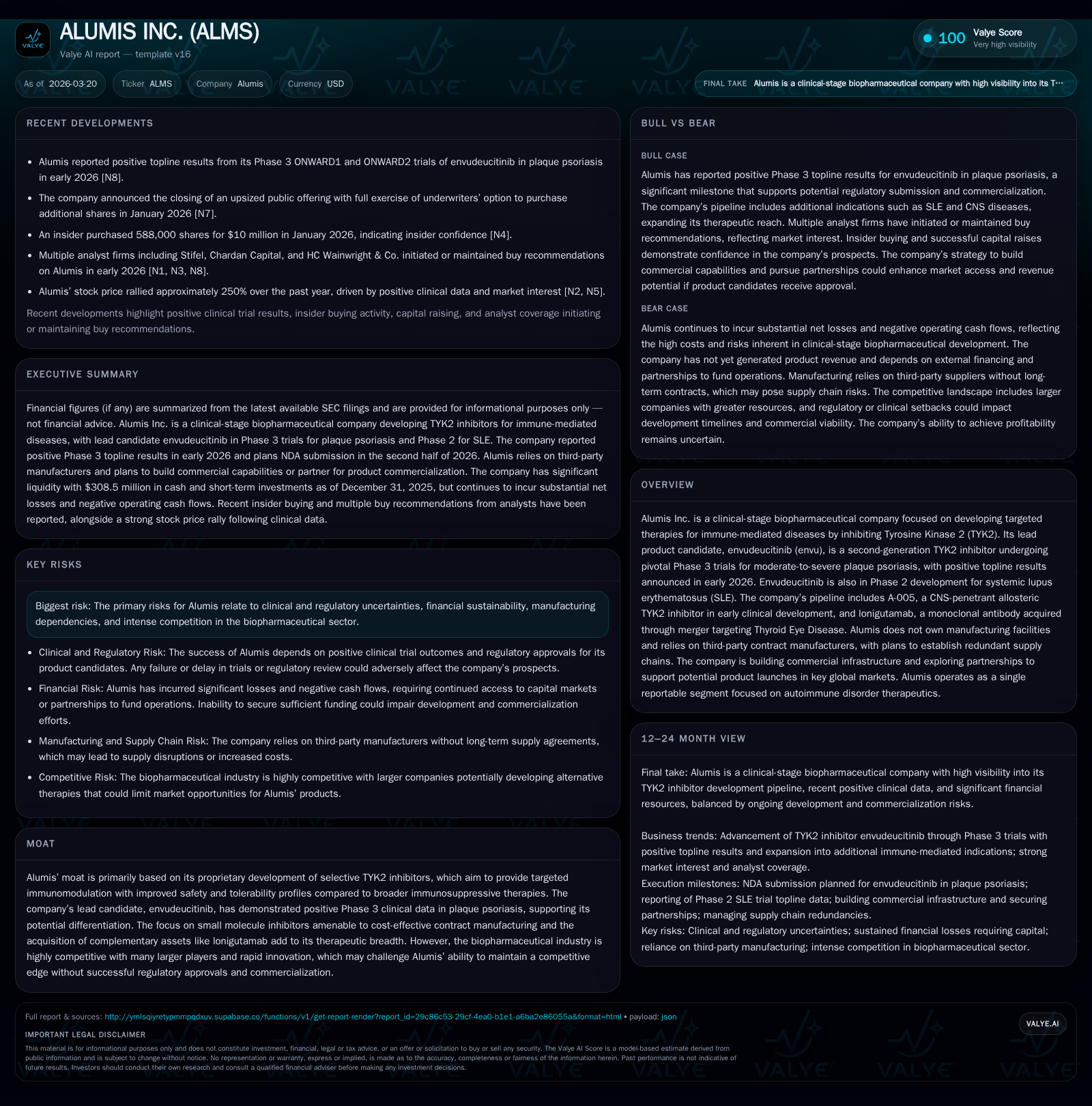
Alumis Inc. demonstrated a significant clinical milestone in early 2026 with positive Phase 3 topline results for its lead TYK2 inhibitor, envudeucitinib, targeting moderate-to-severe plaque psoriasis. This breakthrough underpins the company’s transition from clinical development to commercial readiness, supported by ongoing Phase 2 studies and an expanding pipeline including CNS-penetrant compounds and acquired monoclonal antibody assets. Despite considerable operating losses intensifying year-over-year due to R&D investments, Alumis sustains a strong liquidity position and strategic capital allocation to support next-stage growth, although manufacturing dependencies on third-party suppliers introduce operational risks ahead of product launch.
Historical Financial Performance and Key Growth Drivers
Alumis Inc.'s financial history through FY2024 and FY2025 reveals stark dynamics typical of a clinical-stage biopharmaceutical firm heavily investing in drug development. Operating income deteriorated from -$300.8 million in FY2024 to -$453.8 million in FY2025, marking nearly a 51% deeper operating deficit [F1]. This expansion of operating expenses correlates closely with increased research and development activity as Alumis advanced its proprietary TYK2 inhibitor programs alongside integration costs from its recent merger.
Conversely, net income displayed an improving trend; losses narrowed by about 17% from -$294.2 million to -$243.3 million over the same period [F1]. This divergence between operating losses and net income performance could indicate favorable non-operating income components or cost management in other areas offsetting some R&D expense acceleration.
Operating cash flow also saw a significant negative move worsening approximately 45% YoY to -$369.5 million in FY2025 [F1]. The high cash burn rate aligns with sector-specific investment rhythms wherein heavy upfront spending precedes potential commercialization revenue streams. Alumis' capex remained modest at $0.65 million in FY2025, decreasing more than 60% from the prior year as capital absorption is minimal once initial infrastructure investments are made [F1].
This financial behavior typifies accelerated clinical-stage biopharma expense pacing—heightened burn rates driven chiefly by pipeline progression coupled with prudent capital expenditure frugality.
Historical performance (annual)
| FY | Net ($mm) | CFO ($mm) | OpInc ($mm) | Capex ($) | Net YoY |
|---|---|---|---|---|---|
| 2025 | -243 | -370 | -454 | 653000 | +17.3% |
| 2024 | -294 | -255 | -301 | 1732000 |
Source: SEC companyfacts cache [F1].
Capital returns and efficiency (annual)
| FY | Buybacks ($) | FCF ($mm) | ROE% |
|---|---|---|---|
| 2025 | 17000 | -370 | -80.8 |
| 2024 | 6000 | -257 | -113.1 |
Source: SEC companyfacts cache [F1].
Table: Alumis Inc. Historical Financial Performance Summary [F1]
Advancements in TYK2 Inhibitor Pipeline and Clinical Progress
Alumis’s therapeutic innovation centers on selective TYK2 inhibition—a targeted approach designed to modulate immune-mediated diseases with enhanced safety over conventional JAK inhibitors that present broader immunosuppression . Its lead candidate envudeucitinib (envu) achieved positive topline Phase 3 data for moderate-to-severe plaque psoriasis announced in early 2026 [N1]. This milestone validates the molecule's potential differentiation in efficacy accompanied by an improved tolerability profile.
Beyond psoriasis, Alumis is progressing envu through Phase 2 development for systemic lupus erythematosus (SLE), expanding its immunomodulatory reach into autoimmune indications where unmet needs persist.
The company’s pipeline breadth extends further with A-005—a CNS-penetrant allosteric TYK2 inhibitor currently in early clinical stages—potentially addressing central nervous system autoimmune manifestations . Complementing small molecule programs is lonigutamab, a monoclonal antibody obtained via merger targeting Thyroid Eye Disease (TED), a condition notoriously resistant to treatment and representing an orphan niche.
These assets collectively position Alumis within a rapidly evolving therapeutic landscape marked by competitors advancing JAK/STAT pathway inhibitors. Selectivity is crucial here; while broad JAK inhibition carries risks such as hematologic abnormalities or infections due to systemic immunosuppression, Alumis aims for finely tuned modulation reducing these side effects—a critical commercial differentiator.
Commercialization Readiness and Manufacturing Strategy
With pivotal data supporting regulatory submission pathways looming post-Phase 3 success [N1], Alumis is concurrently preparing its go-to-market capabilities while managing complex manufacturing logistics intrinsic to biopharmaceuticals.
The company foregoes owning manufacturing facilities outright; instead it leverages contract manufacturing organizations (CMOs) for both API synthesis and final drug product formulation [S16]. This strategy aligns well with small molecule compounds like envu and A-005 which facilitate robust outsourcing due to relatively straightforward synthetic chemistry compared to biologics.
However, reliance on third-party manufacturers introduces Chemistry Manufacturing and Controls (CMC) risk—a known challenge wherein supply chain disruptions or quality issues can imperil timelines or increase cost structures materially.
To mitigate this risk profile, Alumis actively pursues redundant supplier qualification for API and drug products ahead of NDA submission for FDA review as well as marketing authorization applications globally [S16]. Key suppliers are located internationally (notably India and Taiwan), requiring careful oversight amid geopolitical sensitivities and logistical complexities.
In parallel with manufacturing risk mitigation, Alumis invests in building commercial infrastructure tailored for key markets: the United States—its primary territory—as well as the European Union and Asia-Pacific regions via internal competencies or partnerships yet to be finalized. Institutional knowledge emphasizes that smaller biopharma firms frequently balance internal salesforce development against strategic alliances to optimize launch execution while prudently managing fixed cost commitments.
Financial Position, Capital Allocation, and Shareholder Returns
At year-end FY2025 Alumis held approximately $89.7 million in cash and cash equivalents alongside current assets totaling $318.2 million versus current liabilities near $73.3 million—yielding a healthy current ratio of roughly 4.34—the indicator of strong near-term liquidity [F1]. This capital base underpins ongoing pipeline advancement investments while cushioning operational demands during commercialization scale-up phases when revenues remain nascent or absent.
Equity capital rose meaningfully from $260.1 million at FY2024-end to $301.3 million by FY2025 close reflecting recent financing rounds or equity issuance linked possibly to its Acelyrin merger transaction completed mid-2025 [F1], [S11]. Buyback activity was negligible—totaling only $17 thousand—consistent with clinical-stage firms focusing resources on growth rather than shareholder distributions [F1]. No dividends were declared nor anticipated given sector norms prioritizing reinvestment over returning capital during pre-revenue phases.
Return on equity (ROE), computed approximately as net income divided by end-of-period equity for FY2025, registers around negative 80.8%, underscoring loss-incurring status aligned with clinical-stage drug development economics absent marketed products generating revenue [F1]. Operating cash flows remain deeply negative reflecting high burn rates typical for companies intensifying pivotal trial activities while ramping internal functions ahead of launches.
Capital expenditures are minimal ($0.65 million in FY2025), indicating limited investment into fixed assets consistent with outsourced production models common among precision-targeted small molecule biopharmaceutical innovators focused on pipeline rather than manufacturing plant ownership [F1].
Risks Pertaining to Regulatory Approval and Industry Competition
Alumis faces multilayered risk vectors characteristic of its developmental phase compounded by market realities:
- Regulatory uncertainty persists despite encouraging Phase 3 data; approval timelines hinge on comprehensive submissions meeting FDA rigor including CMC comparability across multiple suppliers acting as industry-standard bottlenecks (‘regulatory cliff’ risk) [S8], [S22], .
- Clinical development inherently involves outcome variability; prior trial success may not directly predict future results especially as patient recruitment competition intensifies across autoimmune indications.
- Financial sustainability remains contingent upon future capital raises or operational revenue generation; ongoing losses create pressure necessitating prudent funding strategies lest operations curtail prematurely [S26].
- Procurement dependencies on third-party manufacturers expose supply chain vulnerabilities including geopolitical instability or quality failures compromising supply continuity before product launches occur [S16].
- Competitive MOAT vulnerability stems from numerous larger pharmaceutical entities advancing overlapping JAK/TYK2 inhibitors benefiting from greater resources; establishing differentiation via safety/tolerability gains remains critical yet challenging amidst rapid innovation rates.
- Intellectual property protection must be vigilantly maintained against infringement threats impacting exclusivity periods essential for recouping substantial R&D investments.
These factors collectively frame a high-risk/high-reward profile demanding sophisticated risk mitigation policies embedded in project governance frameworks customary within biotech portfolio management lexicon.
Future Outlook: Milestones to Watch and Analytical Considerations
Looking forward through mid-2026 onward investors should monitor several inflection points representing value triggers:
- Submission of New Drug Application (NDA) or Biologics License Application (BLA) following pivotal Phase 3 results expected provides a regulatory readout timeline imperative for commercialization ramp planning [N1].
- Progression of envu into additional indications such as SLE will extend potential market penetration while lifecycle management strategies around lonigutamab acquisitions represent diversification steps critical for long-term resilience.
- Qualification and validation of redundant contract manufacturers encompass essential operational milestones mitigating CMC-related delays impacting approval timelines [S16].
- Partnering announcements could augment reach or de-risk commercialization investment burdens especially outside the U.S., reflecting strategic scaling approaches prevalent among specialized biotechs seeking global footprints without full infrastructure buildouts.
- Cash runway metrics vis-à-vis burn rate trajectories will signal capital adequacy supporting sustained R&D investment until positive top-line growth materializes; absence of explicit guidance necessitates tracking quarterly updates closely.
Analytically focusing on these events fosters clarity around valuation inflections connected tightly with successful navigation from promising clinical proof points toward commercial execution delivering eventual revenue generation required for profitability realization.
Disclaimer: This report synthesizes publicly filed financials ([F1]), SEC disclosures ([S#]), regulatory filings ([S#]), news releases ([N#]), and proprietary excerpts without offering investment advice or price projections. Data accuracy depends on reported sources; readers should consider inherent uncertainties typical within early-stage biopharmaceutical enterprises.
Disclaimer: This is research-only, informational analysis and not investment advice. It may include AI-generated interpretation and general industry context. Always verify important details using primary sources.

Comments