
Alta Equipment Group’s Operating Income Rebounds Despite Widening Net Loss and Liquidity Pressure
After multi-year fluctuations, Alta Equipment Group posts operating income growth yet records larger net losses and strained equity in its fiscal 2025 results.
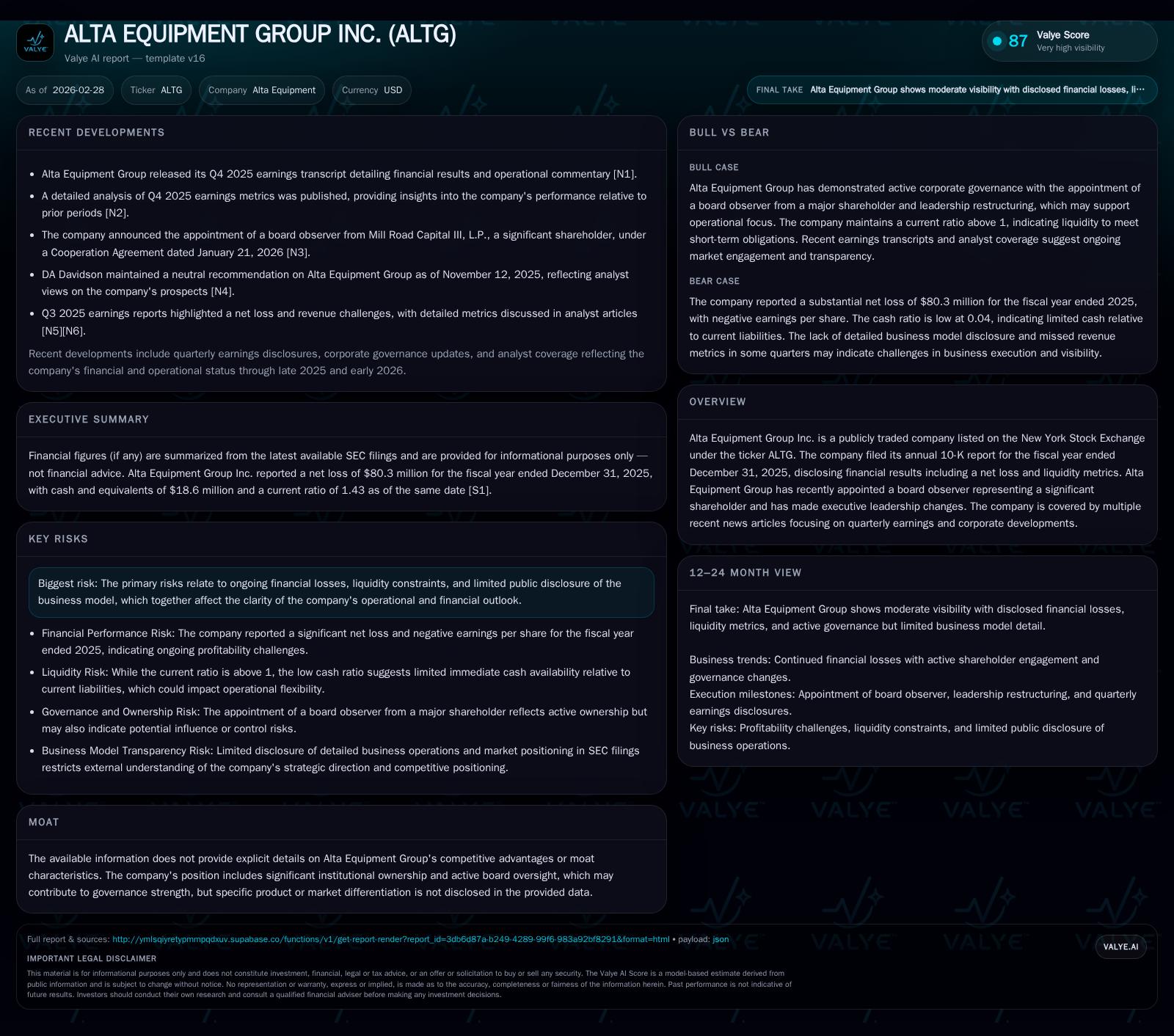
Alta Equipment Group Inc. reported a 24.7% increase in operating income for the fiscal year 2025, reaching $23.2 million, reversing a prior downtrend. However, net losses expanded to $80.3 million in 2025, worsening from the previous year’s $62.1 million loss, reflecting continuing challenges below the operating line. The company’s cash flow from operations declined sharply by over 40%, and equity turned negative, indicating financial strain despite liquidity measures including preferred stock dividends and active board governance. Investors should monitor management’s efforts to stabilize profitability and manage leverage amid limited disclosure of competitive moats or market differentiation.
Historical Financial Performance
Alta Equipment Group's financial trajectory over the past four years displays volatility marked by oscillations in both operating income and net profit margins.
Historical performance (annual)
| FY | Net ($mm) | CFO ($mm) | OpInc ($mm) | Capex ($mm) | Net YoY |
|---|---|---|---|---|---|
| 2025 | -80 | 33 | 23 | 9 | -29.3% |
| 2024 | -62 | 57 | 19 | 15 | -797.8% |
| 2023 | 9 | 64 | 54 | 12 | -4.3% |
| 2022 | 9 | 26 | 41 | 13 |
Source: SEC companyfacts cache [F1].
Capital returns and efficiency (annual)
| FY | Div ($mm) | Buybacks ($mm) | FCF ($mm) |
|---|---|---|---|
| 2025 | 3 | 8 | 24 |
| 2024 | 3 | 6 | 42 |
| 2023 | 3 | 51 | |
| 2022 | 3 | 6 | 13 |
Source: SEC companyfacts cache [F1].
¹ Significant drop due to operational headwinds back then; prior year comparisons indicate high volatility.
Alta’s operating income recovered notably in fiscal year (FY) 2025 to $23.2 million from $18.6 million in FY2024 following a sharp decline from $54.4 million in FY2023 [F1]. This rebound suggests some operational leverage benefits or cost control measures beginning to take root after prior pressure.
Conversely, net income tells a grimmer story: the company swung back into steep losses with a net loss of $80.3 million in FY2025 compared to a $62.1 million loss in the prior year [F1]. This divergence signals that non-operating factors such as financing costs or impairment charges are weighing heavily.
Operating cash flow dropped precipitously by over forty percent year-over-year to $33 million while capital expenditure fell by about forty percent to $9.2 million [F1]. Despite this decline in capex providing some cash flow relief resulting in roughly $23.8 million free cash flow (CFO minus capex), cash conversion efficiency appears challenged.
Further complicating financial health is Alta’s equity position which deteriorated into negative territory at approximately -$8.8 million at the end of FY2025 compared to positive balances above $70 million the previous two years [F1]. Negative shareholders’ equity typically reflects accumulated losses surpassing paid-in capital or asset impairments—key flags when analyzing solvency risk.
Growth Prospects and Challenges
The company disclosed no explicit segmental growth targets or business line specifics in filings beyond general references to handling equipment solutions [S1], offering limited transparency on core revenue drivers or competitive moats.
However key developments include:
- The appointment of Mill Road Capital III LP as a board observer reflecting significant insider influence with around 13.4% common stock ownership [S16][S17][N3]. This could indicate potential strategic shifts or heightened governance oversight benefiting long-term value creation.
- Appointment of Craig Brubaker as COO for the Material Handling segment as of December 31st signals an operational focus possibly geared toward better execution or business unit management [S20].
From an industry perspective — though not detailed here — the material handling sector generally navigates trends related to automation integration and fleet electrification across warehouses and logistics hubs; absence of explicit commentary restricts assessing Alta's readiness for these transformative waves.
Risks outlined emphasize liquidity constraints coupled with ongoing losses that constrain investments in R&D or expansion initiatives which could cap growth if unresolved [S5][S6][S4]. Moreover absence of detailed customer base analysis or market share data further clouds forward visibility.
Forecasts and Key Milestones
Alta has not provided near-term revenue or profit guidance publicly within recent filings or earnings releases [N1][N2][S1], typical for smaller cap industrial equipment providers facing turnaround phases.
Market participants should watch for:
- Quarterly profitability inflection points beyond operating income improvements,
- Liquidity adequacy metrics via quarterly reports,
- Capacity enhancements led by new COO,
- Outcomes from Mill Road Capital's supervisory role,
- Adjustments in dividend policy and capital structure maneuvers.
Given current trends and lack of formal forecasts it remains imperative to track operational execution progress alongside any strategic pivots communicated via official channels.
Capital Allocation and Returns
Alta maintains a dividend policy focused exclusively on its Series A cumulative perpetual preferred stock with declared dividends amounting to $0.625 per Depositary Share each quarter ($625 per share unit), consistently paid through fiscal year 2025 [S14][S15]. No dividends were declared on common stock.
Share repurchase activity continued modestly with $7.5 million spent on buybacks during FY2025 up from $5.8 million previous year reflecting some confidence or opportunistic capital deployment despite losses [F1].
Return on equity (ROE) cannot be meaningfully assessed due to negative equity; however approximations using net loss suggest disproportionate annual ROE around negative nine hundred percent range—a reflection primarily of accounting accumulation rather than intrinsic return generation [F1].
Free cash flow remains positive though diminished relative to earlier years indicating ongoing operational cash generation capacity but under pressure margins requiring vigilant stewardship.
Summary Analysis
Alta Equipment Group Inc.’s latest fiscal results encapsulate a complex recovery scenario where operational improvements are emerging yet are offset by growing net losses and deteriorating balance sheet metrics. The company must manage liquidity prudently while sharpening operational efficiencies under new leadership and shareholder scrutiny.
Without transparent disclosures about products or market positioning it is challenging to quantify their competitive moat; reliance on institutional oversight through board observers highlights governance as a current pillar supporting corporate strategy execution.
Investors seeking clarity should watch subsequent quarterly updates carefully for signs of sustainable margin expansion and stabilizing net profitability alongside strengthening capital structure dynamics.
This report is factual and does not constitute investment advice.
Disclaimer: This is research-only, informational analysis and not investment advice. It may include AI-generated interpretation and general industry context. Always verify important details using primary sources.

Comments