
Amerant Bancorp Q2 2026: Enhanced Credit Risk Controls and Stable Liquidity Position
Amerant Bancorp's Q2 2026 update highlights strengthened credit risk management and steady liquidity supported by Federal Home Loan Bank borrowing capacity.
Amerant Bancorp implemented enhanced underwriting, risk rating monitoring, and annual review processes in Q2 2026 to improve the timeliness and accuracy of credit risk assessments. The bank also intensified problem asset oversight through more frequent portfolio reviews and earlier involvement of workout specialists. As of June 30, 2026, Amerant maintained $0.7 billion in outstanding Federal Home Loan Bank advances with increased borrowing capacity of $2.4 billion, supporting liquidity flexibility. These developments may reduce future loan losses and bolster funding stability amid a competitive regional banking environment.
Credit Risk Management Enhancements
In its Q2 2026 filing dated July 31, Amerant Bancorp detailed significant enhancements to its credit risk management framework [S2]. The company implemented improved underwriting standards, more rigorous risk rating monitoring, and annual loan review processes designed to increase the timeliness and accuracy of credit risk assessments. These measures facilitate earlier identification of potential credit deterioration, which is critical for mitigating future loan losses and preserving capital adequacy.
Additionally, Amerant strengthened problem asset oversight by increasing the frequency of portfolio reviews and expanding monitoring of criticized credits. The bank also involved workout specialists earlier in the problem loan resolution process and clarified the segregation of duties between business units and credit functions. These practices align with industry best practices for managing credit risk and may enhance the bank's ability to proactively address emerging credit issues [S2].
Liquidity and Funding Profile
Amerant Bancorp's liquidity position remained stable through the first half of 2026 [S2]. The bank maintained $0.7 billion in outstanding advances from the Federal Home Loan Bank (FHLB) as of June 30, 2026, consistent with the $0.7 billion reported at December 31, 2025. This activity indicates active asset-liability management without material income volatility from refinancing actions [S2]. The stable level of advances combined with increased borrowing capacity supports the bank's ability to manage asset growth and potential funding stress scenarios.
Business Model and Market Focus
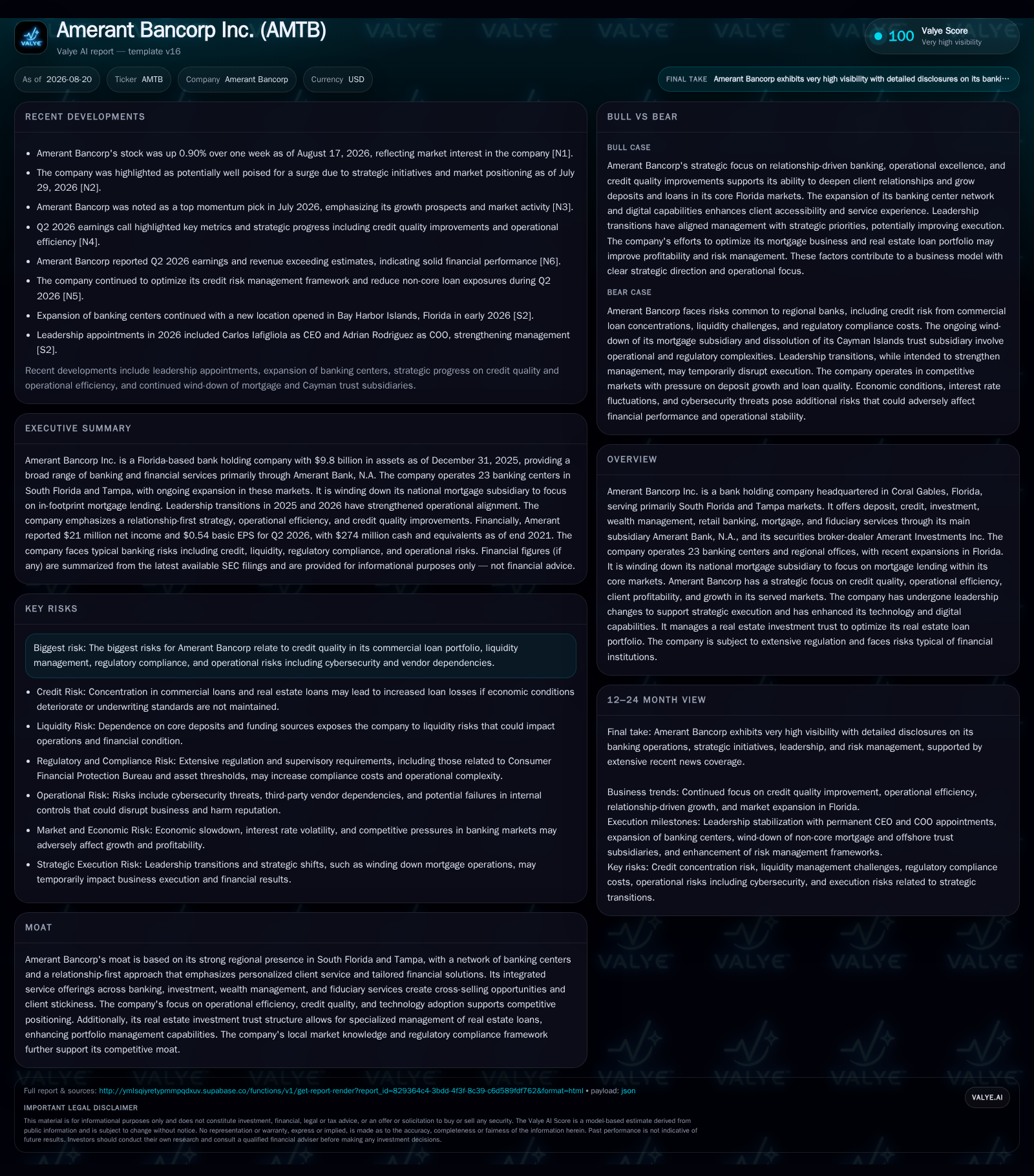
Amerant Bancorp operates primarily as a regional bank serving retail and commercial customers in South Florida and Tampa, Florida. The bank offers a comprehensive suite of financial products including deposit accounts, credit products, investment and wealth management services, mortgage lending, and fiduciary services through 23 banking centers [S1].
As part of its strategic portfolio management, Amerant is executing a plan to wind down its national mortgage subsidiary, Amerant Mortgage, to concentrate mortgage lending efforts within its core South Florida and Tampa markets. This refocus aims to improve operational efficiency and credit quality by leveraging the bank's familiarity and expertise in these geographic areas [S1].
Risk Factors and Capital Adequacy
Credit quality remains a key risk factor for Amerant, particularly given its concentration in commercial real estate loans. The enhanced credit risk management processes are intended to mitigate this risk by enabling earlier detection and resolution of problem loans [S2]. The bank periodically updates its allowance for expected credit losses to reflect loan volumes, credit conditions, and economic factors in its markets [S9].
Regulatory capital ratios and liquidity metrics are closely monitored to ensure compliance with minimum requirements [S9]. Amerant's stable liquidity position, supported by FHLB advances and borrowing capacity, provides a buffer to manage potential credit stress and maintain capital adequacy.
Analytical Conclusions
Amerant Bancorp's enhanced underwriting, risk rating monitoring, and annual review processes, coupled with strengthened problem asset oversight, likely improve the early detection of credit deterioration. This improvement could reduce future loan losses and support capital stability, a critical factor for profitability and regulatory compliance in regional banking [S2].
The stable outstanding FHLB advances at $0.7 billion alongside an increased borrowing capacity to $2.4 billion provide liquidity flexibility [S2]. This funding profile supports the bank's ability to manage asset growth and navigate potential liquidity stress scenarios, which is essential for operational stability.
Business Economics and Implications
In the regional banking sector, credit quality directly influences net interest margin and loan loss provisions, which in turn affect profitability and capital adequacy. Amerant's enhanced credit risk controls aim to reduce the incidence and severity of non-performing loans, thereby improving net interest income and preserving capital. Earlier workout specialist involvement and more frequent portfolio reviews can limit credit losses and reduce volatility in loan loss provisions.
Liquidity management, including access to FHLB advances, is vital for funding asset growth and meeting withdrawal demands. Amerant's increased borrowing capacity enhances its funding flexibility, enabling the bank to respond to market changes without incurring excessive costs or liquidity shortfalls.
Focusing mortgage lending on core markets may improve operational efficiency by concentrating resources on familiar geographic areas with better market knowledge. This could translate into improved credit quality and reduced operational risk.
Watchpoints
Investors and analysts should monitor quarterly updates on non-performing loans and criticized credits to assess the effectiveness of Amerant's enhanced credit risk management. Trends in loan loss provisions and charge-offs will provide insight into credit quality trajectory.
Changes in FHLB borrowing levels and remaining borrowing capacity will indicate liquidity management dynamics and funding flexibility. Deposit growth and composition, especially the ratio of core to brokered deposits, remain important for stable funding.
These developments are material as they underpin the bank's credit quality outlook and funding stability in a competitive regional banking environment. Continued execution and monitoring of these initiatives will be critical to sustaining asset quality and operational resilience going forward.
Disclaimer: This is research-only, informational analysis and not investment advice. It may include AI-generated interpretation and general industry context. Always verify important details using primary sources.

Comments