
AutoNation’s Scale and Service Ecosystem Sustain Earnings Despite Sales Pressure
AutoNation reports mixed Q4 results with earnings above expectations yet sales declines reflecting broader industry headwinds.
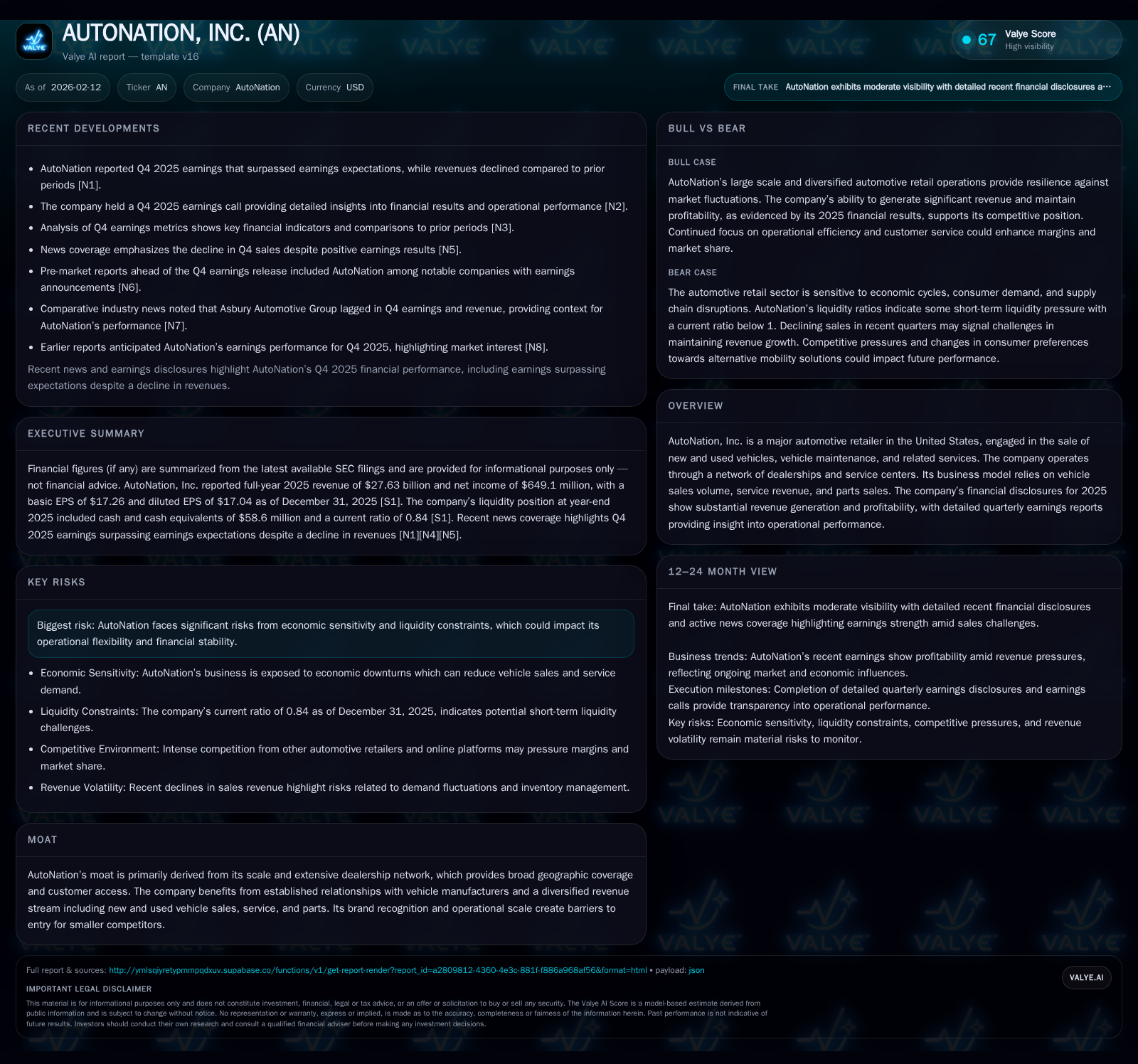
AutoNation’s Q4 2025 earnings notably exceeded estimates despite a downturn in sales volume, highlighting effective cost management and margin resilience. The company's diversified revenue streams—from new and used vehicle sales to parts and services—underpin its robust profitability. However, liquidity constraints and economic sensitivity present ongoing risks amid a challenging macro environment. Peer comparisons indicate AutoNation’s scale remains a critical competitive advantage in an increasingly complex U.S. automotive retail landscape.
A Mixed Fourth Quarter: Earnings Beat Amid Sales Decline
In February 2026, AutoNation disclosed Q4 2025 results that presented something of a paradox: strong earnings performance surpassing analyst projections collided with softer revenue and vehicle sales figures [N1][N4][N12]. While total revenues fell short of expectations due largely to declining unit sales volumes across new and used vehicles, net income showed resilience, indicative of disciplined margin controls and cost efficiencies. The company’s earnings call transcript revealed management's focus on maximizing per-unit profitability through optimized inventory mix and targeted operational actions compensating for volume headwinds [N2]. This duality underscores AutoNation’s capacity to leverage its scale and cost structure to protect bottom-line outcomes even as top-line growth slows.
Decoding AutoNation’s Revenue Streams: New vs. Used Vehicles and Services
A detailed breakdown from the company’s latest 10-K filing underscores the multifaceted nature of AutoNation’s business model [S1]. New vehicle sales remain a core contributor but have experienced pressure due to broader market dynamics including supply chain disruptions and waning consumer discretionary spending. Used vehicles have increasingly assumed prominence within total revenue composition, often yielding higher margins compared to new cars. Additionally, parts and service operations—encompassing maintenance, repairs, and warranty work—offer a steady revenue stream less sensitive to cyclical fluctuations.
This diversification is critical: while vehicle retailing drives top-line volume swings, the recurring nature of service contracts and aftermarket parts nurtures profitability stability. Fiscal 2025 data show the company generating approximately $27.6 billion in total revenue with significant contribution from non-new-vehicle segments [F1]. This mix cushions the impact of volatile vehicle demand but also requires constant operational agility to balance inventory levels and fixed cost absorption.
Scale and Reach: The Moat Behind AutoNation’s Competitive Position
AutoNation's moat derives fundamentally from its vast dealership network spanning major U.S. markets coupled with robust manufacturer relationships [valye_report_excerpt.moat][S1]. Operating hundreds of franchises under diverse brand partnerships affords unmatched geographic coverage that smaller competitors cannot easily replicate. This scale translates into potent pricing leverage—both in acquiring inventory and setting retail prices—and enhanced marketing reach.
Moreover, established ties with automakers facilitate preferred access to limited models or incentives at times when market conditions tighten supply. Brand recognition as an automotive retail leader further entices customers seeking trustworthiness and service quality in high-consideration purchases. Collectively, these factors erect meaningful barriers to entry given the capital-intensive nature of dealership operations and complexity in managing multi-brand inventories.
Financial Strength vs. Liquidity Strains: Analyzing Balance Sheet Signals
Despite operational strengths, balance sheet scrutiny reveals underlying liquidity challenges that warrant attention [F1][S1]. At year-end 2025, AutoNation reported approximately $58.6 million in cash equivalents against $5.54 billion in current liabilities, resulting in a current ratio of about 0.84—below the conventional benchmark of 1.0 signaling tight short-term liquidity.
This situation reflects several structural characteristics intrinsic to automotive retail, such as reliance on floorplan financing for inventory purchase—a sizable component of current liabilities—and seasonal working capital needs. While large-scale credit facilities help moderate immediate cash flow pressures, restricted liquidity could constrain strategic flexibility or amplify vulnerability amidst sudden market contractions or interest rate shifts.
These balance sheet signals reinforce the importance of vigilant cash management practices going forward, especially if macroeconomic uncertainties deepen consumer caution toward discretionary big-ticket spending.
Risk Landscape: Economic Sensitivity and Operational Challenges Ahead
AutoNation's risk profile prominently features economic sensitivity coupled with potential liquidity constraints [valye_report_excerpt.risks][S1]. Historically dependent on consumer confidence and availability of auto financing, the company faces headwinds from inflationary pressures affecting borrowing costs alongside labor shortages impacting service capacity.
The recent earnings call commentary acknowledged these operational challenges explicitly, noting cautious guidance around vehicle sales volumes amid uncertain demand trajectories [N2]. Furthermore, supply chain disruptions continue to inject unpredictability into new vehicle availability impacting inventory strategies.
Such vulnerabilities underscore that despite a durable moat, external macro forces could materialize into near-term performance volatility requiring nimble risk mitigation.
Momentum in Market Sentiment: What Broker Ranks and Stock Movements Reveal
Market participants have responded to AutoNation's recent results with nuanced optimism [N13][N9][N8]. The company’s inclusion among top-ranked momentum stocks during early February indicated investor interest driven primarily by consistent earnings beats even as revenues disappointed.
Brokerage sentiment reports highlight balancing acts between confidence in management’s margin discipline versus concern over persistent topline pressures amid tightening consumer spending patterns. Trading volumes and share price movements have reflected this dynamic equilibrium—volatility alongside bouts of upward momentum tied closely to quarterly report releases rather than sustained fundamental re-rating.
This pattern suggests that while AutoNation retains appeal for active traders focused on operational execution signals, longer-term investor conviction may hinge on navigating upcoming economic uncertainties successfully.
Comparing Peers: How AutoNation Stands Relative to Asbury and Lithia Motors
Placing AutoNation within the competitive peer set reveals differentiated strengths amidst shared industry challenges [N6][N7]. Asbury Automotive Group recently reported disappointing Q4 results missing earnings targets alongside revenue softness—positioning it as relatively weaker among the large automotive retailers. Conversely, Lithia Motors projects more optimistic growth outlooks backed by aggressive acquisition strategies enhancing scale effects.
AutoNation straddles the middle ground: its entrenched network provides superior coverage compared to Asbury but lacks Lithia's recent expansion dynamism. This context reinforces that scale alone is necessary but not sufficient; regional execution excellence coupled with financial flexibility will determine ultimate competitive positioning moving forward.
Disclaimer: This analysis is based solely on publicly available information as of February 12, 2026. It does not constitute investment advice or recommendations regarding securities issued by AutoNation or any other entities mentioned herein. Readers are encouraged to consider their own research objectives and consult professional advisors before making financial decisions.
Disclaimer: This is research-only, informational analysis and not investment advice. It may include AI-generated interpretation and general industry context. Always verify important details using primary sources.

Comments