
Navigating Complexity: AIR T INC’s Strategic Rex Acquisition Amid Regulatory and Financial Headwinds
A comprehensive analysis of AIR T INC's acquisition of Rex reveals intricate integration challenges within a tightly regulated regional airline sector, coupled with financial and currency risks.
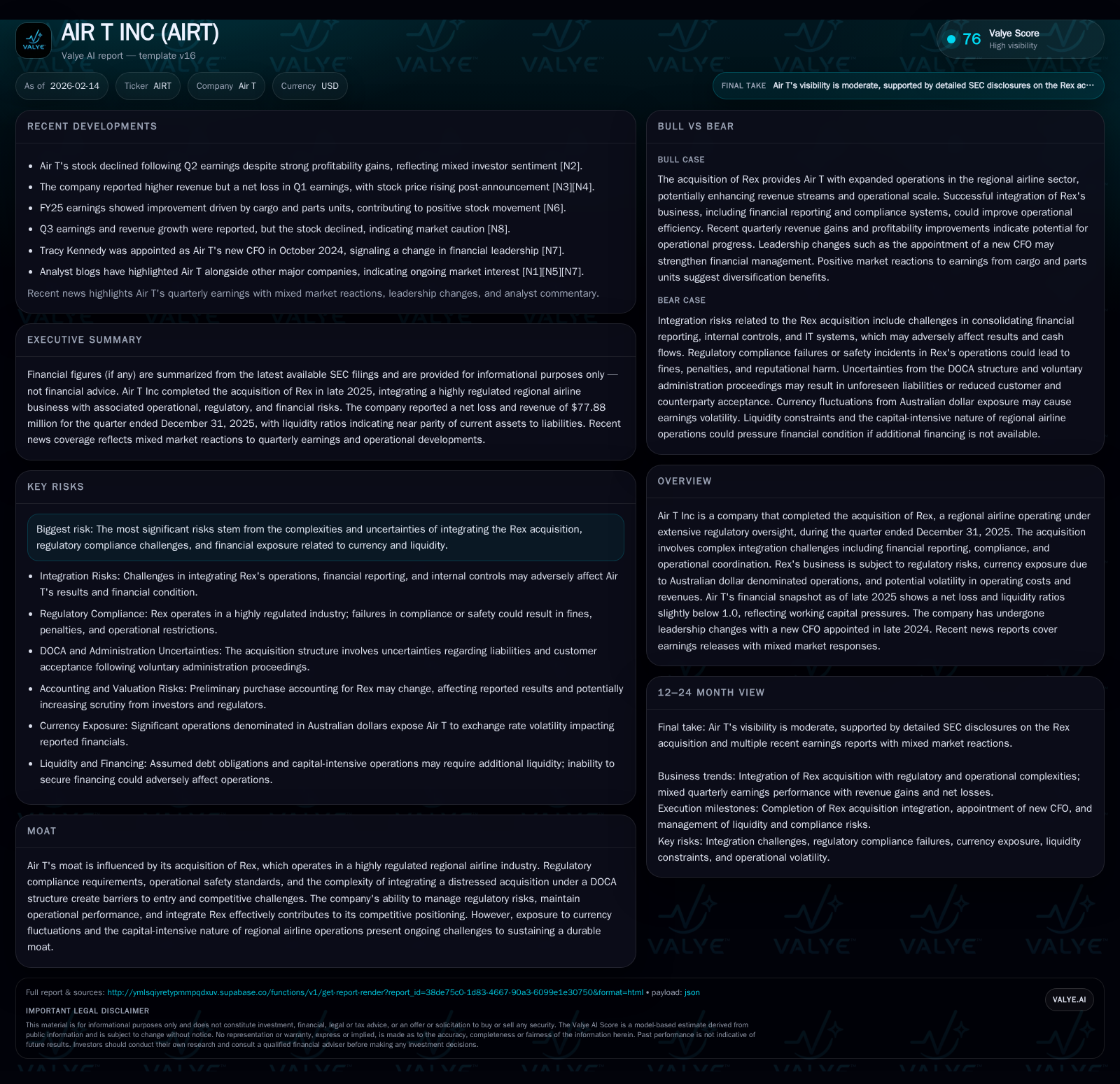
AIR T INC embarked on a high-stakes acquisition of Rex, an Australian regional carrier operating under stringent regulatory oversight and complex restructuring arrangements. The integration demands span operational, financial reporting, compliance, and cultural dimensions, presenting tangible risks amid liquidity pressures and currency exposure. While the acquisition offers the potential to fortify AIR T’s competitive positioning through regulatory barriers to entry, ongoing uncertainties around seamless execution and market acceptance temper outlooks.
The Ambitious Bet: Acquiring Rex Amid Australian Regulatory Complexities
In late 2025, AIR T INC completed the acquisition of Rex, a regional Australian airline enveloped by the complexities of a voluntary administration proceeding governed by a Deed of Company Arrangement (DOCA). This maneuver transcended a mere business expansion; it was a high-risk strategic bet fraught with layered challenges. Rex’s operational framework unfolds against one of the most stringent aviation regulatory regimes globally — encompassing exhaustive safety protocols, maintenance standards, crew training mandates along with consumer protection stipulations overseen by multiple Australian authorities.
Such regulatory entanglements translate into a mosaic of compliance obligations that can materially influence operational flexibility. Moreover, the acquisition structure via DOCA inherently introduced unresolved liabilities, contingent claims, and obligations whose timing and magnitude remain partly opaque. For AIR T, absorbing Rex meant inheriting not only flight routes but a legacy enveloped in legal ambiguities — impacting counterparties’ willingness to engage commercially and casting shadows over supplier and customer trust dynamics.
These factors collectively made the deal far more than an asset purchase; it was an exercise in navigating intertwined legal-financial-operational labyrinths requiring prudent stewardship. The stakes extend beyond typical acquisition risk — missteps could trigger reputational impairment or escalated costs that jeopardize forthcoming operational synergies [S2][F1].
Decoding Integration: From Financial Systems to Corporate Culture
Integration efforts following the close have been intricate. Reconciling diverse financial reporting processes represents a formidable task — each entity had dissimilar accounting policies, internal controls architectures, timelines for monthly closings, and compliance frameworks. Harmonizing these demands involved reconfiguring information technology systems ranging from ERP platforms to compliance tracking modules.
Beyond technology lies the human element: retaining key personnel essential for continuity amid organizational shifts poses retention challenges. Culture clashes loom despite shared industry context due to underlying differences in corporate governance styles shaped by jurisdictional nuances.
Management has flagged that these combined operational hurdles require not just upfront spending but ongoing managerial bandwidth at a time when liquidity is already constrained [S2]. This complexity suggests near-to-medium term headwinds on earnings growth until steady-state integration stabilizes.
Under the Microscope: Navigating Compliance Risks and Industry Oversight
Regional airlines operate under unrelenting regulatory scrutiny; for Rex integrated now within AIR T’s remit this intensifies considerably. Failure modes span safety incidents traceable to lapses in maintenance or crew proficiency – both heavily audited aspects with direct consequences for operational licenses.
Regulators impose strict mandates on training frequency and certification renewals that amplify operating cost structures. An adverse safety event or non-compliance finding would not only incur fines or penalties but potentially result in partial route suspensions or restrictions impairing revenue flows.
Reputational impact can cascade rapidly across consumer sentiment domains affecting booking rates especially as competitors in Australia nimbly capitalize on any perceived weakness. The overlay of compliance risk thus remains among the gravest threats underpinning post-acquisition operations [S2][valye_report_excerpt].
Financial Fragility: Liquidity, Losses, and Working Capital Pressures
The latest financial snapshot reveals tangible strains embedded in AIR T’s balance sheet. For the quarter ending December 31, 2025: net losses amounted to approximately $2.45 million while current assets stood at $161 million against current liabilities of $167 million yielding a current ratio just shy of unity at 0.96 [F1].
This signals tight working capital conditions accentuated by cash outflows linked with integrating Rex’s business processes plus addressing legacy claims tied to its prior status under DOCA.
Operating margin compression incurred from increased compliance overheads combined with provisioning uncertainties further stretch liquidity. These metrics spotlight acute vulnerability that management must address through cash flow optimization or external financing solutions [F1][S2].
Currency Currents: The Impact of Australian Dollar Exposure
Rex's operating base denominates most transactions in Australian dollars (AUD), exposing AIR T's consolidated financials to exchange rate volatility against the U.S. dollar (USD) — its reporting currency.
Fluctuations in AUD/USD rates have dual impacts: revenues converted from AUD may contract if USD strengthens while certain operating costs pegged locally remain fixed or rise due to inflationary pushes in Australia’s economy.
This mismatch complicates forecasting accuracy as currency swings introduce unpredictability into earnings estimates. Such foreign exchange dynamics add another dimension of financial risk layer atop already pressured margins [valye_report_excerpt][S2].
Management in Transition: The Role of New Leadership in Steering Change
A crucial element shaping AIR T’s trajectory has been leadership change with appointment of a new Chief Financial Officer toward late 2024. This transition arrives at a pivotal juncture demanding decisive stewardship over complex integration chores.
The CFO is tasked with instilling enhanced financial discipline including rigorous budgeting aligned with fluctuating cash flows as well as fortifying internal control environments post-acquisition adjustments.
Moreover, investor communications hinge on transparent updates regarding progress on combining operations without glossing over emerging risks—a delicate balancing act vital for maintaining market credibility during this turbulent phase [valye_report_excerpt].
Market Ambivalence: Understanding Mixed Reactions in Recent Earnings
Recent earnings releases elicited lukewarm investor responses reflecting ambivalence about whether associated integration pains will abate swiftly enough to generate sustainable positive momentum.
Disparate expectations between analysts projecting rapid stabilization versus company caution emphasizing ongoing uncertainties create this unsettled sentiment.
Further complicating perception are lingering concerns over undisclosed contingent liabilities carried from Rex's former DOCA status which fuel wariness around declared gains related to bargain purchase accounting adjustments [valye_report_excerpt].
Such market ambivalence underscores fragility in confidence levels pending clearer evidence of robust execution milestones.
Assessing AIR T’s Moat Post-Acquisition: Sustainable or Skin-Deep?
AIR T cites its strengthened competitive edge stemming from owning Rex’s route network fortified by incumbent regulatory barriers limiting rivals’ entry capability.
However, this purported moat remains susceptible given:
- Heavy capital expenditure requirements characteristic of regional airlines;
- Vulnerability to currency-driven cost volatility;
- Execution risks embedded in complex corporate amalgamation;
- Pressure on operational efficiency during integration ramp-up.
Hence, whether this advantage translates into durable economic rents depends significantly on successful risk mitigation across multidimensional fronts [valye_report_excerpt].
Risk Radar: Identifying Ongoing Vulnerabilities After the Deal
Key vulnerabilities crystallized post-acquisition include:
- Potential failure to meet integration timelines compromising timely consolidation reporting;
- Operational disruptions arising from any lapses in rigorous compliance regimes;
- Unanticipated legacy liabilities post-administration distorting provisioning adequacy;
- Risk of counterparty reticence delaying commercial negotiations or imposing unfavorable payment terms;
- Continuous exposure to foreign exchange fluctuations destabilizing profit margins;
- Dependence on new leadership effectiveness amidst evolving internal controls;
- Market skepticism reiterating until sustained clinical proof points emerge around earnings normalization.[S2][valye_report_excerpt]
Explicit recognition of these factors remains critical for internal vigilance frameworks guiding strategic decision making.
Looking Ahead: What Successful Integration Could Mean for AIR T
Despite formidable headwinds evident today, successful assimilation of Rex within AIR T holds meaningful upside potential if managed adeptly.
Operational synergies realized through streamlined processes and rationalized overhead could translate into improved margin profiles. Restored reputation alongside regulatory adherence could unlock broader commercial acceptance reviving demand elasticity historically constrained by DOCA-related perceptions.
Financially tighter working capital management coupled with proactive foreign exchange hedging could alleviate volatility stresses enhancing forecasting clarity.
Ultimately, navigating this multidimensional challenge will dictate if AIR T transitions from transient disruption towards stable growth anchored by competitive repositioning powered by thoughtful leverage of regional aviation dynamics [valye_report_excerpt][F1].
This report synthesizes publicly available company filings including Air T Inc's recent SEC Form 10-Q alongside secondary industry contextual analysis. It does not constitute investment advice but aims to provide an informed understanding of AIR T’s strategic position post-Rex acquisition.
Disclaimer: This is research-only, informational analysis and not investment advice. It may include AI-generated interpretation and general industry context. Always verify important details using primary sources.

Comments