
PicoCELA Inc.: Balancing Pioneering Mesh Wi-Fi Innovation with Financial and Operational Risks
An incisive review of PicoCELA’s proprietary wireless technology, manufacturing strategies, and financial dynamics amid concentration challenges.
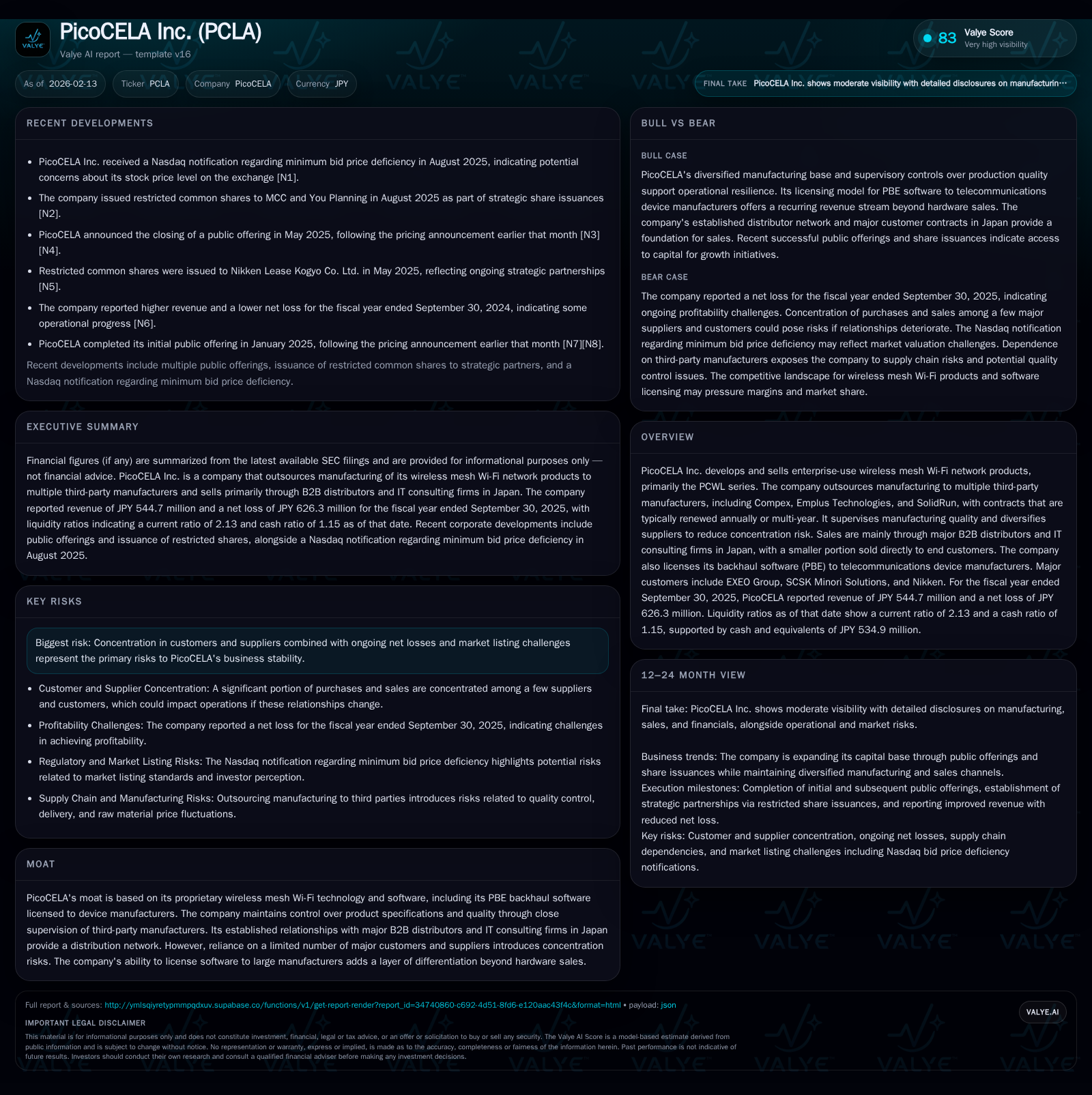
PicoCELA Inc. stands at the intersection of advanced enterprise Wi-Fi innovation and operational complexity. The company's proprietary PCWL mesh network products and unique PBE backhaul software form a differentiated foundation, supported by robust intellectual property recognition. However, recent fiscal years have seen a sharp revenue contraction and expanding net losses driven partly by delayed product deliveries and a concentrated supply and customer base. While manufacturing outsourcing and supplier diversification efforts mitigate some risks, continued financial challenges and Nasdaq listing pressures underscore uncertainties in PicoCELA's near-term trajectory.
The Heart of Innovation: PicoCELA’s Proprietary Mesh Wi-Fi and Software Advantage
PicoCELA’s identity as a technology innovator centers on its enterprise-grade wireless mesh Wi-Fi products, particularly the PCWL series. At the foundation is its proprietary PBE backhaul software—an asset both embedded in hardware function and separately licensed to other telecommunications device manufacturers. The PBE software is not just another network tool; it features specific encryption mechanisms that guard against reverse engineering and rely heavily on know-how kept outside formal patent applications. This tactical approach signals a nuanced intellectual property strategy that balances visibility with stealth.
Patents licensed from Kyushu University anchor the company’s technologies legally while earning recognition from respected authorities such as the Japan Patent Attorneys Association and the Japan Patent Office. These awards speak to PicoCELA’s commitment to IP utilization excellence, conferring reputational goodwill that could support future partnerships or licensing growth.
The synergy between hardware innovation and software licensing elevates PicoCELA’s differentiation in a crowded wireless networking market. However, this moat hinges on sustained control over manufacturing specifications—ensured through rigorous supervisory processes—and continued access to critical patents.
Manufacturing Web: Outsourcing Strategies and Quality Control Mechanisms
PicoCELA abstains from owning manufacturing facilities; instead, it orchestrates production through an array of third-party manufacturers including Compex, Emplus Technologies, and SolidRun. This multi-supplier model is not static—it involves active management via project bids inviting competition for new designs, alongside routine inspections and visits ensuring conformity with exacting specifications.
Notably, contract terms default to automatic renewals unless terminated annually—a practice that fosters stable supplier relationships while preserving flexibility. This balance allows PicoCELA to spread different PCWL models or manufacturing phases across multiple partners simultaneously. Such diversification mitigates some supply chain risks but invites complexity in logistics and cost control.
Pricing agreements set fixed manufacturing amounts prior to production starts; however, fluctuations in raw material costs are absorbed by manufacturers—not unexpectedly adding pressure on partner margins but protecting PicoCELA's cost stability.
Distribution and Partnerships: Ties That Bind in a Narrow Customer Base
Sales of PicoCELA’s mesh Wi-Fi ecosystem currently flow predominantly through major B2B distributors and IT consulting firms based in Japan. This distribution channel capitalizes on established client relationships but also concentrates reliance—major customers like EXEO Group, SCSK Minori Solutions, and Nikken represent substantial portions of revenue.
Direct sales to end customers are comparatively modest but important adjuncts complementing distribution partnerships. This narrow customer base presents a double-edged sword: while facilitating focused service delivery and embedded relationships within enterprise networks, it heightens vulnerability should any single large customer reduce orders or change procurement strategies.
Financial Turndowns: Decoding Revenue Declines and Escalating Losses
The financial picture reported for fiscal year ended September 30, 2025 reveals headwinds that challenge expectations set by prior years’ growth momentum. Total revenues fell by roughly 30.6% year-over-year to JPY 544.7 million (approximately $3.68 million), driven predominantly by delays in tailored industry-specific product deliveries—a factor that slowed recognized equipment sales by nearly 29%. Concurrently, revenues from SaaS maintenance shrank by 37.7%, correlating directly with falling hardware installations.
Cost of goods sold retreated proportionally about 29.7%, mirroring reduced sales volumes but not enough to stem operational losses which widened sharply. Selling, general and administrative expenses nudged upwards by approximately 2.5%, largely attributable to increased professional fees tied to Nasdaq regulatory filing requirements—a clear example of how compliance obligations weigh regardless of business scale.
Operating loss expanded roughly 34.5% year-over-year to JPY 601.4 million with net loss similarly increasing over 30% driven by these combined pressures despite some easing in interest expenses owing to reduced borrowings.
Mitigating Concentration Risks: Supplier and Customer Diversification Efforts
While PicoCELA actively diversifies manufacturing across several trusted partners through bidding processes for new product lines or stages in assembly, concentration remains notable—with two or three suppliers individually accounting for over 10% of purchase volumes annually at times.
Similar dynamics characterize the customer side where the bulk of sales passes through a handful of large clients. Such concentration poses risk exposure if key relationships falter or if any supply disruption arises due to vendor issues.
The annual renewal structure for supplier contracts permits tactical adjustments yet actual shifts appear incremental rather than transformative—likely reflecting the difficulty in quickly onboarding alternative qualified manufacturers capable of meeting high quality thresholds dictated by proprietary technology.
Intellectual Property as a Defensive Moat: Letters from Patent Recognition to License Risks
PicoCELA relies heavily on its patent portfolio licensed from Kyushu University—a cornerstone not just technologically but legally securing competitive advantages embedded within the PBE software system. Encryption protocols further impose technical barriers preventing replication through reverse engineering or unauthorized decompilation.
Recognition via awards conferred by Japan's patent institutions underscores credibility within intellectual property circles—a potentially valuable intangible asset for negotiations or partnerships seeking technologically protected solutions.
Nevertheless, underlying dependence on licensed patents entails inherent fragility; termination or non-renewal could force product redesigns or hinder further development efforts critically impacting PicoCELA's future innovation trajectory.
Operational Footprint: Small but Strategically Placed Workforce and Office Setup
With only 55 full-time employees categorized mainly into management (7), finance (5), sales/product (19), engineering (20), plus administrative roles (4), PicoCELA operates a relatively lean organizational structure emphasizing engineering talent crucial for R&D continuity.
Confidentiality agreements are standard practice reflecting vigilance toward protecting sensitive knowhow embedded within both products and software platforms—even more salient given third-party manufacturing reliance.
Physical premises consist of modest leased office space totaling just over 1,000 square feet in an office building located in Tokyo's Nihonbashi district—an arrangement typical for tech innovators prioritizing agile resource deployment over real estate investment.
Cloud Services and Licensing: Adding Layers Beyond Hardware Sales
Though hardware constitutes the primary revenue source via PCWL device sales, supplementary income derives from SaaS maintenance contracts as well as licensing of the encrypted PBE backhaul software separately offered to telecommunications equipment manufacturers.
This bifurcated revenue approach introduces some resilience against pure product sales volatility while signaling strategic pivot points where service-based offerings might progressively complement traditional hardware-led operations.
Notably, the recent downturn caused declines in both hardware shipments and associated SaaS services reflecting their interconnectedness yet maintaining diversified cash flow streams aligns with contemporary industry trends towards hybrid business models blending products with cloud-enabled services.
Future Outlook: Liquidity Position, Market Constraints, and Growth Prospects
PicoCELA ended fiscal 2025 with current assets at approximately JPY 992 million against current liabilities around JPY 465 million yielding a current ratio near 2.13—indicative of comfortable short-term liquidity buffers despite persistent operational losses exceeding half a billion yen annually.
Market challenges compound beyond internal metrics; notably recent Nasdaq notifications regarding minimum bid price deficiencies have necessitated heightened regulatory efforts costing additional professional fees—a drag visible within rising SG&A figures.
Looking ahead balances cautiously assess whether ongoing innovative strengths can surmount concentrated customer/supplier dependencies alongside evolving market pressures that test small-cap tech firms' ability to scale profitably under international listing standards.
Disclaimer: This analysis is based on publicly available information up to February 2026 including SEC filings [S1][S2] and company data [F1]. It does not constitute investment advice or recommendations.
Disclaimer: This is research-only, informational analysis and not investment advice. It may include AI-generated interpretation and general industry context. Always verify important details using primary sources.

Comments