
Ambow Education Holding: Navigating AI-Driven Hybrid Learning and Regulatory Complexities
Ambow Education advances AI-powered hybrid learning through strategic university partnerships amid U.S. regulatory and operational challenges.
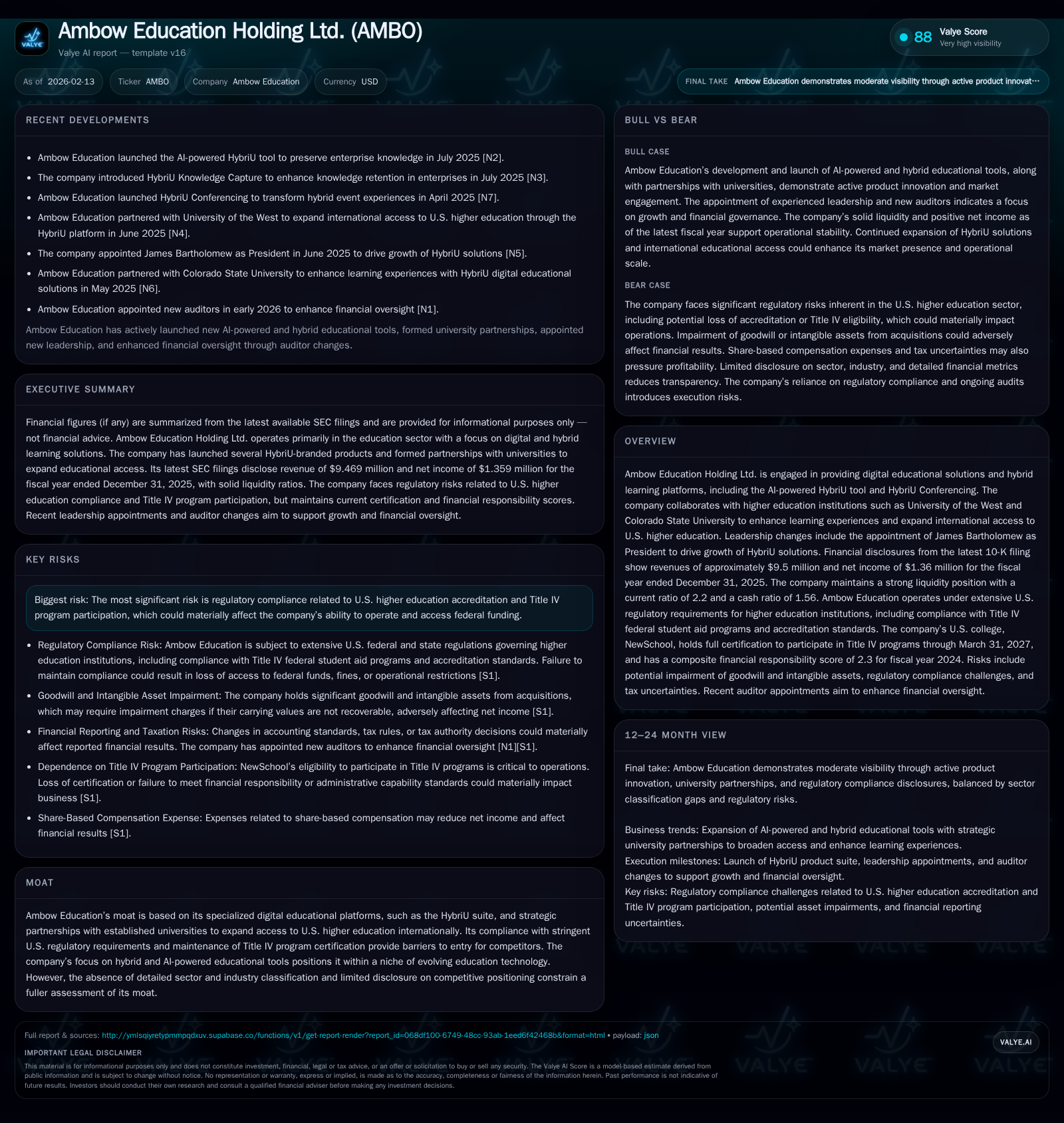
Ambow Education Holding Ltd. has positioned itself as a niche player in the evolving education technology landscape by leveraging its AI-enabled HybriU platform and forging strategic collaborations with established U.S. universities. The company reported modest profitability supported by a strong liquidity profile for fiscal year 2025, while simultaneously contending with significant regulatory requirements tied to Title IV compliance and accreditation. Leadership changes aim to catalyze growth in digital offerings despite ongoing operational risks, including educator retention and technological disruption. Investors should watch for how Ambow balances innovation ambitions against a tightly regulated environment that shapes its market access and scalability.
Reimagining Higher Education: Ambow’s AI-Powered Hybrid Platform
Ambow Education stands at the forefront of an educational transformation driven by its proprietary HybriU platform—a suite augmented by artificial intelligence that fuses remote learning flexibility with interactive hybrid formats. This technology ecosystem aims to transcend traditional classroom limits while enhancing personalization through AI capabilities embedded within HybriU Conferencing and other digital tools [valye_report_excerpt]. By integrating machine learning algorithms to tailor content delivery, Ambow addresses rising demands for scalable, immersive learning experiences worldwide.
What distinguishes HybriU is not merely its technical sophistication but its strategic alignment with global education trends favoring blended modalities. As institutions grapple with post-pandemic shifts toward hybrid models, Ambow’s offering nestles into an emerging niche combining accessibility with pedagogical innovation. This positioning forms a moat—anchored in specialized tech development coupled with consistent R&D investments—to defend against commoditization pressures pervasive in edtech sectors [S1]. Nevertheless, this frontier of innovation also invites volatility due to rapid AI evolution and integration complexities that could disrupt legacy operations.
Strategic University Collaborations: Building Bridges to U.S. Education
Beyond technology, Ambow leverages vital partnerships with recognized American institutions like University of the West and Colorado State University to enhance both program content and market credibility [valye_report_excerpt]. These alliances serve multiple strategic functions: extending U.S.-based degree pathways overseas, enriching curricular offerings through accredited affiliations, and anchoring Ambow’s brand promise on quality benchmarking.
Such collaborations construct formidable entry barriers for competitors who lack similar academic endorsements or integrated platforms facilitating international student access. Additionally, these arrangements generate network effects—drawing more learners attracted by joint credentialing—thus supporting scalable enrollment growth despite geographic dispersion [analysis].
However, scalability hinges on managing these partnerships’ complexity without compromising educational outcomes or regulatory compliance frameworks—a delicate balancing act essential for sustainable expansion.
Leadership Dynamics: The Bartholomew Appointment as Growth Catalyst
In December 2025 filings, Ambow announced James Bartholomew as President charged specifically with spearheading HybriU’s expansion [valye_report_excerpt; S2]. This leadership infusion underscores the company’s commitment to sharpen its operational focus on digital product commercialization amid evolving market dynamics.
Bartholomew’s role is pivotal—not only executing growth strategies but also navigating an intricate compliance landscape that shapes product deployment timelines and funding eligibility. Leadership efficacy here translates directly into investor confidence and internal alignment around innovation acceleration vs. risk mitigation priorities.
This executive reshuffle hints at an inflection point where strategic vision meets operational rigor, seeking competitive traction through clearer accountability structures while sustaining stakeholder trust.
Financial Health Check: Navigating Modest Profitability and Strong Liquidity
From a financial standpoint, Ambow reported revenues approximating $9.47 million for FY2025 alongside positive net income nearing $1.36 million [F1]. These figures reflect modest profitability against a backdrop of ongoing investments in AI-based solutions and regulatory compliance expenditures.
Liquidity metrics bolster confidence in operational sustainability under pressure scenarios: The current ratio stood around 2.2, evidencing ample short-term asset coverage relative to liabilities; concurrently, a cash ratio near 1.56 indicates robust immediate liquidity buffers [F1; S1].
Yet revenue scale remains constrained relative to broader edtech incumbents or diversified education conglomerates—signaling challenges ahead in expanding top-line momentum while controlling fixed costs linked to content development and faculty compensation.
Careful stewardship will be required to balance reinvestment cycles without eroding margins or cash cushions essential for strategic flexibility.
Regulatory Tightrope: Title IV Compliance and Accreditation Risks
Ambow operates within one of the most stringent regulatory environments governing higher education in the U.S., primarily under Title IV program requirements that authorize institutional eligibility for federal student aid [valye_report_excerpt; S1]. Compliance here is non-negotiable: any lapse or adverse action threatens both funding streams critical to recruitment funnel health and licensure standing fundamental for legitimacy.
The risk profile is nuanced—while such regulations erect formidable market entry barriers deterring less compliant competitors, they also concentrate exposure for Ambow whose operational footprint straddles domestic regulations applied to cross-border educational delivery models.
This tightrope walk mandates robust compliance protocols embedded within daily operations alongside proactive engagement with accrediting bodies to manage evolving legislative landscapes effectively [S1]. Failure scenarios could trigger significant enrollment attrition or financial strain due to restricted access to government-backed financing options.
Human Capital Challenges: The Crucible of Educator Recruitment and Retention
At the pedagogical core lies a persistent challenge: securing educators qualified not only in subject expertise but also adept in leveraging digital platforms across diverse cultural contexts [S1]. Ambow acknowledges potential shortages impacting teaching consistency—a key determinant of student satisfaction and brand equity.
Rising hiring costs exacerbate pressures on operating budgets while retention difficulties risk diluting instructional quality crucial for program reputation building. Share-based compensation plans intended to attract talent impose additional expense recognition impacting net results yet remain vital tools amid competitive talent markets [S1].
Navigating this crucible demands well-designed incentivization coupled with scalable professional development systems tailored to remote delivery paradigms influencing future workforce stability.
Innovation vs. Disruption: Balancing AI Investment with Operational Stability
Ambow’s aggressive bets on cutting-edge AI technologies through HybriU embody high growth aspirations tempered by execution risks intrinsic to novel tech adoption [valye_report_excerpt; S1]. Rapidly evolving algorithms require continuous updates raising integration complexities alongside user experience considerations impacting customer retention.
Operational disruptions may arise from shifts in internal processes fueled by automation or data analytics enhancements potentially clashing with legacy workflows or educator adaptability thresholds.
Thus, management must orchestrate incremental innovation paced enough to preserve existing service quality while unlocking new capabilities—an inherently challenging equilibrium between pioneering disruption and conservative operational stewardship.
Governance and Oversight: Auditor Changes and Shareholder Decisions in Focus
Recent corporate governance advancements indicate a maturing emphasis on transparency and oversight following prior scrutiny concerns. The appointment of Guangdong Prouden CPAs GP as independent auditor ratified at the December 2025 Annual General Meeting reflects steps toward reinforcing financial reporting integrity [N1; S2]. Likewise, electing Mingjun Wang onto the Board introduces fresh perspectives poised to bolster governance frameworks particularly relevant amid complex regulatory demands.
These moves signal management responsiveness aligned with shareholder interests aiming at enhanced controls critical in fostering investor confidence amid volatile external environments.
Ongoing attentiveness will be essential—especially given industry volatility—to maintain governance robustness that underpins sustainable growth narratives.
This analysis synthesizes publicly available disclosures without extending investment advice or specific forecast recommendations. Readers should consider inherent uncertainties and broader economic factors when evaluating Ambow Education Holding Ltd.’s evolving business trajectory.
Disclaimer: This is research-only, informational analysis and not investment advice. It may include AI-generated interpretation and general industry context. Always verify important details using primary sources.

Comments