
Crisp Momentum's Bold Foray into Western Microdramas Balances Innovation with Financial Struggles
Crisp Momentum pursues a pioneering position in short-form scripted video through diversified IP and revenue streams amid nascent market challenges.
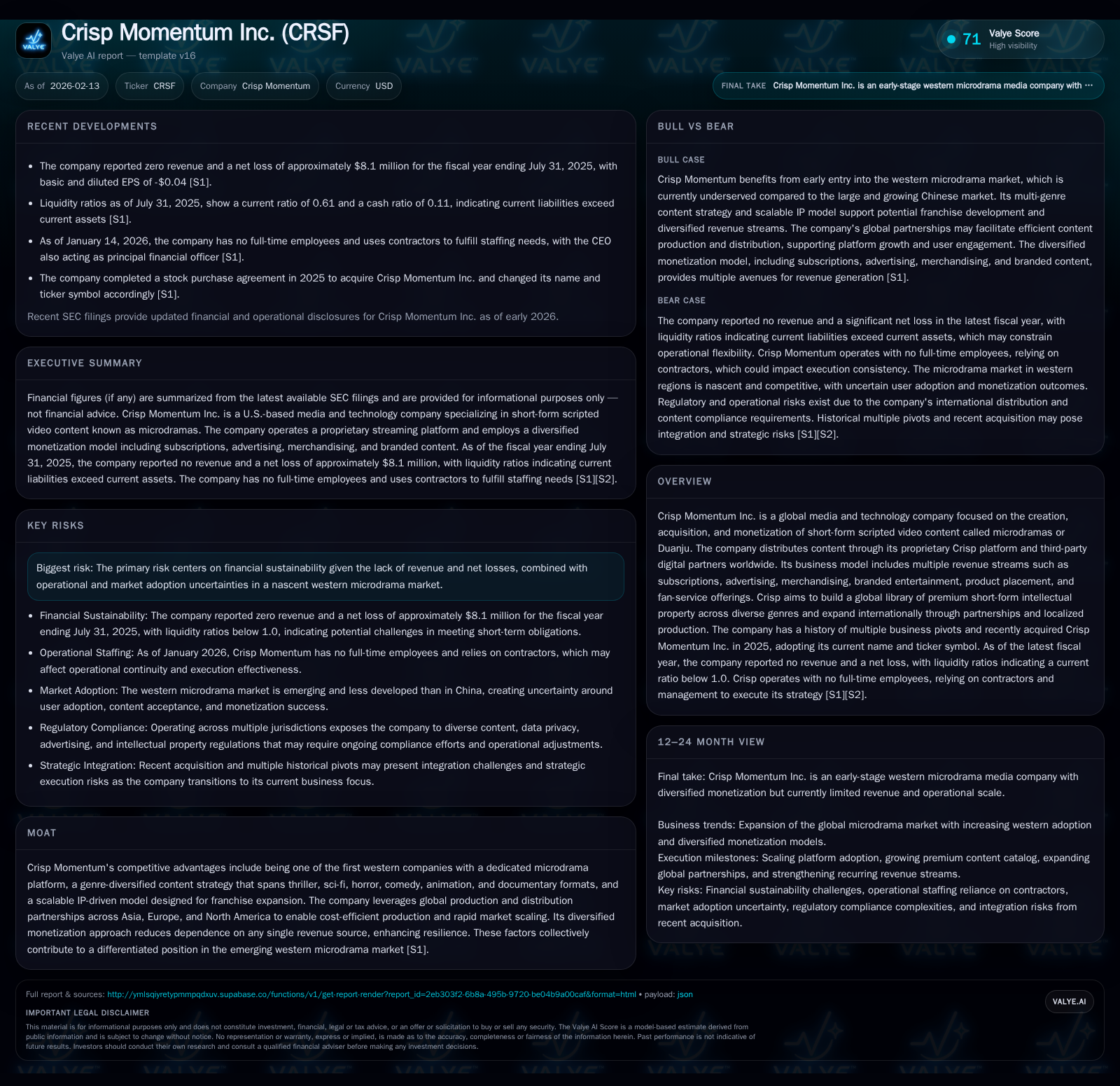
Crisp Momentum Inc. has transformed itself from its historic technological roots into a media company focused on microdramas, an emerging genre of short-form scripted video content. Leveraging a proprietary streaming platform alongside global content partnerships, the company seeks to build franchise-ready intellectual property across multiple genres and monetize it through diverse revenue sources. However, its early-stage financials highlight zero revenue and significant net losses, raising material concerns about liquidity and operational scalability. This analysis unpacks Crisp’s strategic positioning in an evolving digital entertainment landscape, emphasizing the interplay between its innovative content model and critical financial risks.
From Automation to Microdramas: The Evolutionary Journey of Crisp Momentum
Originally incorporated in 1986 as a technology company specializing in automated luminometers for microbiological testing, Crisp Momentum has traversed a remarkable corporate path marked by multiple pivots to stay relevant amidst changing market dynamics. In the ensuing decades following the discontinuation of its initial operations in 1996, it ventured into molecular separation technologies leveraging electrostatics — an initiative ultimately abandoned. The early 2020s saw another strategic shift into blockchain technology and digital assets under the moniker OpenLocker Holdings. However, the most consequential transformation came in mid-2025 when Crisp acquired an existing microdrama-focused media entity and adopted its name and ticker symbol [S1]. This acquisition crystallized Crisp's fresh identity as a global media technology player seeking to exploit the rising trend of short-form scripted video.
Such historical flux underscores an adaptive but challenging legacy wherein the company has had to redefine its core competencies repeatedly. While this might raise questions about strategic consistency, it also highlights management’s willingness to embrace emergent opportunities — laying groundwork for ventures like its dedicated microdrama platform that launched at a time when western markets are only beginning to recognize this content format’s potential [S1].
Decoding Duanju: The Allure and Innovation of Microdramas
At the heart of Crisp Momentum’s current strategy lies Duanju, or microdramas — succinct scripted episodic stories typically spanning one to two minutes per episode across multi-episode arcs. This format contrasts sharply with traditional longer-form streaming series or films by catering specifically to mobile-first viewers with reduced attention spans and high content churn rates. While microdramas originated chiefly in Asian markets where they have amassed considerable audiences, Crisp seeks to pioneer their adoption in western territories by operating one of the first commercial platforms exclusively devoted to this genre outside Asia [S1].
The allure is multifaceted: these brief narratives enable quick viewer engagement suited for on-the-go consumption while unlocking franchise expansion through sequels and spin-offs due to their modular structure. Furthermore, shorter production cycles reduce costs relative to conventional productions. Crisp’s proprietary platform integrates standard monetization options plus fan-service layers that deepen user engagement beyond passive viewing — an evolutionary step toward cultivating active communities around each IP property [valye_report_excerpt].
This move does not come without risk; novelty in any entertainment segment demands audience education and behavior shifts. Yet by establishing franchise-ready IP early within a diversifying short-form slate positioned on mobile devices globally accessible through partnerships, Crisp increases odds of winning first-mover advantages [S1].
Crisp's Content Arsenal: Diverse Genres and IP Strategy
Diversification is central both stylistically and strategically for Crisp Momentum’s IP approach. Its curated catalogue spans thriller, science fiction, horror, comedy, animation, and documentary formats — a spectrum chosen deliberately not only for broad appeal but also for cross-genre franchising possibilities. Rather than betting on single-hit phenomena typical within constrained niches, this varied genre mix aims to spread creative risk while facilitating adaptation across multiple media forms such as merchandise or potential long-format adaptations [S1].
This content strategy fosters competitive moats by capturing diverse demographics simultaneously while building cumulative intellectual property assets poised for licensing deals domestically and internationally. The scalability angle is critical: because each series consists of bite-sized episodes enabling faster rollout cycles compared to traditional productions, the company can iterate genres more readily according to consumer reception signals garnered from platform analytics [valye_report_excerpt].
However, such breadth also demands robust creative management frameworks ensuring quality control and brand coherence across distinct viewer segments — notably challenging for a relatively nascent operation endeavoring rapid international expansion.
Monetizing Moments: Crisp’s Multifaceted Revenue Blueprint
Crisp Momentum adopts an expansive revenue model mindful of short-form content market challenges where unit economics often thin out. Revenue avenues encompass subscription fees granting ad-free access; advertisement-supported viewing permitting scale; merchandising including collectibles; branded entertainment featuring product placements; licensing agreements with third-party platforms; plus fan-service offerings that may include premium digital goods or enhanced interactive experiences [S1].
This multiplicity hedges against overreliance on any single income source which remains vital given the still embryonic state of western microdrama monetization models. Moreover, ancillary revenues via merchandising or licensing present pathways toward capturing higher-margin returns tied directly to user attachment levels fostered through serialized storytelling.
However, operational complexity escalates proportionally with such revenue diversity. Managing simultaneous streams entails nuanced marketing coordination alongside technological infrastructure capable of supporting various transaction types seamlessly within the platform environment — tasks demanding both capital investment and managerial expertise often scarce within early-stage firms [valye_report_excerpt].
Global Reach and Network: Partnership Power in Content Production and Distribution
One notable strength distinguishing Crisp Momentum is its networked approach combining content production with global distribution partnerships spanning Asia, Europe, and North America. These alliances enable cost-efficient production leveraging region-specific resources while accelerating access across multiple digital platforms worldwide [S1].
Such geographical reach facilitates tapping into established microdrama markets (notably Asia) while forging pathways into western audiences unfamiliar with the format but increasingly receptive as digital habits evolve. Additionally, cross-border collaborations help mitigate currency fluctuations and regulatory idiosyncrasies that might otherwise stall pure domestic endeavors.
Distribution through both the proprietary Crisp platform plus third-party partners maximizes viewer touchpoints but introduces dependencies on external digital ecosystems whose terms may shift unexpectedly — underscoring a delicate balance between scalable reach versus control retention [valye_report_excerpt]. The company’s success depends heavily on maintaining these relationships while optimizing regional content localization efforts.
Assessing Financial Realities: Liquidity Concerns and the Path to Sustainability
Despite promising strategic positioning on paper, Crisp Momentum’s financial health presents significant red flags emblematic of many early-stage media startups striving for product-market fit in new verticals. As per most recent SEC filings dated July 31, 2025:
- Revenue registered stands at zero dollars indicating lack of commercial traction tangible enough for monetization recognition.
- Net loss tallied approximately $8.1 million reflecting ongoing high operating expenses largely driven by development costs.
- Cash reserves are scant near $53k against current liabilities exceeding $503k culminating in a concerning current ratio around 0.61 revealing liquidity pressures.
Critically noted is auditor commentary expressing substantial doubt about the company’s ability to remain a going concern absent additional funding or swift revenue improvement [S1][F1]. Such conditions emphasize precarious short-term sustainability despite long-term ambitions.
For investors or stakeholders scrutinizing scalability prospects: these metrics suggest funding constraints could impede crucial investments necessary for platform enhancements or broader marketing needed for user base expansion highlighted as key success factors elsewhere in disclosures [valye_report_excerpt]. Operationally expensive diversification strategies may thus require calibration against closer-to-cash generating initiatives until clearer revenue paths emerge.
Navigating Risks in an Emerging Market Landscape
The opportunity landscape also comes laced with notable risks captured exhaustively within SEC Risk Factors sections:
- Early-stage status combined with limited operating history complicates forecasting reliability or peer comparison benchmarks.
- Market adoption uncertainties loom large due to novelty of western microdrama consumption patterns coupled with rapidly evolving viewer tastes exerting pressure on content development agility.
- Heavy reliance on third-party digital platforms exposes Crisp to shifts in partnership terms or algorithmic changes negatively impacting distribution.
- Restrictions related to penny stock classification curtail liquidity in share trading adding layers of investor risk.
- Intellectual property protection poses further vulnerabilities if infringement claims arise or IP rights enforcement lags amidst international dealings.
- Retention challenges amongst key personnel involved in creative direction could disrupt continuity during critical growth phases [S1].
These factors collectively underline substantial operational fragility that must be managed prudently alongside innovation pursuits intrinsic to disruptive content sectors.
Outlook Amidst Uncertainty: Strategies for Growth and Market Adoption
Looking forward without engaging in speculative forecasting involves identifying areas management reportedly targets based on disclosures:
Efforts will likely prioritize enhancing algorithm-driven user preference anticipation technologies aimed at refining content recommendations fostering longer-term engagement metrics necessary for subscription conversions. Retention programs coupled with expanded global production partnerships remain focal points enabling diversified offerings responsive to cultural nuances central for wider acceptance beyond niche demographics [S1].
Talent acquisition strategies presumably involve securing creative professionals adept at developing compelling narratives within constrained formats while scaling IP franchises intelligently through sequels or spin-offs requiring minimal additional capital compared to full feature productions.
Capital raises or alternative financing avenues appear imperative given existing cash burn rates to support iterative platform improvements alongside marketing campaigns designed to accelerate brand awareness within competitive digital media ecosystems dominated by entrenched incumbents.
Ultimately Crisp’s survival hinges upon executing this complex alchemy balancing resource allocation amidst continuing losses against securing footholds within an emerging western microdrama marketplace where consumer habits remain malleable but unproven sufficiently for immediate profitability.
This analysis is grounded exclusively on information disclosed in SEC filings from January-February 2026 alongside Valye report excerpts as of February 13, 2026. It avoids speculative projections beyond official statements or disclosed strategic intentions. Readers should consider inherent uncertainties linked both to nascent market development dynamics and early-stage financial conditions described herein when contextualizing this overview.
Disclaimer: This is research-only, informational analysis and not investment advice. It may include AI-generated interpretation and general industry context. Always verify important details using primary sources.

Comments