
AppTech Payments Advances Cloud-Native Fintech Infrastructure Amid Liquidity Pressures
Latest quarterly results highlight AppTech’s deployment progress with its digital banking platform and Payments-as-a-Service, alongside short-term financing to manage working capital constraints.
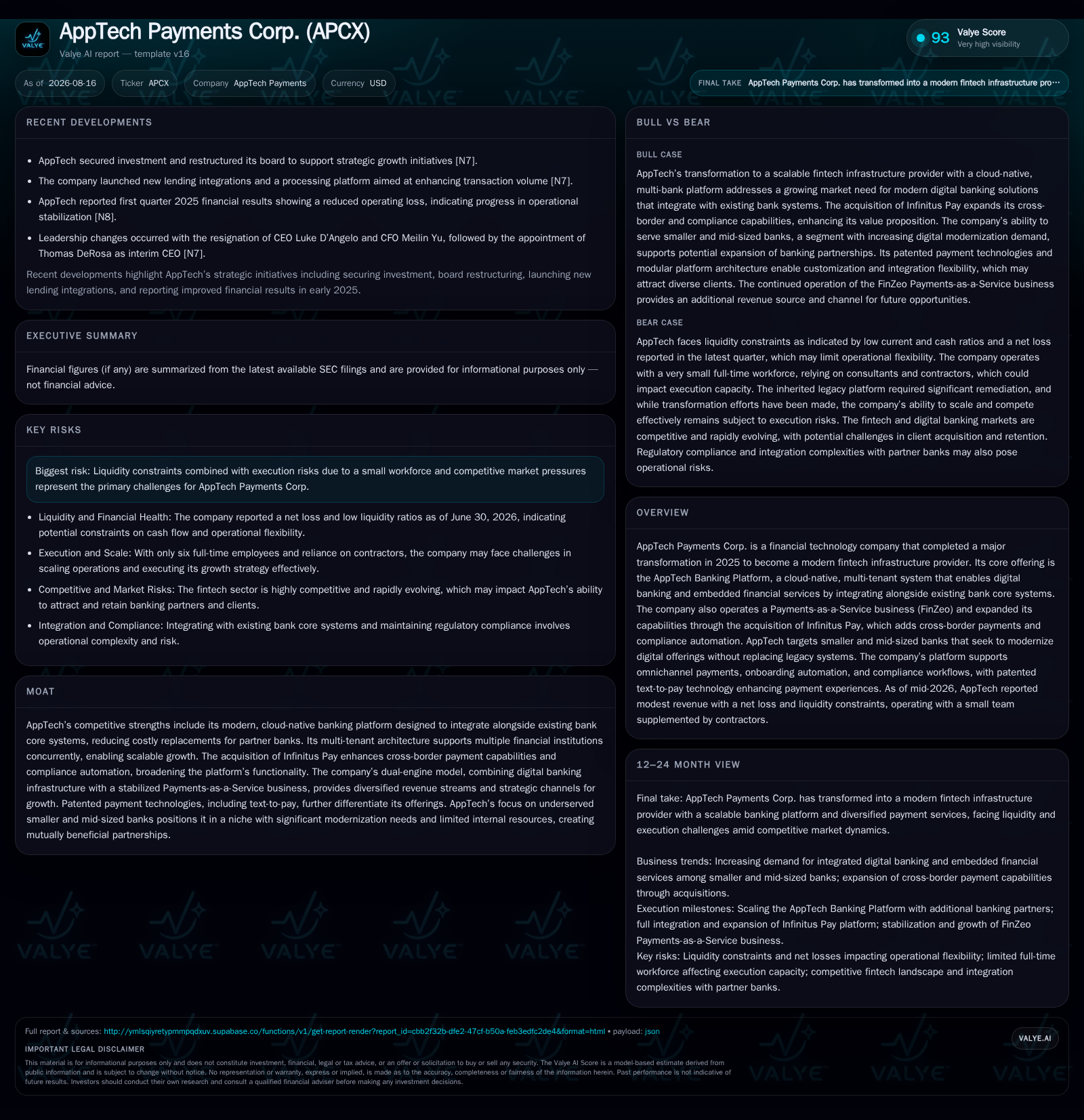
AppTech Payments Corp. continues to transform its business by focusing on a cloud-native, multi-tenant digital banking platform that integrates with existing bank core systems and stabilizing its Payments-as-a-Service segment. The company has onboarded initial partner banks onto its platform and expanded capabilities through the acquisition of Infinitus Pay, enhancing cross-border payments and compliance automation. Despite these operational advances, AppTech faces significant liquidity challenges, reflected in a low current ratio and reliance on short-term promissory notes from related parties. Growth is driven by demand from smaller banks for overlay fintech infrastructure and expanding cross-border payment volumes, but execution risks remain elevated due to resource limitations and competitive fintech pressures.
Recent Operating Update Highlights
AppTech Payments Corp.'s Q2 2026 filing confirms continued operational momentum alongside pronounced liquidity constraints [S2]. The AppTech Banking Platform—the company's core fintech infrastructure offering—has been fully deployed with its first partner bank actively processing clients on a cloud-native, multi-tenant architecture designed for seamless integration alongside existing legacy core banking systems [S1]. This overlay approach mitigates costly and disruptive full core replacements for smaller and mid-sized banks seeking digital modernization.
The Payments-as-a-Service segment branded FinZeo remains a stable revenue contributor following remediation of inherited platform issues [S1]. This dual-revenue model blends SaaS subscription income from platform licensing with transaction fees from payment processing activities. Strategic enhancement came via acquiring Infinitus Pay, which extends the platform’s capabilities into compliance automation workflows and cross-border payments—a critical growth vector given increasing global transaction volumes and regulatory complexity [S1].
Leadership changes took effect early Q3 with the departure of CEO Thomas DeRosa on July 1, 2026. Felipe A. Corrado IV assumed interim CEO responsibilities while maintaining CFO duties [S11][S12]. Corrado’s expertise in financial advisory services including corporate turnarounds positions him to guide the company through near-term liquidity management while scaling operations.
Business Model Analysis
AppTech generates revenue primarily through SaaS licensing fees for its AppTech Banking Platform coupled with transaction-based fees arising from its FinZeo Payments-as-a-Service solution [S1]. The platform’s multi-tenant design supports simultaneous servicing of multiple financial institutions within a single cloud instance—enabling scalable expansion across smaller banks that require modern digital banking features without replacing their legacy core systems outright
This integration-friendly approach reduces switching costs for partner banks—a key competitive advantage in a market where full core system replacement is expensive and disruptive. Revenue quality depends on growing the number of onboarded financial institutions (MRR drivers) and increasing transactional throughput generating fee income.
Value-added services such as automated onboarding workflows lower customer acquisition friction for banks while patented technologies like text-to-pay enhance end-user engagement during payment events, potentially raising fee yield per user [S1]. The Infinitus Pay acquisition diversifies revenue streams into high-growth areas of cross-border payments and compliance automation—critical as regulatory demands intensify.
The FinZeo PaaS business provides steady marketplace-based payment revenues but requires ongoing investment to maintain competitiveness post-acquisition remediation. Sales channels focus directly on smaller banks lacking internal modernization resources.
Industry Context & Competitive Positioning
Operating within the fintech infrastructure sector, AppTech competes with providers offering either full core replacements (e.g., FIS) or overlay platforms (e.g., Solarisbank). Its cloud-native multi-tenant architecture aligns it with overlay models facilitating rapid scalability across multiple smaller banks simultaneously.
Industry leaders like Fiserv and Stripe offer broad suites spanning payments to embedded finance; AppTech differentiates itself through integration ease alongside legacy cores (minimizing disruption), patented payment technologies enhancing user experience, plus diversified revenues balancing stable PaaS income with emerging SaaS adoption.
However, AppTech's relatively small scale limits technology resources and bargaining power compared to larger incumbents. Competitors range from established providers extending product lines to fintech startups targeting niche verticals or geographies.
Growth Drivers
Structural growth drivers include accelerating demand among smaller/mid-sized banks seeking cost-effective digital transformation without wholesale core replacements. Regulatory complexity fuels demand for embedded compliance automation integrated directly into transaction workflows—strengthened by the Infinitus Pay acquisition.
Cross-border payments represent a dynamic expansion area tied to rising international commerce; AppTech’s enhanced capabilities position it well to capture increased volumes here.
Embedded finance adoption also propels demand for modular banking functionalities integrated into non-banking ecosystems. AppTech's cloud platform supports rapid onboarding of new partners or service lines enabling agility.
Relevant KPIs are onboarding rates of financial institutions (proxying future recurring revenue), transaction volume growth (especially cross-border), monthly recurring revenue trajectory from subscriptions versus transactional fees, onboarding time reductions enhancing sales velocity, and compliance incident rates impacting operational risk.
Risks & Execution Watchpoints
Liquidity risk is acute given the low current ratio (~0.14) signaling minimal buffer against near-term obligations [F1]. Reliance on short-term promissory notes at elevated interest rates introduces refinancing risk every quarter along with increased fixed charges.
Execution risks arise from managing concurrent platform development, customer onboarding expansion, evolving regulatory compliance demands, and sales channel ramp-up within a small workforce [S1]. Competitive pressures require continuous product innovation while controlling costs prudently.
Legal proceedings related to past acquisitions introduce potential distraction or liability risks if unresolved [S1]. Technology reliability including uptime and data security remain critical given fintech customers’ sensitivity to service disruptions.
Monitoring sustainable growth in recurring SaaS revenue alongside expanding payment volumes without disproportionate cash burn will be essential indicators of operational health.
What To Watch Next
Upcoming milestones include scaling partner bank onboarding onto the AppTech Banking Platform; accelerated transaction volume metrics will indicate go-to-market effectiveness. Integration progress of Infinitus Pay’s cross-border payment and compliance features into core workflows should become evident through operational updates or product announcements.
Balance sheet developments post-Q2 will be critical as short-term promissory notes mature rapidly; any shift toward longer-term financing or equity infusion would materially improve financial flexibility narratives.
Further executive leadership stabilization beyond interim arrangements would signal strategic clarity important for investor confidence. Quarterly disclosures clarifying subscription revenue trends or margin improvements would enhance visibility into commercialization progress shaping long-term viability.
Financial Profile Discussion
AppTech’s liquidity profile entering Q3 remains challenged: current assets stood at roughly $980,000 against current liabilities exceeding $6.8 million as of June 30, reflecting an imbalanced working capital structure [F1]. The company addressed immediate working capital gaps through related-party promissory notes totaling $500,000 each issued since late June bearing 9% interest maturing in just three months [S3]. These flexible but high-cost bridge financings reflect constrained external capital access typical for small-cap emerging fintech companies seeking positive cash flow inflection points.
Cash & equivalents were last reported at $1.55 million as of March 31, 2024 [F1]. Total debt was estimated around $579,000 at end-2024 indicating manageable baseline leverage though recent short-term liabilities increase balance sheet risk [F1]. Net debt was negative as of late-2024 but probably deteriorated amid ongoing operating losses [F1].
Close monitoring of cash burn relative to incoming subscription/transaction revenues will reveal sustainability absent fresh equity injections or longer-term debt facilities under improved terms.
This analysis is based exclusively on official filings through August 2026 without forecasting future performance or making investment research views.
Disclaimer: This is research-only, informational analysis and not investment advice. It may include AI-generated interpretation and general industry context. Always verify important details using primary sources.

Comments