
PermRock Royalty Trust’s Income Sensitivity to Permian Commodity Swings
Latest filings underscore PermRock's dependence on commodity prices and operator execution for its royalty income from Permian Basin assets.
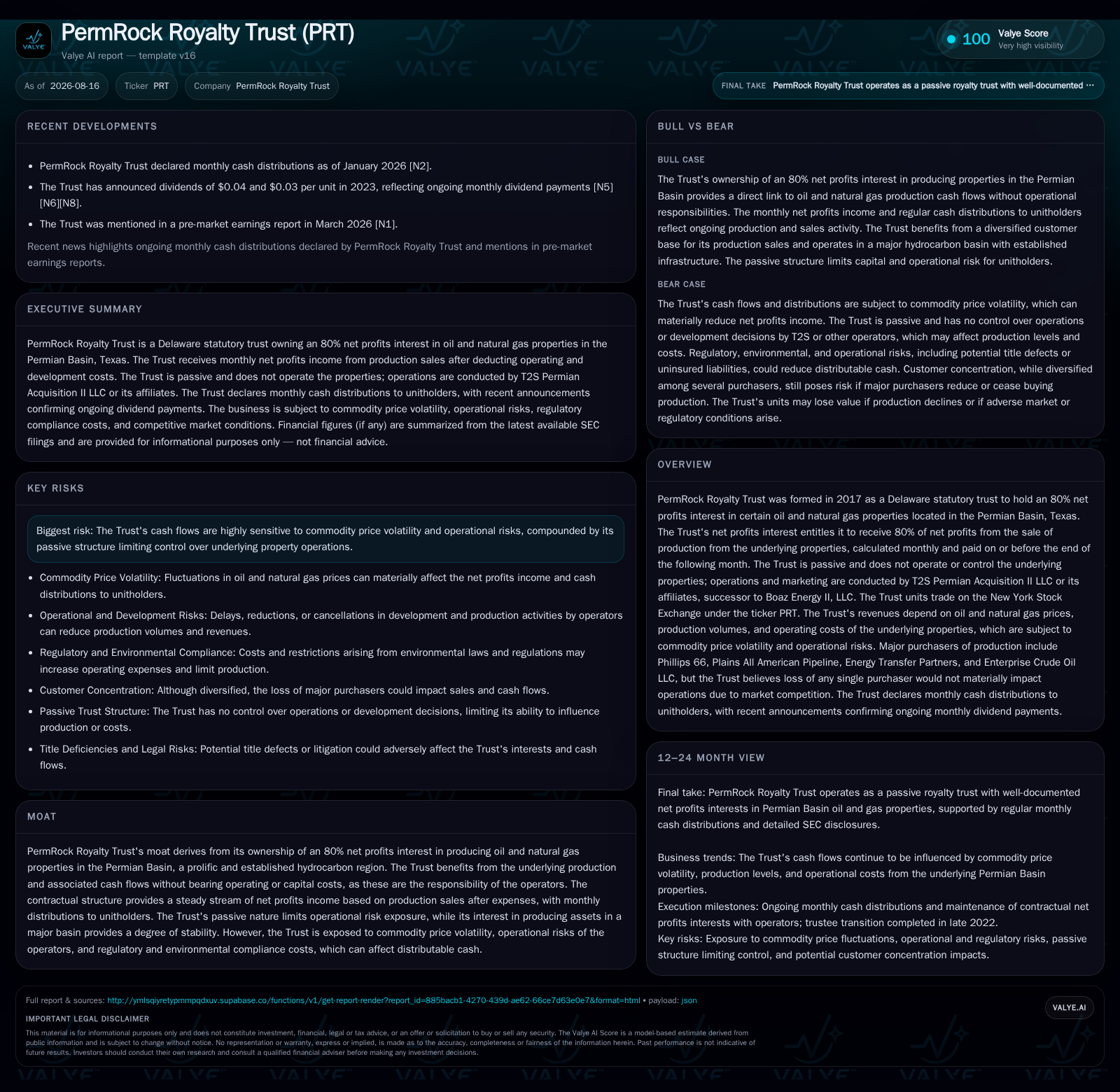
PermRock Royalty Trust’s recent quarterly disclosures highlight its revenue and distributions remain highly sensitive to oil and natural gas price fluctuations and the operational performance of its underlying Permian Basin assets. Holding an 80% net profits interest, PermRock receives monthly cash flows net of operating expenses, exposing it to volatility driven by commodity cycles and operator cost management. Regulatory developments, particularly EPA methane emission rules, add operational risk that could affect future distributable cash flow. Key monitoring points include operator production volumes, realized pricing differentials, regulatory impacts, and distribution trends.
Recent Quarterly Operating Update Anchored in May Production
PermRock Royalty Trust’s latest distribution declared in July 2026 amounted to $0.022579 per trust unit payable mid-August, derived principally from production during May 2026 [S3]. This timing illustrates the standard lag between production activities and income receipt common among royalty trusts due to collection processes and expense reconciliations. For unitholders, this cadence offers relatively prompt income feedback closely tied to near-current commodity market conditions and operational outcomes.
This update is critical for investors seeking timely insight into how recent commodity price movements and operator performance translate into distributable cash flow.
Business Model Centered on an 80% Net Profits Interest in Permian Basin Assets
PermRock owns a significant 80% net profits interest (NPI) in a portfolio of producing oil and gas properties located primarily in Texas’s prolific Permian Basin—a key U.S. hydrocarbon-producing region [S1]. An NPI entitles the trust to residual revenue after all operating expenses related to extraction and delivery are deducted by the operators managing these assets. This contrasts with a fixed royalty interest that shares gross revenue without cost deductions.
Operators market produced hydrocarbons under contracts indexed regionally with adjustments for quality (e.g., Btu content), transportation fees, and other logistical factors affecting realized prices [S1]. The trust’s monthly income reflects net profits after deducting operating costs such as gathering facility fees, pipeline transportation charges, lease operating expenses, and environmental compliance costs.
Thus, two main variables govern income variability: realized sales prices per barrel or Mcf reflecting benchmark indices adjusted for local differentials; and operating expense levels controlled by operators but directly impacting distributable margins. Effective cost management at the operator level is therefore pivotal for sustaining distributions.
Operational Delegation Creates Execution Risk Exposure
The underlying producing properties are operated by T2S Permian Acquisition II LLC or affiliates following prior ownership by Boaz Energy II LLC. As a passive trust holder without operational control or capital commitments, PermRock relies entirely on these operators’ effectiveness in maintaining production volumes through drilling success, well maintenance programs, enhanced recovery techniques deployment, and prudent capital expenditure management.
Regulatory challenges heighten operational risks. Notably, recent EPA final rules imposing stringent methane emission limits introduce compliance costs that operators must absorb. Methane emissions represent lost product and potential liabilities; thus mitigation efforts increase operating expenses deducted before calculating net profits payable to the trust [S1], [S9].
Additionally, long-standing environmental laws such as CERCLA may expose operators or owners indirectly to remediation liabilities related to historical disposal practices on these leases—potentially affecting operational costs or development timelines.
Industry Context: Royalty Trusts versus Upstream Operators
PermRock exemplifies oil and natural gas royalty trusts that hold interests passively rather than operate assets directly. In contrast, upstream producers like ConocoPhillips or master limited partnerships such as Enterprise Products Partners own producing assets outright and bear full exposure to commodity price fluctuations alongside capital expenditure demands for exploration and infrastructure development.
This distinction shapes risk-return profiles significantly. While royalty trusts avoid drilling capex variability—which can be large and unpredictable—they lack influence over asset growth prospects. Their revenue streams reflect external market conditions plus operator decisions over which they have no control.
Peers include other Permian-focused royalty trusts such as the Permian Basin Royalty Trust; these entities share similar exposure patterns shaped by contract terms affecting net profit shares but differ by acreage size or asset quality. Trading publicly on exchanges like NYSE provides investors with direct energy sector exposure tempered by operational insulation yet sensitive to commodity cycles.
Growth Drivers: Commodity Prices, Production Stability, Infrastructure Enhancements
Income growth hinges on sustained or rising oil and gas prices boosting realized sales revenues. Operator success in maintaining or increasing production volumes through effective drilling programs or operational efficiencies also supports stable or growing distributions.
Infrastructure expansions reducing pipeline bottlenecks can narrow discount differentials between benchmark prices (e.g., WTI/NYMEX) and actual sales receipts at gathering points—improving realized pricing which feeds into net profits calculations.
While no recent acquisitions of additional net profits interests are reported, such transactions or leasehold extensions would enhance asset scale. Favorable regulatory environments promoting operational continuity without excessive compliance costs also support growth prospects.
Risks: Price Volatility, Operator Execution Uncertainty, Regulatory Cost Pressures
PermRock’s earnings are highly exposed to volatile oil and natural gas markets; sharp price declines translate directly into lower distributable income given its pass-through NPI structure [S2],. Unlike integrated producers able to hedge output or diversify activities, the trust has limited internal mechanisms to mitigate commodity risk.
Operator execution risks include disappointing drilling results reducing reserve replacement rates; mechanical failures causing spot outages; or deferral of capital expenditures undermining long-term production sustainability—all beyond the trust’s influence but materially impacting distributable cash flow.
Emerging environmental regulations—especially those targeting methane emissions—increase operators’ compliance costs passed through as higher operating expenses deducted prior to net profit calculations. These incremental cost pressures could compress distributions absent offsetting price gains [S9].
Market liquidity constraints occasionally affecting publicly traded royalty units pose secondary concerns compared to fundamental commodity-operator dynamics.
Monitoring Priorities: Production Volumes, Price Differentials, Regulatory Developments, Distribution Trends
Investors should track upcoming quarterly disclosures detailing operator-reported production volumes for signs of reserve health supporting future cash flows. Declining trends may foreshadow reduced incomes.
Commodity price movements remain paramount; analysis should compare WTI crude benchmarks against realized selling prices adjusted for regional transportation differentials highlighting margin pressures or relief points.
Regulatory updates regarding EPA methane standards or waste management rules warrant close attention for incremental operating cost implications ultimately reflected in distributions.
Distribution declarations provide near-term signals of cash flow health; sequential changes contextualize whether external variables exert pressure or tailwinds influencing unitholder returns.
This analysis synthesizes recent SEC disclosures with industry-standard frameworks essential for evaluating passive oil & gas royalty interests concentrated within prolific hydrocarbon basins.
Disclaimer: This is research-only, informational analysis and not investment advice. It may include AI-generated interpretation and general industry context. Always verify important details using primary sources.

Comments