
Catalyst Bancorp Strengthens Regional Presence with Lakeside Merger and Strategic Lending Shift
Catalyst Bancorp’s Q2 2026 reflects merger integration impacts, evolving loan portfolio composition, and ongoing community banking challenges.
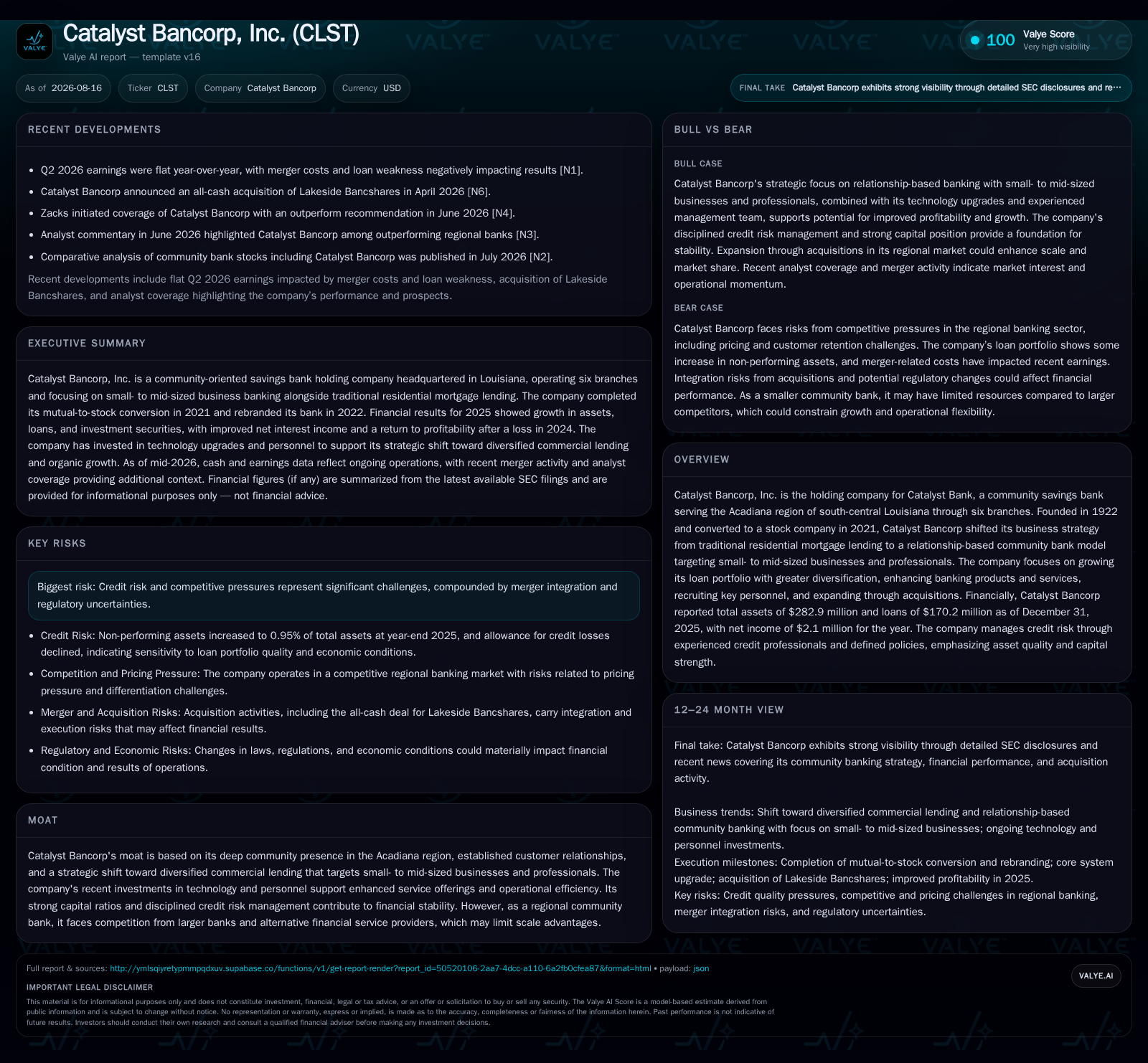
Catalyst Bancorp, a Louisiana-based community savings bank holding company, completed its acquisition of Lakeside Bancshares in mid-2026, expanding its branch network and asset base significantly. The company’s latest quarter showed stable earnings but pressure from merger-related expenses and softer loan growth. Catalyst's strategic pivot from traditional mortgage lending toward diversified commercial relationships marks a structural transformation aimed at sustainable growth. Key risks remain around credit quality, integration execution, and competitive market dynamics.
Recent Operating Update: Merger Completion and Q2 Performance
Catalyst Bancorp finalized its acquisition of Lakeside Bancshares on July 14, 2026, a transformative event that materially expanded its geographic reach into Calcasieu Parish with four new branch locations. This deal increased the company's assets by more than $375 million and added substantial loan and deposit volumes—Lakeside reported $229.8 million in loans and $277.6 million in deposits at March 31, 2026 [S26][S27]. This merger aligns with Catalyst's strategic intent to grow scale via acquisitions while deepening community banking relationships.
Business Model: Transformation Toward Relationship-Centric Commercial Banking
Catalyst Bancorp operates as the holding company for Catalyst Bank, a community savings bank established nearly a century ago serving south-central Louisiana through six full-service branches prior to the Lakeside acquisition [S1]. Historically reliant on traditional long-term residential mortgage lending focused on properties within St. Landry Parish and nearby areas, Catalyst began shifting its business model around 2021 toward a relationship-driven community bank framework targeting small- to mid-sized businesses and professionals [S1].
This strategic pivot emphasizes diversified commercial lending rather than solely residential real estate loans. The rationale is to create a more balanced loan portfolio less susceptible to regional residential housing market fluctuations while leveraging local knowledge to cultivate deeper client connections. Revenue mechanics primarily revolve around net interest income derived from loans funded by customer deposits supplemented with borrowings from sources such as the Federal Home Loan Bank system [S1]. Fee income from banking services adds incremental revenue.
Underlying profitability depends critically on managing net interest margin amidst changing funding costs, controlling provision levels for credit losses through disciplined underwriting practices, and optimizing operating efficiency ratios given the labor-intensive nature of relationship banking. Catalyst also seeks to enhance product offerings through technology investments that support customer service scalability.
Industry Structure and Competitive Position
Within the regional community banking sector, Catalyst operates in a competitive environment marked by larger national banks with broader product menus, credit unions offering often favorable rates, and emergent fintech lenders targeting niche customer segments. Its distinct value proposition lies in deep local presence in Acadiana combined with newly acquired territories via acquisition.
Branch density prior to the merger was modest with six locations; adding Lakeside's four branches improves both scale and convenience for customers but also introduces complexity in unifying operations across regions. Credit risk management gains importance especially given potential concentration risks inherent in localized markets.
Financially, Catalyst exhibits strong capitalization—with shareholders' equity representing nearly 29% of total assets at end-2025—providing a cushion against economic downturns or loan losses. However, the bank's relatively small size compared to larger peers limits economies of scale advantages and may constrain pricing power on loans or deposit products.
Growth Drivers
Key drivers fueling Catalyst's growth trajectory include:
- Merger Integration: The addition of Lakeside's asset base significantly expands Catalyst’s footprint enabling cross-selling opportunities across complementary customer bases [S26][S27].
- Loan Portfolio Expansion: Focused origination of commercial loans to small and mid-market businesses aims at diversifying revenue streams beyond residential mortgages [S1].
- Deposit Base Development: Maintaining deposit stability post-merger and attracting low-cost deposits underpin funding cost control vital for net interest margin preservation.
- Technological Enhancements: Investments promise stronger operational efficiency which can improve margins over time despite short-term rise in non-interest expenses related to integration efforts [N1].
- Local Economic Conditions: Favorable business activity within Louisiana supports demand for borrowing among regional enterprises.
Risks and Watchpoints
Despite these positives, Catalyst faces several risks:
- Credit Quality Deterioration: Recent modest increase in non-performing assets underscores vigilance needed as economic cycles turn or borrower stress emerges post-merger [S1][N1].
- Merger Execution Risk: Integration complexities can delay expected synergies or disrupt customer retention if service levels falter.
- Competitive Pressures: Larger institutions’ scale advantages may limit yield expansion; fintech competitors can erode market share among younger or tech-savvy customers.
- Regulatory Compliance Costs: Heightened oversight after mergers often elevates compliance burden increasing operational expenditures.
- Interest Rate Environment Volatility: Fluctuations impact net interest margin directly through deposit beta changes and borrowing costs.
Monitoring provisions for credit losses relative to emerging portfolio performance indicators will provide an early signal of asset quality shifts. Successful cross-selling measurable via fee income trends could reflect stronger customer engagement post-merger.
What to Watch Next
Near-term developments critical for assessing Catalyst’s trajectory include:
- Post-merger quarterly financial reports detailing loan growth rates within acquired branches versus legacy operations.
- Evolution of net interest margin amid changing deposit mix and cost of borrowings.
- Non-performing asset ratio trends coupled with provision expense changes indicating credit risk trajectory.
- Efficiency ratio progress reflecting integration cost management against revenue scaling.
- Regulatory commentaries or enforcement actions that might affect operational flexibility or capital adequacy requirements.
- Announcements regarding further branch expansions or acquisitions signaling continued consolidation strategy.
Financial Profile Discussion
As of June 30, 2026, Catalyst Bancorp holds $36.98 million in cash and equivalents against $10 million total debt outstanding, translating into a net cash position supportive of liquidity needs post-merger [F1]. This liquidity base facilitates funding of ongoing loan originations without excessive reliance on wholesale borrowings while providing flexibility to absorb integration expenses.
Maintaining robust capital adequacy ratios remains essential given loan portfolio expansion ambitions combined with regulatory expectations applicable to savings bank holding companies entering larger asset brackets due to acquisitions.
Disclosure: This analysis is based solely on publicly available information from SEC filings dated through August 14, 2026; news reports; and relevant industry context. It does not constitute investment advice.
Disclaimer: This is research-only, informational analysis and not investment advice. It may include AI-generated interpretation and general industry context. Always verify important details using primary sources.

Comments