
StoneBridge Acquisition II Corp Advances Toward Business Combination with Focus on APAC and EMEA Opportunities
StoneBridge Acquisition II Corp maintains its SPAC trajectory, leveraging a $57.5 million trust to identify an international target in tech-driven verticals across Asia-Pacific and EMEA.
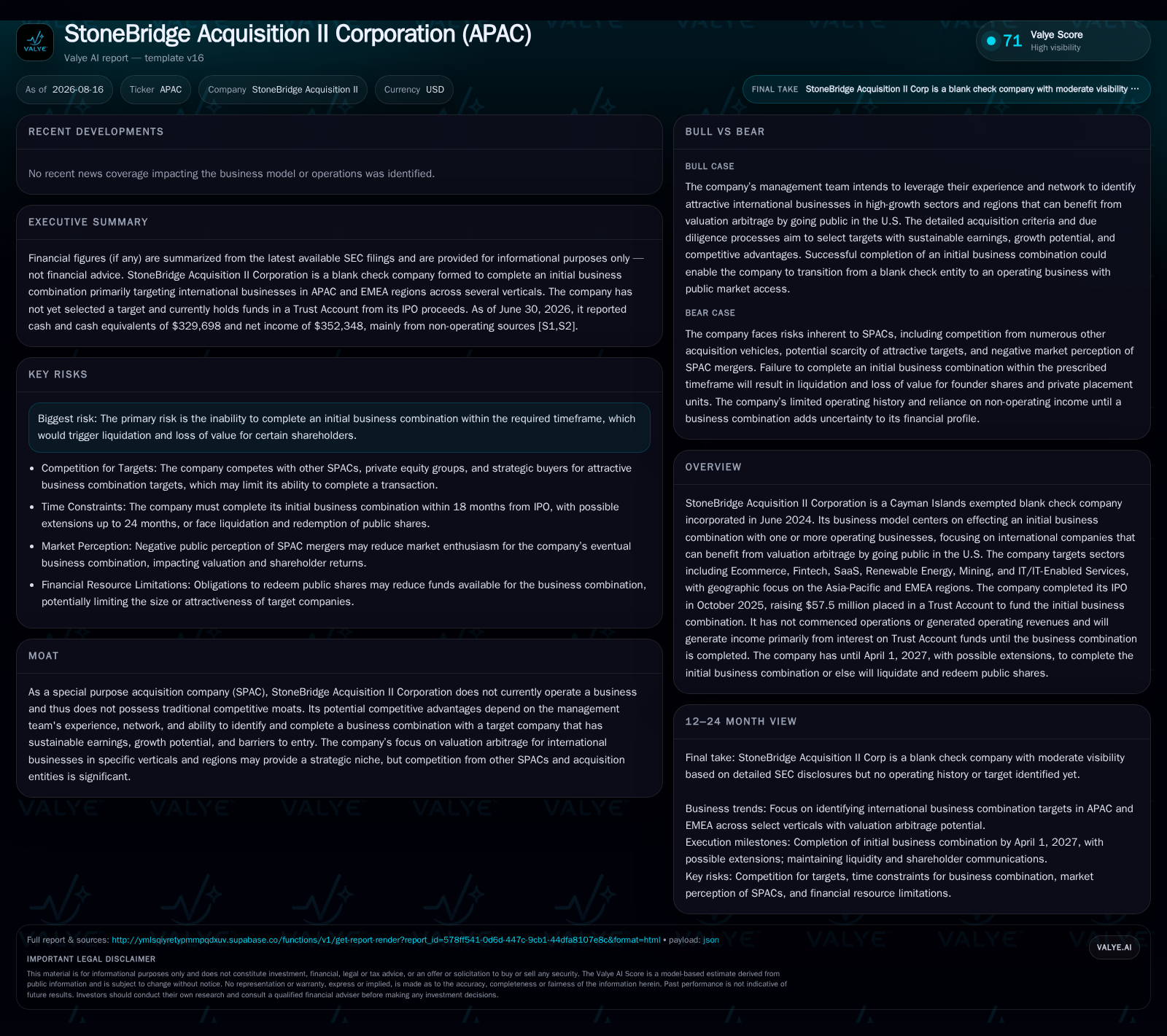
StoneBridge Acquisition II Corporation, a Cayman Islands–based special purpose acquisition company (SPAC), is progressing within its April 2027 deadline to complete a business combination. The company raised $57.5 million through its October 2025 IPO and targets acquisitions in Ecommerce, Fintech, SaaS, Renewable Energy, Mining, or IT services sectors focused on the Asia-Pacific (APAC) and Europe, Middle East & Africa (EMEA) regions. As of mid-2026, no acquisition target has been announced. Its governance structure—with founder shares and sponsor voting commitments—may facilitate deal approval despite potential public shareholder dissent. The SPAC's liquidity remains sufficient for ongoing operations during the search phase [S1][S2][S3][F1].
Recent Operating Update: Maintaining Search Momentum Amid No Target Announcement
In its latest quarterly filing for the period ending June 30, 2026, StoneBridge Acquisition II Corp reported no material changes in risk factors and reaffirmed its April 1, 2027 deadline to complete an initial business combination [S2][S1]. The absence of an announced target remains typical for SPACs early in their lifecycle but highlights the critical importance of timely deal sourcing.
Financially, the company holds approximately $330K in cash and equivalents as of March 31, 2026, with current assets substantially exceeding current liabilities—resulting in a strong current ratio near 4.88 at quarter-end June 30 [F1]. This liquidity supports operational expenses during the due diligence and negotiation phases without reliance on operating revenues.
A recent Form 8-K filing detailed structural aspects including separate trading of units composed of Class A ordinary shares paired with rights exercisable upon consummation of the business combination [S3]. These features underscore typical SPAC mechanisms designed to balance investor interests pre- and post-deal.
Business Model: Enabling International Valuation Arbitrage Through De-SPAC Transactions
StoneBridge Acquisition II functions as a blank check company incorporated in the Cayman Islands specifically to raise capital via an IPO ($57.5 million gross proceeds in October 2025) that it holds in a trust account earning interest until used for an acquisition [S1]. Its core objective is identifying an operating company—primarily international—that benefits from valuation arbitrage by listing publicly on U.S. national exchanges through a de-SPAC process.
The targeted sectors—Ecommerce, Fintech, SaaS, Renewable Energy, Mining, and IT/IT-Enabled Services—reflect high-growth industries where private valuations in APAC and EMEA may lag those achievable on U.S. markets [S1]. Post-business combination revenue generation shifts exclusively to the acquired entity’s core operations rather than sponsor income from trust interest.
This model hinges on successful identification of businesses with sustainable earnings growth potential that can attract positive public market reception post-merger [S1]. Until then, StoneBridge’s revenue consists solely of interest income from its trust account funds while it incurs administrative costs related to search activities.
Industry Context and Competitive Positioning
Operating amid a crowded SPAC environment competing against other blank check companies targeting similar sectors or geographies requires leveraging management’s expertise and networks effectively. StoneBridge’s moderate IPO size positions it toward mid-market acquisitions but limits capability for larger deals compared with peers raising hundreds of millions.
Its governance structure features founder shares and sponsor stakes representing roughly one-quarter ownership with commitments by insiders to vote favorably on initial business combinations [S1]. This concentration can facilitate deal approval but also introduces governance complexities around minority shareholder dissent and redemption risk.
Redemption rights exercised by public shareholders reduce available deal capital and create execution risk—a common challenge across SPACs that affects valuation arbitrage opportunities negatively if pervasive [S10]. The firm must therefore balance attractive deal terms against shareholder appetite for participation versus redemption.
Growth Drivers: Sector Tailwinds and Geographic Focus
Demand drivers include rising interest from international technology-enabled companies seeking efficient U.S. public market access outside traditional IPO channels. The focus on APAC and EMEA aligns with macroeconomic trends where digital transformation accelerates Ecommerce adoption; Fintech innovation expands financial inclusion; SaaS platforms benefit from recurring revenues; Renewable Energy meets sustainability mandates; Mining addresses resource needs; and IT services support global digitization efforts [S1].
Management’s operational experience across these regions may provide differentiated sourcing advantages amid competitive deal flow.
Additional growth enablers include potential use of forward purchase agreements or PIPE financing structures post-announcement to augment available capital beyond trust funds—mitigating dilution effects from redemptions and enhancing transaction viability [S18].
Risks and Watchpoints
The primary risk remains failure to consummate a business combination before April 1, 2027—the deadline after which liquidation is mandatory—resulting in return of trust funds less expenses and complete loss of sponsor equity value [S1]
Other risks include difficulties finding targets meeting strategic criteria such as sustainable earnings growth or high barriers to entry within volatile sectors like mining or early-stage renewable energy [S1]. Shareholder votes may not favor transactions despite sponsor voting commitments if perceived terms are unattractive.
Regulatory developments affecting SPAC structures or increased investor protections could constrain operational flexibility going forward. Post-merger integration challenges also pose execution risks reducing expected valuation arbitrage benefits.
What To Watch Next
Investors should monitor announcements regarding potential target identification or term sheets providing insight into deal economics aligned with sponsor-public shareholder interests [S3]. Key indicators will include:
- Timing updates relative to the April 2027 deadline,
- Redemption rates following any deal announcements,
- Shareholder vote outcomes determining transaction feasibility,
- Market reception reflected in share price behavior post-deal,
- Use of PIPE financing or forward purchase agreements enhancing capital deployment.
These factors will signal whether StoneBridge Acquisition II can successfully leverage its sector/geography focus combined with management expertise to close a value-accretive business combination.
This analysis synthesizes publicly filed disclosures to assess StoneBridge Acquisition II's positioning as a SPAC advancing toward a de-SPAC transaction emphasizing international tech-driven sectors within APAC/EMEA. It highlights key operational metrics supporting ongoing search activities while underscoring typical timing risks inherent in blank check companies.
Disclaimer: This report does not constitute investment advice but provides an analytical perspective based solely on publicly available information.
Disclaimer: This is research-only, informational analysis and not investment advice. It may include AI-generated interpretation and general industry context. Always verify important details using primary sources.

Comments