
OneMedNet Strengthens Healthcare Data Platform Amid Persistent Liquidity Challenges
OneMedNet’s latest quarter reveals ongoing cash constraints while highlighting its growing healthcare data partnerships and compliance efforts as key strategic pillars.
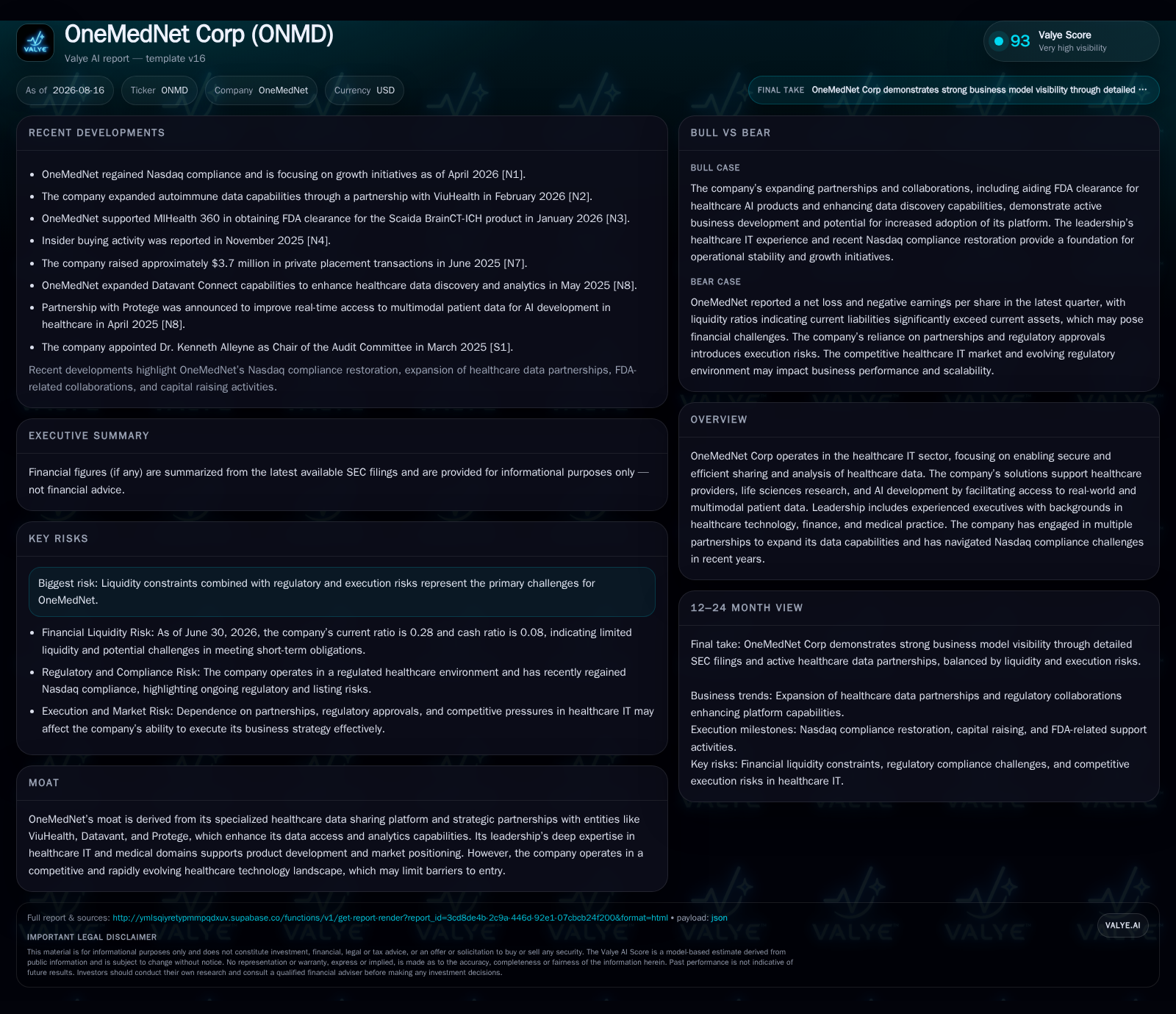
In the 2026 second quarter, OneMedNet Corp continued to expand its healthcare data platform capabilities through partnerships with industry players such as Datavant and ViuHealth, enhancing its access to real-world and multimodal patient data. However, liquidity remains a significant challenge, with a low current ratio pointing to working capital stress that could limit operational flexibility. The company’s business model, based on subscription licensing and advanced data aggregation services for healthcare providers and life sciences firms, benefits from strategic alliances but faces competitive pressure and integration complexity common in healthcare IT. Regulatory compliance and data privacy adherence represent both a cost center and a critical factor sustaining customer trust. Key monitoring points include contract renewals, onboarding of new data sources, and progress against Nasdaq listing requirements.
Latest Quarterly Operating Landscape: Liquidity Pressure during Platform Growth Efforts
The company's balance sheet shows cash and equivalents of only $358,000 against current liabilities totaling approximately $4.73 million, resulting in a critically low current ratio near 0.28 [F1]. This substantial working capital gap constrains financial flexibility in managing day-to-day operations and scaling platform adoption efforts. Total debt remains relatively low at $132,000; however, this negligible leverage does not offset obligations coming due shortly [F1]. These figures indicate ongoing dependence on external capital inflows to sustain operations absent immediate expansion in recurring revenues or cost reductions.
No material shift in risk disclosures accompanies these results; regulatory compliance risks including HIPAA adherence remain unchanged but central to stable revenue retention [S7]. This tight liquidity condition underscores the tradeoff between maintaining investment in platform development—critical for competitive positioning—and preserving runway during uneven revenue growth.
OneMedNet’s Healthcare Data Platform: Business Model Anchored on Partnership Expansion
The core of OneMedNet's business model is centered around providing a platform-as-a-service (PaaS) enabling secure healthcare data sharing and analytics geared towards healthcare providers, pharmaceutical companies, life sciences researchers, and AI-driven health technology developers [S1]. Recurring revenue stems primarily from subscription or licensing agreements granting access to integrated electronic health records (EHR), real-world data (RWD), and anonymized patient datasets delivered via enterprise software solutions.
The company leverages strategic partnerships with specialized data intermediaries such as Datavant—known for connecting fragmented healthcare datasets—and ViuHealth—a firm focusing on clinical insight generation through high-fidelity patient data—to broaden its platform’s interoperability footprint. These alliances reduce customers’ time-to-data-onboarding and increase the volume and variety of accessible healthcare information. Such depth directly supports more sophisticated clinical analytics applications demanded by value-based care initiatives and AI research workflows.
Customer retention hinges on high renewal rates backed by platform reliability, security assurances aligned with HIPAA standards, and continuous expansion of relevant dataset integrations. Licensing fees combined with analytic service contracts compose the bulk of revenues while marginal incremental costs are related mainly to onboarding new data sources and maintaining compliance infrastructure.
Competitive Environment: How OneMedNet Compares within Healthcare IT Data Ecosystem
Within the competitive landscape shaped by rapid digital transformation in healthcare IT, OneMedNet contends with peers spanning multiple niches including pure-play healthcare data platforms like Datavant itself, healthcare data aggregators such as Protege, and larger cloud software providers serving life sciences customers like Veeva Systems.
A key structural challenge for OneMedNet is the relatively low entry barriers typical in this sector since regulatory requirements such as HIPAA compliance are well-standardized industry-wide rather than proprietary. Thus, technological innovation speed—especially around scalable integration frameworks—and partnership ecosystems critically differentiate platforms but limit lasting moats.
Customer switching costs are moderate owing to standard contract lengths but can be elevated if deep integrations into enterprise workflows or long-term clinical trial collaborations exist. Unlike large incumbents like Cerner Corporation or Health Catalyst which command entrenched EHR client bases or extensive analytics platforms respectively, OneMedNet operates more as a nimble intermediary focused on flexible data aggregation facilitating specialized use cases.
'Connectivity Wins': The Impact of Strategic Data Partnerships on Platform Depth and Customer Stickiness
A salient feature cited across filings highlights OneMedNet's focus on expanding its network of strategic partnerships to enhance its platform’s capacity for broad-scale healthcare data interoperability. By integrating multiple external data aggregation points, the company can offer more comprehensive real-world evidence supporting drug development pipelines and AI training models.
These partnerships shorten customers' time-to-onboard new datasets—one of the arduous aspects in healthcare IT dealing with heterogeneous system formats—and improve subscription renewal rates driven by perceived expansion in dataset breadth and clinical trial relevance [S1]. Enhanced access to life sciences-specific datasets also allows OneMedNet to capture higher average contract values reflective of tailored analytics services demanded by pharmaceutical collaborators.
Such alliance-driven network effects mimic broader industry trends where connectivity amplifies product relevance amid complex regulatory landscapes that prioritize verified compliance over raw feature innovation.
'Compliance Costs vs. Competitive Edge': Regulatory Framework Influence on Execution Risk and Operating Expense
OneMedNet operates within an environment heavily regulated by federal mandates including HIPAA governing patient data privacy. The ongoing expenditure required for cybersecurity defenses, internal audits, staff training, and technology upgrades constitutes a significant cost center impacting operating margins [S7]. Nevertheless, these investments are indispensable for maintaining client trust—a prerequisite for entering long-term subscription agreements unique to sensitive healthcare information domains.
Though risk disclosures remain static without recent material changes in enforcement landscapes or litigation exposure, management communicates vigilance around balancing compliance costs against sustaining competitive positioning that hinges on robust privacy safeguards [S7]. Avoiding any breach or non-compliance directly affects renewal probabilities due to reputational damage risks.
'Scaling Barriers': Technology Integration Challenges Constrain Growth Leverage Potential
Despite enhanced partnership ecosystems mitigating some onboarding complexities, the diverse origins of health datasets pose persistent integration challenges affecting sales cycles and operational scalability.
Heterogeneous data standards among hospitals’ EHR systems coupled with evolving formats for real-world evidence require substantial engineering effort per new source onboarded. This upstream complexity inflates customer acquisition cost profiles while slowing achievement of scale-driven operating leverage typically seen when platforms hit critical mass usage thresholds.
Such technical execution risks align with common themes across mid-tier healthcare IT firms facing obstacles enlarging enterprise footprints rapidly enough to offset fixed R&D investments.
'Pipeline Ahead': What To Monitor Next in Contracts, Data Onboarding, and Revenue Momentum
Looking forward into Q3/Q4 2026 periods ahead of the scheduled September Annual Meeting noted specifically in recent proxy-related filings [S3,S22], attention will focus on commercial committee activities established since December 2024 tasked with closing high-value enterprise deals
Progress monitoring customer contract renewals—the lifeblood metric for recurring revenue growth—as well as incremental partnership announcements or expansions will serve as leading indicators for accelerating top-line momentum after past quarters marked by cautious investment amid liquidity constraints.
Further scrutiny should fall on any developments regarding Nasdaq listing compliance especially concerning bid price rules that have pressured issuer outlook previously although no immediate delisting threats were disclosed lately [S9].
Financial Profile Discussion: Navigating Negative Operating Income With Tight Working Capital
Financially, OneMedNet reflects typical early-stage challenges prevalent among emerging growth firms within healthcare IT focused on robust platform development ahead of scalable monetization. As of June 30, 2026 balance sheet snapshots confirm cash reserves at $358K versus more than $4.7M in current liabilities producing suboptimal liquidity ratios (~0.28) incompatible with self-sustaining operations absent additional funding rounds or strong revenue catch-up [F1]
Operating losses persist significantly ($9.67 million operating loss reported through 2025 year-end) underscoring heavy R&D investments versus nascent sales volume [F1]. Total debt is minimal relative to liabilities at roughly $132K indicating limited leverage but no immediate relief from working capital pressures [F1].
Importantly, recent entry into a standby equity purchase agreement enables tapping up to $25 million from Yorkville subject to registration statement conditions offering essential capital relief options albeit dilutive over time [S13,S17]. Continued focus on managing burn rate alongside expanding subscription base is vital.
This analysis synthesizes filings through August 14, 2026 alongside industry context exclusive of speculative forecasts. It highlights how OneMedNet balances innovative partnership-driven platform expansion within stringent liquidity confines typical for emerging players in regulatory-intensive healthcare information technology markets.
Disclaimer: This is research-only, informational analysis and not investment advice. It may include AI-generated interpretation and general industry context. Always verify important details using primary sources.

Comments