
Plus Therapeutics Balances Nanomedicine Innovation with Capital and Regulatory Challenges
Plus Therapeutics advances proprietary cancer-targeting radiotherapeutics amid ongoing funding needs and regulatory complexities.
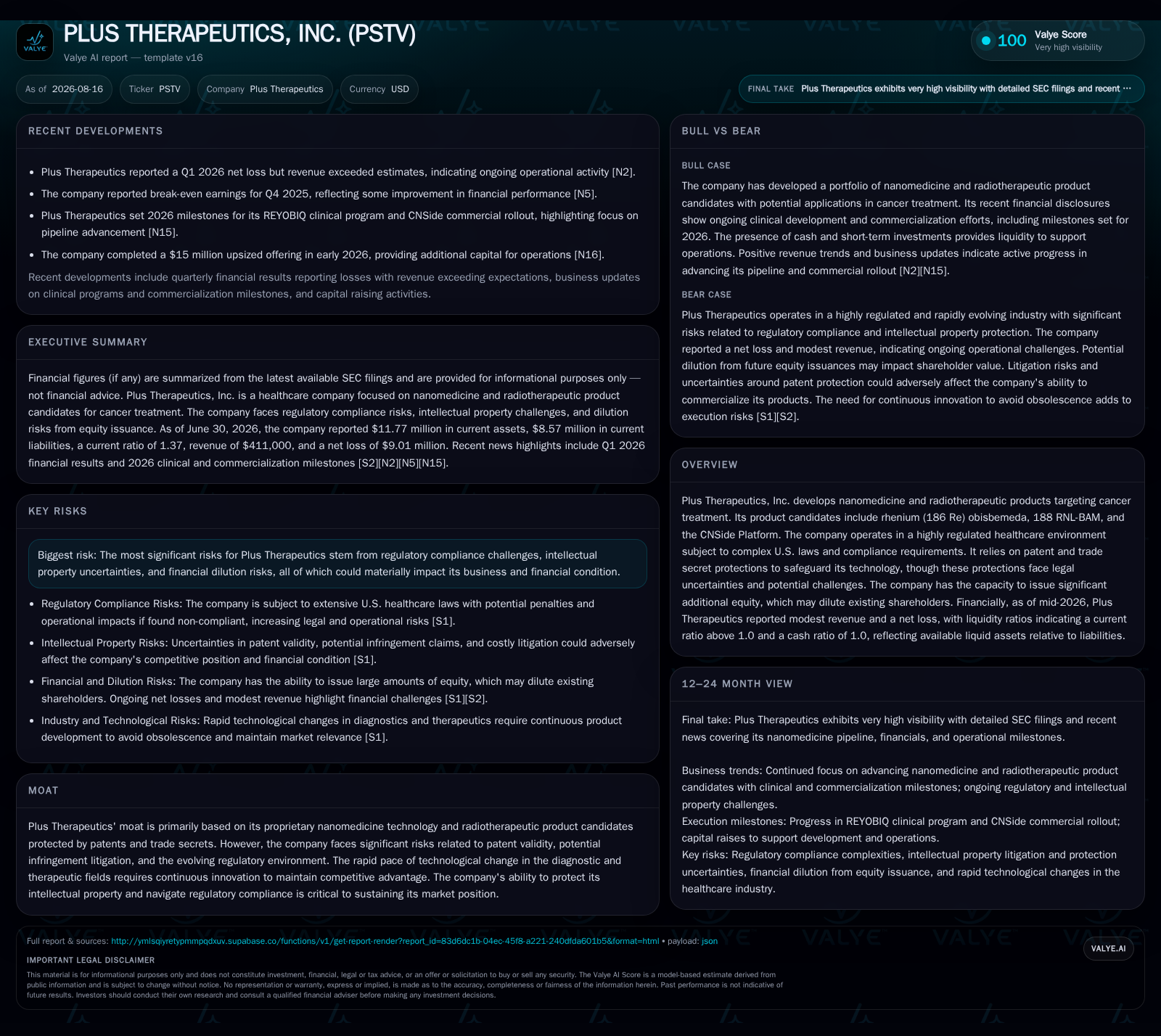
Plus Therapeutics operates in the highly specialized biotech sector focused on nanomedicine and radiotherapeutic cancer treatments, with a portfolio including rhenium-based compounds and a CNSide diagnostic platform. The latest quarterly filing highlights ongoing intellectual property management, regulatory compliance efforts, and capital raises via equity instrument issuances to fund development activities. Despite modest near-term revenue, the company faces substantial net losses, significant debt relative to cash reserves, and risks tied to patent challenges and payer reimbursement. Success depends on advancing clinical trials, securing approvals, expanding payer coverage, and careful capital management to sustain operations.
Recent Operating Update
Complementing the quarterly disclosure is an August 14 event filing ([S3]) reiterating management’s focus on navigating regulatory pathways, advancing clinical programs (notably the rhenium (186 Re) obisbemeda candidate), and commercialization efforts surrounding the CNSide Platform targeting cerebrospinal fluid tumor cell enumeration. These operate within the rigorous framework of FDA oversight and payer reimbursement dynamics.
Business Model
Plus Therapeutics operates predominantly as a developmental-stage biotechnology firm specializing in nanomedicine-driven radiotherapeutics directed at oncology indications. Key product candidates include rhenium (186 Re) obisbemeda—designed for targeted tumor radiotherapy—and related isotopic agents leveraging novel delivery technologies for precise cancer cell eradication ([S1]). Revenue generation mechanisms remain nascent: early-stage revenues arise mainly from milestone payments, limited diagnostic test sales (CNSide), licensing fees where applicable, and grant income.
The CNSide Test exemplifies a translational product seeking payer coverage post-FDA clearance attempts by serving as an adjunct diagnostic assay providing molecular tumor cell enumeration in cerebrospinal fluid—an innovation poised at the intersection of diagnostics and personalized oncology treatment planning ([S1], [S2]).
Monetization hinges critically on regulatory approvals enabling clinical adoption and facilitations of favorable reimbursement pathways through payors such as Medicare and private insurers. Licensing strategies also form part of revenue diversification aims but are presently constrained by pipeline maturity.
Operating margins are currently negative owing to elevated R&D outlays required for trial progression across multiple oncology indications plus the overheads typical in biotech discovery-to-market cycles. Given the absence of broad commercial product sales thus far, expense capitalization is modest while operating losses accumulate.
Industry Structure and Competitive Position
The biotechnology sub-sector focused on nanomedicine-enabled radiopharmaceuticals is marked by long development timelines exceeding five years and requires navigation through demanding FDA regulatory processes for both therapeutic agents and associated diagnostics. Peer groups span firms like Moderna and BioNTech commanding proprietary nanomedicine platforms albeit mostly mRNA vaccines rather than radiotherapeutics; meanwhile Novartis brings scale in radiotherapeutic portfolios but operates larger commercial platforms. Blue Earth Diagnostics offers a peer reference point within radiopharmaceutical diagnostics repertoire but with differing target indications.
Plus Therapeutics positions itself as a specialist innovator with proprietary isotopic formulations intended to address unmet oncology needs—particularly tumors with difficult-to-treat CNS involvement. However, it lacks commercial scale or extensive partner licensing deals akin to larger peers.
The competitive moat relies heavily on intellectual property enveloping patents granted or pending around formulation chemistry, delivery methods, and diagnostic techniques. Legal challenges can erode exclusivity; hence robust defense capabilities against infringement or invalidation are critical ([S1]). Further complicating market entry are payer reimbursement uncertainties common across novel oncologic diagnostics that can delay adoption despite regulatory clearances.
Growth Drivers
Key drivers of Plus Therapeutics’ growth prospects lie in several interconnected vectors:
- Clinical Pipeline Advancement: Progression through clinical trial phases directly influences valuation inflections. Successful Phase II/III results or regulatory submission milestones enhance prospects for approval-led revenue ramp ([S1], [S2]).
- Regulatory Approvals: Accelerated FDA clearances facilitate product commercialization both therapeutically (rhenium compounds) and diagnostically (CNSide).
- Payer Coverage Expansion: Achieving positive reimbursement decisions from Medicare/Medicaid alongside private insurers reduces deployment hurdles for CNSide tests; securing codes and coverage enables billing consistency.
- Licensing and Partnerships: Potential collaborations with larger pharmaceutical manufacturers could provide not only capital but also manufacturing scale-up expertise essential for isotopic products reliant on sophisticated production processes.
- Technological Advances: Continuous innovation in nanomedicine platforms strengthens differentiation vs competitors offering alternative treatment modalities.
- Market Need: Growing cancer prevalence globally creates sustained demand for more effective therapeutics addressing resistant tumor types.
Risks and Watchpoints
Monitoring these factors is vital for assessing sustainability.
What To Watch Next
Investors should vigilantly track milestones signaling operational execution such as:
- Quarterly updates on cash runway measures given strained liquidity position ([F1], [S2]).
- Announcements on clinical trial enrollment progress or data readouts revealing efficacy/safety profiles critical for approval pathways.
- Regulatory submissions including Investigational New Drug (IND) filings or Premarket Approval (PMA) requests relating both to therapeutics and diagnostics.
- Updates regarding payer coverage decisions influencing rapid uptake of CNSide testing services.
- Any new partnership or licensing agreements providing non-dilutive funding or enhancing distribution capacities.
- Intellectual property litigation outcomes which could impact freedom-to-operate scenarios.
These serve as actionable checkpoints in assessing Plus Therapeutics’ trajectory towards commercial viability.
Financial Profile Discussion
Reflecting its developmental stage status coupled with ongoing investment-intensive clinical programs, Plus Therapeutics reported modest trailing revenues circa $5.2 million USD as of end-2025 but incurred substantial net losses exceeding $22 million USD for that period ([F1]). The negative operating income underscores high fixed costs absorbed by relatively early-stage product commercialization efforts.
On the liquidity front as of Q2 2026, the company reports approximately $2.37 million USD in cash and equivalents against current liabilities approximating $8.57 million USD, yielding a current ratio around 1.37—indicative of tight working capital conditions but above critical distress levels ([F1]). Total debt figures from the latest available data remain unclear post recent equity issuances, though prior convertible notes contributed to elevated obligations ([F1], [S2]). Equity issuance tied to debt exchanges during H1 2026 contributed recently to balance sheet adjustment but also implied shareholder dilution potential ([S2]).
The cash burn rate aligned with R&D intensity implies continued external financing dependence unless rapid commercialization gains emerge compellingly. Capital allocation balances advancement in clinical development versus conservative cost controls amidst uncertain near-term commercial revenue growth.
This analysis synthesizes publicly available SEC disclosures detailing Plus Therapeutics’ strategic positioning within the biotechnology segment focusing on cancer-targeting nanomedicine radiotherapeutics alongside evolving diagnostics commercialization trails. It integrates financial metrics underscoring ongoing funding requirements typical within this high-risk drug development arena while emphasizing intellectual property management imperatives amid challenging regulatory landscapes. Continued close monitoring of upcoming operational disclosures is warranted given the company’s sensitive liquidity state coupled with significant growth inflection dependency on clinical success and payer acceptance.
Disclaimer: This is research-only, informational analysis and not investment advice. It may include AI-generated interpretation and general industry context. Always verify important details using primary sources.

Comments