
Cenntro Inc. Advances Distributed Manufacturing and Hybrid Sales Amid Ongoing Profitability Challenges
Recent quarterly disclosures highlight Cenntro’s operational shifts toward localized assembly and hybrid distribution, while financial losses persist.
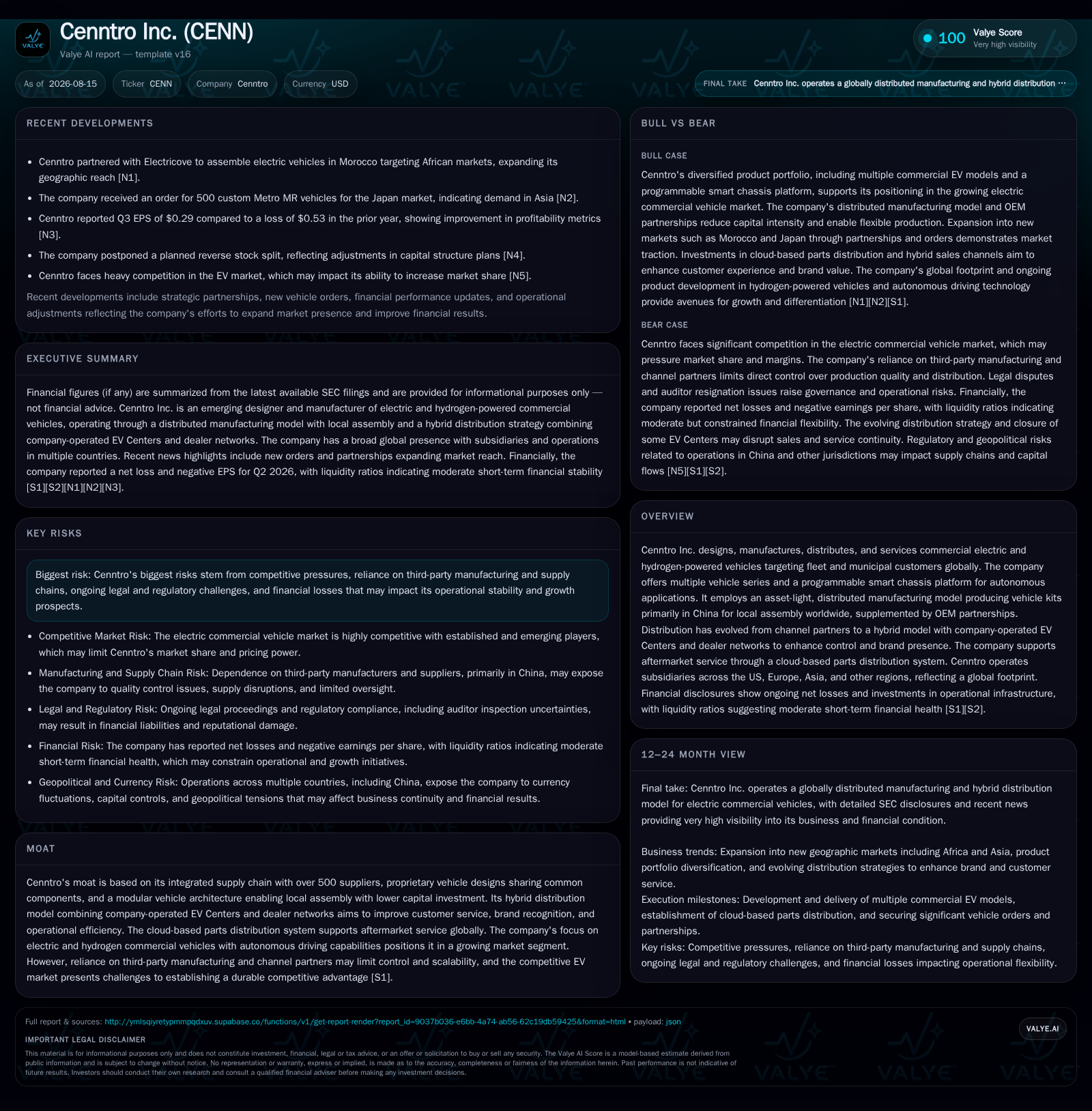
Cenntro Inc. operates in the commercial electric and hydrogen vehicle sector, focusing on designing and delivering zero-emission vehicles for fleet and municipal customers globally. Its asset-light manufacturing strategy leverages China-based component production with local assembly facilities to optimize cost and responsiveness. The company is transitioning from channel partners to a hybrid sales model combining company-operated EV Centers and dealer networks to strengthen brand control and aftersales service. Despite technological advancements including programmable smart chassis for autonomous applications, Cenntro continues to report operating losses amid investments in R&D, supply chain expansion, and network development. Key risks include scaling manufacturing capacity, supply chain reliability, competitive pressure, and regulatory complexities. Monitoring vehicle delivery volumes, local assembly utilization, dealer productivity, and progress on profitability milestones will be critical to assessing execution.
Recent Operating Update
Cenntro's latest quarterly filing dated August 14, 2026 (Form 10-Q) reconfirms ongoing investments in scaling production capabilities, technology development, and sales network evolution within the commercial electric vehicle sector [S2]. While operating losses continue as the company builds out infrastructure and expands operations, these expenditures reflect strategic priorities aimed at long-term market positioning rather than short-term profitability.
A July 2026 event filing notes corporate governance updates without material shifts to business strategy or operations [S3]. The April 2026 annual report provides comprehensive context on Cenntro’s product portfolio—including six series of commercial vehicles such as Metro®, Logistar™, Teemak™, Avantier™, Bison Motor™, and Antric One—and highlights its proprietary programmable smart chassis technology that supports autonomous driving integration [S1].
Business Model
Cenntro’s revenue derives mainly from sales of electric and hydrogen-powered commercial vehicles designed for fleet operators and municipal clients worldwide [S1]. The company employs a distributed manufacturing model that combines centralized component production—primarily in China sourced through an integrated supply chain of over 500 vetted suppliers—with localized final assembly near end markets. This approach balances capital efficiency with responsiveness to regional demand while maintaining quality control via standardized modular vehicle architectures [S18].
The transition from reliance on private-label channel partners toward a hybrid sales model combining company-operated EV Centers alongside dealer networks aims to enhance brand control, improve customer experience, and capture greater aftermarket service revenues [S24]. This shift reflects recognition that direct retail presence strengthens brand identity critical for fleet contract negotiations.
Complementing vehicle sales is an aftermarket parts distribution system managed through a cloud-based platform (PARDISYS), which integrates inventory management across centralized warehouses in China with regional distribution centers in Spain and New Jersey [S24]. This system enables dynamic replenishment aligned with geographic demand patterns supporting recurring revenue streams from parts and services
Industry Positioning & Competitive Landscape
The commercial electric vehicle industry is characterized by rapid technological change driven by regulatory mandates favoring zero-emission fleets alongside declining battery costs improving total cost of ownership. Cenntro competes alongside pure-play commercial EV manufacturers like Workhorse Group and Nikola Corporation as well as established OEMs such as Daimler Truck expanding their electric offerings.
Cenntro differentiates itself through its programmable smart chassis platform enabling autonomous driving applications—a growing segment aligned with logistics automation trends—while leveraging an asset-light manufacturing model that reduces capital intensity but increases dependence on third-party suppliers vulnerable to global supply chain disruptions [S1][S18].
The evolving hybrid sales channel strategy also reflects a trade-off between increased operational complexity of running proprietary EV Centers versus benefits of enhanced brand equity compared to prior private-label partner models.
Growth Drivers
Structural tailwinds include accelerating regulatory mandates for fleet electrification across North America and Europe particularly targeting municipal customers seeking emissions compliance.
Battery pack cost declines forecasted by Bloomberg NEF support improved economics for electric trucks versus internal combustion alternatives; Cenntro’s vertical integration efforts into battery packing could enhance margin leverage if scaled successfully [S1]
Autonomous driving technology embedded in the smart chassis expands addressable markets through partnerships with logistics providers pursuing automation efficiencies.
Expansion of charging infrastructure—including level 2 AC up to 22kW, level 3 DC fast charging—and hydrogen refueling coupled with mobile energy storage solutions enhances operational flexibility facilitating broader fleet adoption [S19].
Aftermarket parts distribution offers a recurring revenue base supporting customer retention over vehicle lifecycles.
Risks & Watchpoints
Key execution risks involve scaling manufacturing capacity while ensuring product quality amid limited high-volume manufacturing experience since pilot production began in 2018 [S1]. Heavy reliance on Chinese suppliers exposes the company to geopolitical tensions or logistical disruptions.
The hybrid distribution network requires balancing costs of operating EV Centers against dealer efficiencies; missteps could impair margins or customer acquisition effectiveness.
Competitive pressures from established OEMs leveraging scale advantages alongside emerging niche players challenge Cenntro’s market penetration.
Financial sustainability remains uncertain given ongoing operating losses reported at approximately $59 million for the year ended December 31, 2025 driven by upfront investments [F1][S1]. Legal proceedings concerning stock option disputes represent contingent risks though not currently material [S21]. Regulatory compliance complexity across multiple jurisdictions adds operational challenges.
Market adoption depends on infrastructure readiness, total cost-of-ownership competitiveness versus ICE vehicles or other ECVs, as well as macroeconomic factors influencing fleet capital spending.
What to Watch Next
Monitoring key performance indicators will be critical:
- Vehicle production volume growth reflecting successful scale-up of local assembly plants.
- Increasing vehicle delivery volumes via company-operated EV Centers indicating effective channel transition.
- Dealer network expansion metrics along with productivity rates signaling geographic penetration.
- Trends in average selling price per vehicle relative to battery pack cost per kWh illustrating margin improvement potential.
- Aftermarket service revenue growth supported by PARDISYS signaling building recurring income streams.
- Progress toward narrowing operating losses or achieving breakeven underpinning financial sustainability.
- Resolution of legal contingencies reducing risk exposure. Management commentary during upcoming earnings releases will provide insight into execution progress amid sector headwinds.
Financial Profile Discussion
As of June 30, 2026, Cenntro holds $4.3 million in cash against $3.5 million in total debt yielding a modest net cash position on the balance sheet [F1]. Current assets of approximately $41.6 million exceed current liabilities near $25.2 million resulting in a current ratio around 1.65 which suggests reasonable short-term liquidity buffers [F1].
Despite this liquidity cushion, the company continues reporting significant operating losses reflecting substantial investments in research & development (approximately $95 million cumulative through end-2025), manufacturing capacity expansion, supply chain integration, and sales infrastructure transitions consistent with early-stage commercial EV manufacturers’ profiles [S1][F1]
Capital allocation discipline balancing growth initiatives against timelines for path-to-profitability will be essential given industry-wide pressures such as raw material cost inflation impacting battery expenses unpredictably.
This analysis is based on publicly available SEC filings as of August 2026 provided by Cenntro Inc., industry knowledge frameworks for commercial electric vehicle manufacturing sectors, and does not constitute investment advice.
Disclaimer: This is research-only, informational analysis and not investment advice. It may include AI-generated interpretation and general industry context. Always verify important details using primary sources.

Comments