
GP-Act III Acquisition Corp. Faces Critical Business Combination Deadline Amid Liquidity Constraints
Approaching its November 2026 deadline to complete a business combination, GP-Act III Acquisition Corp. confronts significant execution risks heightened by diminished cash reserves and substantial shareholder redemptions.
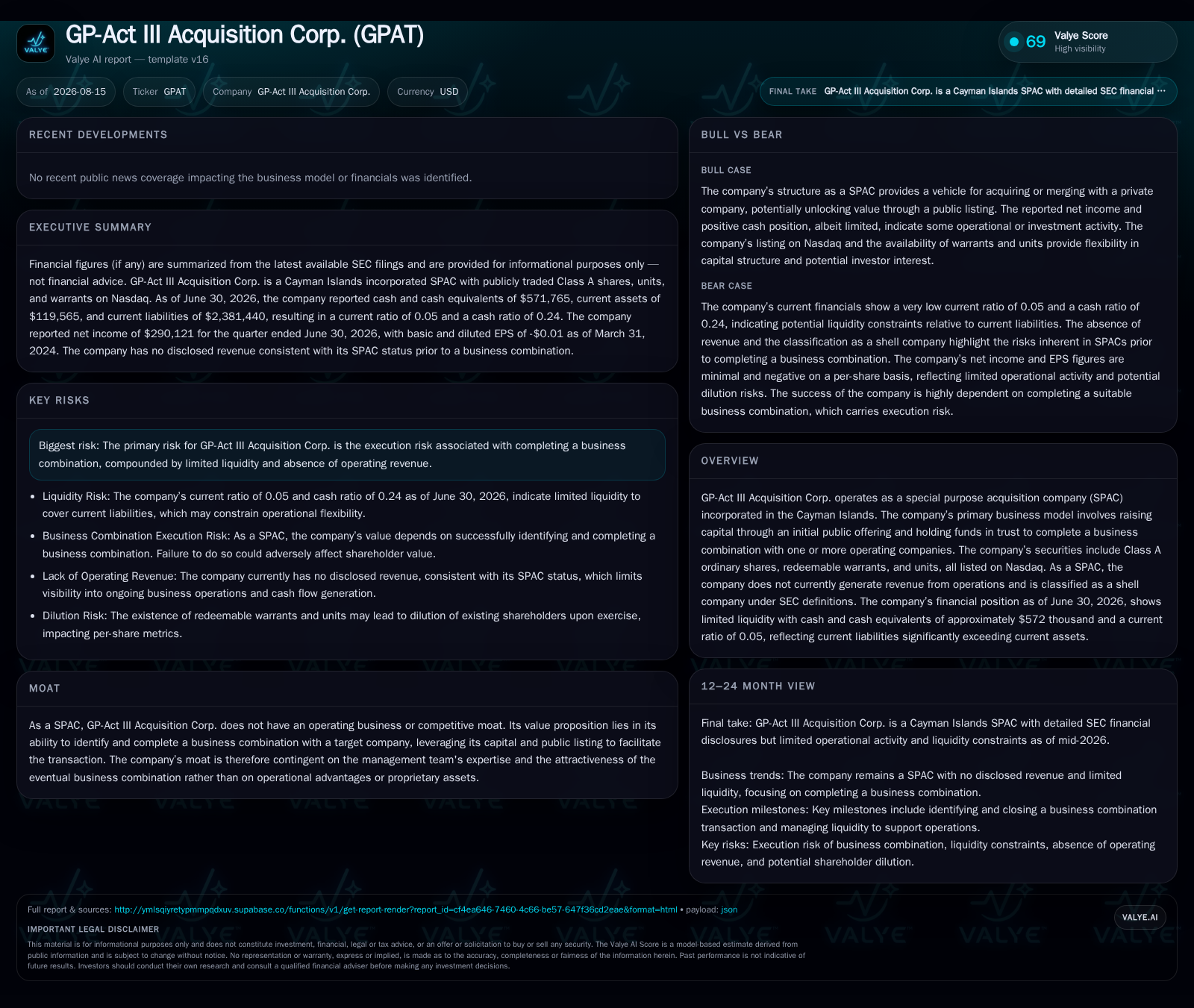
GP-Act III Acquisition Corp., a Special Purpose Acquisition Company (SPAC), remains focused on completing a merger or acquisition by November 13, 2026. The latest quarterly filing reveals severe liquidity pressures, with unrestricted cash of approximately $10,600 and a current ratio of 0.05, reflecting current liabilities vastly exceeding current assets. Following nearly $215 million in shareholder redemptions earlier this year, the trust account balance has fallen below $100 million, limiting capital available for deal funding. The company's value hinges on the sponsor team's expertise and ability to secure a suitable target amid geopolitical and market volatility. Investors should closely monitor progress toward transaction completion, redemption trends, and trust account liquidity as the deadline approaches.
Recent Operating Update: Liquidity Pressures Intensify Ahead of Business Combination Deadline
GP-Act III Acquisition Corp.'s latest quarterly report filed August 14, 2026 [S2] highlights acute liquidity constraints as it approaches the extended November 13 deadline to consummate its initial business combination. The company's unrestricted cash balance stands at approximately $10,600 [S2], far below typical operating requirements for public entities managing compliance and transactional activities. Meanwhile, current liabilities exceed $2.3 million while current assets are just under $120,000 [F1], resulting in an extremely low current ratio of 0.05 — an indicator of significant working capital deficiency that could impede operational flexibility.
This financial pressure is compounded by substantial shareholder redemptions executed during an extraordinary general meeting on May 12, 2026 [S13]. Approximately 19.8 million Class A ordinary shares were redeemed at about $10.89 per share for aggregate redemptions near $215 million [S13], reducing the Trust Account balance from its original IPO proceeds of $287.5 million to roughly $97.8 million available for acquisition funding post-redemption [S13]. Such large-scale redemptions reflect investor wariness and materially constrain deployable capital.
While Sponsor HoldCo has committed to indemnify the Trust Account against claims that could erode liquidation proceeds below contractually stipulated levels [S22], these protections exclude certain third-party claims or unenforceable waivers — leaving residual execution risk.
Geopolitical instability cited in filings — including ongoing conflicts involving Russia-Ukraine and Middle East tensions — adds uncertainty that may affect market conditions relevant to target valuations and PIPE financing appetite [S2].
Business Model: A Blank Check Vehicle Centered on Deal Execution
GP-Act III Acquisition Corp. is structured as a Cayman Islands exempted company operating as a blank check entity with no operating revenues prior to completing its business combination [S1]. Its business model revolves around raising capital through an IPO — selling units composed of Class A ordinary shares paired with redeemable warrants exercisable at fixed prices — then holding these funds in a Trust Account until identifying one or more private companies for merger or acquisition.
Revenue generation is non-operational pre-merger and primarily consists of interest income earned on Trust Account securities [S1]. Operating expenses include costs related to regulatory compliance, due diligence on prospective targets, legal fees, and underwriting expenses associated with the IPO.
A defining feature is public shareholders’ redemption rights allowing them to receive their pro rata share of Trust Account funds prior to deal consummation [S13]. This mechanism creates a dynamic tension between preserving capital for acquisitions versus potential dilution or deal size reduction driven by redemptions.
Industry Context and Competitive Positioning
Within the broader SPAC ecosystem comprising numerous publicly listed blank check companies targeting diverse sectors and deal sizes, GPAT distinguishes itself through its sponsor team’s extensive private equity and operational experience [S1]. GP Investments brings over three decades of alternative investment expertise; IDS III LLC’s leadership provides scaling capabilities; Boxcar Partners adds further management depth.
Despite this pedigree, GPAT faces challenges common among late-stage SPACs navigating investor skepticism following prior waves of SPAC volatility. Its depleted Trust Account relative to peers retaining higher balances or securing PIPE commitments heightens execution risk.
Regulatory scrutiny around SPAC disclosures and valuation methodologies continues intensifying market demands for transparency regarding acquisition criteria — while GPAT targets U.S.-based businesses valued between $1 billion and $5 billion but maintains sectoral flexibility [S1]
Growth Drivers
GPAT’s growth trajectory hinges entirely on successfully consummating its initial business combination:
- Leverage sponsor networks targeting high-potential U.S.-focused companies seeking expedited public listing alternatives relative to traditional IPO routes [S1].
- Extended deadline approval provides additional runway compared to expiration-triggered liquidations common in expiring SPAC cases [S13].
- Potential access to supplementary financing via PIPE transactions or equity issuances may augment Trust Account proceeds if transaction pricing requires expansion beyond existing funds [S1].
- Market stabilization or rebounds could improve target valuations or willingness among private companies to engage in SPAC mergers under favorable terms.
These growth avenues remain highly contingent on macroeconomic conditions and management’s ability to finalize deals within the limited timeframe.
Risks and Watchpoints
Key risks center on execution failure coupled with strained liquidity:
- Failure to complete any business combination before November 13 triggers automatic dissolution and liquidation per governing documents [S13], potentially resulting in losses for non-redeeming shareholders.
- Near depletion of unrestricted cash limits capacity to fund ongoing operational needs including legal compliance during critical transaction phases [S2].
- High shareholder redemption rates reduce net deployable capital threatening minimum financing thresholds required by target companies or contractual deal terms.
- Geopolitical conflicts contribute macroeconomic uncertainty affecting investor sentiment, valuation multiples, and PIPE investor participation.
- Sponsor indemnification commitments have enforceability boundaries exposing residual risk case from third-party claims affecting Trust Account balances [S22].
Investors should closely monitor disclosures regarding merger target announcements (if any), timing milestones toward closing transactions, evolving Trust Account balances post-redemption events, shareholder voting outcomes on extensions or restructuring proposals, warrant exercise activity, and PIPE financing developments.
Disclaimer: This is research-only, informational analysis and not investment advice. It may include AI-generated interpretation and general industry context. Always verify important details using primary sources.

Comments