
NRX Pharmaceuticals Advances Ketamine-Based CNS Therapeutics Amid FDA Milestones and Clinical Expansion
Clinical-stage biotech NRX Pharmaceuticals progresses FDA approvals for preservative-free ketamine formulations while expanding interventional psychiatry services.
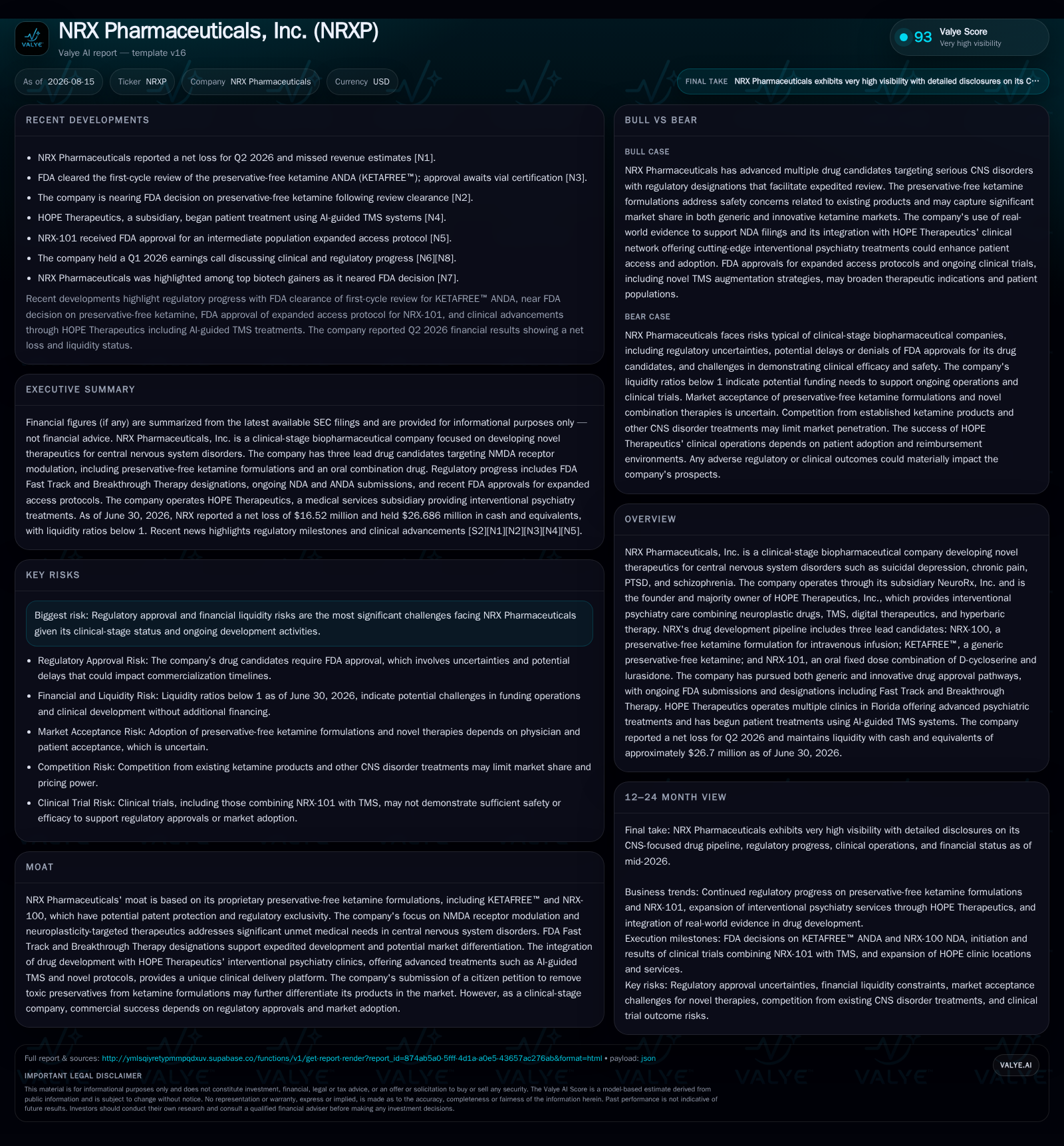
NRX Pharmaceuticals focuses on novel NMDA receptor modulating therapies targeting CNS disorders, including proprietary preservative-free ketamine products. Recent FDA interactions signal near-term regulatory milestones for its generic ANDA (KETAFREE™) with first-cycle review clearance and ongoing NDA filings for NRX-100 and NRX-101, supported by Fast Track and Breakthrough Therapy designations. The company complements drug development through HOPE Therapeutics’ interventional psychiatry clinics, combining neuroplastic drugs with TMS and digital therapeutics to broaden patient access. Financially, NRX maintains a modest cash position but operates at a net loss typical of clinical-stage biopharma, underscoring capital needs to support pivotal trials and commercial launch readiness.
Recent Operating Update: Regulatory Progress Signals Approaching Commercialization
NRX Pharmaceuticals’ most recent quarterly filing dated August 14, 2026 ([S2]) reveals that the company is advancing key regulatory dossiers for its three lead product candidates targeting CNS disorders with novel NMDA receptor modulation mechanisms.
Foremost among these is KETAFREE™, a generic preservative-free ketamine formulation submitted via an ANDA pathway. Notably, the FDA cleared the first-cycle review of this application without any drug-related major deficiencies — a significant achievement given that only approximately 14% to 18% of ANDAs pass first submission hurdles ([S3],[N3]). The sole remaining concern involves packaging vial certification. The FDA has committed to an expedited review timeline due to KETAFREE’s inclusion on the Shortage List, acknowledging the strategic importance of U.S.-based injectable ketamine supply. Management expects resolution consistent with first commercial sales anticipated in 2026 ([S3]).
Simultaneously, the NDA filing for NRX-100, a proprietary preservative-free intravenous ketamine formulation initially started in late 2024, is targeted for mid-2026 filing. The program benefits from FDA Fast Track Designation that applies broadly across depression indications including bipolar depression with suicidal ideation ([S12],[S10]). This designation not only accelerates review but also confirms recognition of unmet clinical need.
Separately, NRX-101 — an oral fixed-dose combination of D-cycloserine and lurasidone designed as a follow-up oral therapy after IV ketamine stabilization — holds Breakthrough Therapy Designation ([S10],[S24]). Phase 2/3 clinical trials are ongoing for severe bipolar depression with acute suicidal ideation or behavior (ASIB), leveraging accelerated pathways to allow NDA submission pending a successful single Phase 2I trial per an FDA Special Protocol Assessment agreement ([S1],[S9],[S21]).
Together, these regulatory steps demonstrate NRX’s dual approach combining generic pathways to rapid market entry (KETAFREE™) alongside innovative neuroplasticity-based therapies (NRX-100 and NRX-101).
Business Model: Dual Drug Development Paths Coupled With Clinical Service Platform
NRX operates primarily through its wholly owned subsidiary NeuroRx, Inc., focusing on therapeutic commercialization for CNS disorders such as suicidal depression, PTSD, chronic pain, and schizophrenia ([S10]). The core business mechanics revolve around advancing patent-protected drug candidates through clinical trials aimed at securing FDA marketing approvals.
Revenue generation remains prospective as products await approval; typical monetization will stem from product sales post-launch supplemented potentially by licensing or milestone payments if partnerships arise. The pipeline contains:
KETAFREE™, which seeks to tap into the generic injectable ketamine market valued over $750 million annually. It aims for swift adoption through indication parity with the reference listed drug (RLD) KETALAR® but differentiates via preservative-free formulation reducing toxicity concerns highlighted in a citizen petition seeking removal of benzethonium chloride preservative from all commercial forms ([S10],[S11]).
NRX-100, an innovatively formulated intravenous ketamine product optimized for stability (three-year room temperature shelf life demonstrated), potentially offering faster onset or improved safety compared to existing nasal formulations like SPRAVATO® ([S12],[S24]).
NRX-101, designed as an oral regimen sustaining neuroplastic changes initiated by ketamine infusions; it targets high-risk bipolar patients with acute suicidality—a niche with few approved options—and has demonstrated synergy when combined with advanced TMS protocols within clinical settings ([S10],[S24]).
Besides pharmaceutical development, NRX drives revenue diversification through its majority-owned medical services platform HOPE Therapeutics. HOPE operates interventional psychiatry clinics delivering integrated treatments: neuroplastic drugs (like ketamine-based products), transcranial magnetic stimulation (TMS), digital therapeutics for behavioral modification, hyperbaric oxygen therapy, and medication management. This vertically integrated model supports patient access and may improve retention while leveraging cross-product synergies ([S10],[S25]).
This blended model aligns pharmaceutical innovation with specialized clinical delivery—a growing industry trend aimed at improving both efficacy data capture and patient outcomes.
Industry Structure and Competitive Positioning
NRX belongs to the clinical-stage biopharmaceutical industry segment specializing in central nervous system therapies focusing on NMDA receptor modulation—a mechanism validated by precedents but still commercially nascent.
Peers such as Sage Therapeutics and Axsome Therapeutics similarly target neuroplasticity-driven CNS treatments but typically focus on novel chemical entities rather than generics or combination formulations.
The generic injectable ketamine space features entrenched players focused on replicating RLD bioequivalence but often employ formulations containing preservatives linked to toxicity issues. By contrast, NRX’s proprietary preservative-free technology targets differentiation backed by patent protection and regulatory exclusivity periods—strengthening barriers to entry ([S20],[S24]).
The layered FDA designations—Fast Track for NRX-100 and Breakthrough Therapy for NRX-101—underscore regulatory confidence in the programs’ addressing unmet medical needs which can shorten time-to-market compared to traditional pathways.
However, competition remains intense across CNS treatments: branded antidepressants from large pharma companies like Johnson & Johnson or Pfizer continue dominating market share; emerging modalities like rapid-acting intranasal S-ketamine also pressure pricing dynamics. Additionally, challenges exist around achieving scale manufacturing compliance for controlled substances requisite for sustained commercialization success ([S5],[S17]).
Growth Drivers: Regulatory Milestones and Clinic Expansion Momentum
Key near-term growth catalysts include obtaining final FDA approval for KETAFREE™, which would enable entry into a fragmented yet sizeable generic injectable market facing supply shortages due to constrained U.S.-based manufacturing availability ([N2],[N3]).
Simultaneously progressing NDA submissions for NRX-100 and NRX-101 aligned with Fast Track designations increase prospects for expedited label expansion into broader depression indications including suicide risk populations—a segment representing millions nationally with high unmet medical needs ([S12],[S21]).
On the clinic services front, HOPE Therapeutics has transitioned from start-up mode to revenue generation in late 2025 through acquisitions (e.g., Dura Medical) and organic openings of multi-site Florida operations expanding into strategic markets such as Boston and Denver ([S10],[S25]). Partnerships with makers of advanced TMS devices (neurocare AG) enhance their service ecosystem enabling combined pharmacologic-neuromodulatory interventions which preliminary data suggest could double antidepressant response rates vs. TMS alone ([S24],[S25]).
Moreover, planned government-supported military studies evaluate further integration of NRX-101 with TMS robotics showing potential new commercial indications beyond traditional psychiatric care settings ([S10]). These initiatives position the company ahead in adopting precision neuromodulation coupled with neuroplastic agents.
Successful trial outcomes leading to accelerated approvals could unlock premium pricing opportunities enhanced by differentiated safety profiles relative to existing options.
Risks and Constraints: Regulatory Uncertainties and Capital Intensity Remain Central Challenges
As a clinical-stage biopharma firm with no approved products yet generating meaningful revenue, NRX faces inherent regulatory risk—including potential delays or non-approval linked to manufacturing site audits or labeling negotiations essential before commercial launch ([S5],[S17]). The identified packaging deficiency delaying KETAFREE™ approval exemplifies how even minor issues can stall commercialization despite favorable initial reviews ([N3],[S3]).
Manufacturing scale-up risks weigh heavily since clinical-grade controlled substance production must meet cGMP standards approved by the FDA; failure here can cause costly delays or require switching suppliers ([S9],[S17]).
Financially, NRX holds approximately $26.7 million in cash and equivalents as of June 30, 2026, with current assets of about $29.2 million against current liabilities near $33.9 million, resulting in a current ratio of approximately 0.86 — indicating some short-term liquidity pressure common among pre-revenue biotech companies requiring periodic financing rounds to fund R&D operations ([F1]). Total debt was last reported at approximately $11.0 million as of December 31, 2023, with net debt effectively negative at that time due to liquid asset buffers exceeding gross borrowings ([F1]).
The company continues to incur substantial operating losses typical of early-stage pharma innovation; the latest annual data show operating losses of around $16 million and net losses exceeding $28 million, underscoring ongoing dependence on external financing or milestone payments to sustain operations long-term ([F1]).
The company also faces competitive pressures from larger incumbents possessing wider portfolios and deeper capital pools capable of investing aggressively in R&D or marketing ([S20]). Success hinges not only on receiving FDA approval but also ensuring effective physician adoption amidst evolving payer landscapes valuing cost-effectiveness ([S8]). Lastly, extensive regulatory compliance demands due to controlled substance status impose ongoing monitoring costs ([S17]).
What To Watch Next: Key Regulatory Decisions And Clinical Trial Outcomes In H2 2026 And Beyond
Investors should focus on:
- FDA’s resumption timing of ANDA review following packaging issue resolution impacting KETAFREE™ approval likelihood before year-end 2026 ([N3],[S3]);
- NDA submission status updates concerning NRX-100 planned for Q2/Q3 2026 ([S2], [S12]) including receipt confirmation of fee waivers or additional feedback;
- Progress signals from Phase 2/3 trials testing NRX-101 efficacy/safety especially regarding bipolar depression patients exhibiting ASIB per SPA guidelines ([S9], [S21]);
- Operational ramp of HOPE’s clinic footprint expansion outside Florida into Boston, Denver & scaling neuromodulation partnerships ([S25]);
- Any disclosures regarding manufacturing scale-up progress or supply chain robustness supporting commercial launch requirements;
- Potential receipt of PDUFA dates post expedited reviews that would confirm timing for market access;
- Capital raising developments critical given ongoing cash burn implied by latest financials (([F1])).
Monitoring these milestones offers concrete markers validating underlying clinical hypotheses while indicating readiness to transition from development-dependent biotech toward commercial entity capable of generating sustainable revenues.
Financial Profile Discussion
At quarter-end June 30, 2026, NRXP reported cash and cash equivalents totaling approximately $26.7 million alongside current assets just above $29 million against current liabilities approaching $33.9 million, resulting in a current ratio of about 0.86 — signaling moderate liquidity pressure common among pre-revenue biotech companies requiring periodic financing rounds to fund R&D operations ([F1]). Total debt outstanding was last reported at approximately $11 million as of December 31, 2023, without more recent disclosures posing uncertainty around leverage evolution; however, net debt effectively remains negative given liquid asset buffers exceeding gross borrowings up till that point ([F1]).
Operating results continue reflecting substantial R&D investments characteristic of early-stage pharma innovation cycles; operating losses through fiscal year-end December 31st reached over $16 million accompanied by net losses exceeding $28 million emphasizing capital-intensive nature prior to commercial inflows ([F1]). These financial metrics reinforce ongoing dependency on equity raises or strategic partnerships needed both to complete pivotal trials—particularly large Phase 2/3 studies required for NDA submissions—and scale-up manufacturing processes essential before product launches.
Disclaimer: This is research-only, informational analysis and not investment advice. It may include AI-generated interpretation and general industry context. Always verify important details using primary sources.

Comments