
Alaunos Therapeutics’ Clinical Wind-Down Tests Nasdaq Compliance Thresholds
Recent cessation of Alaunos Therapeutics' sole clinical trial and acute liquidity shortfall intensify its risk of Nasdaq delisting and threaten operational continuity.
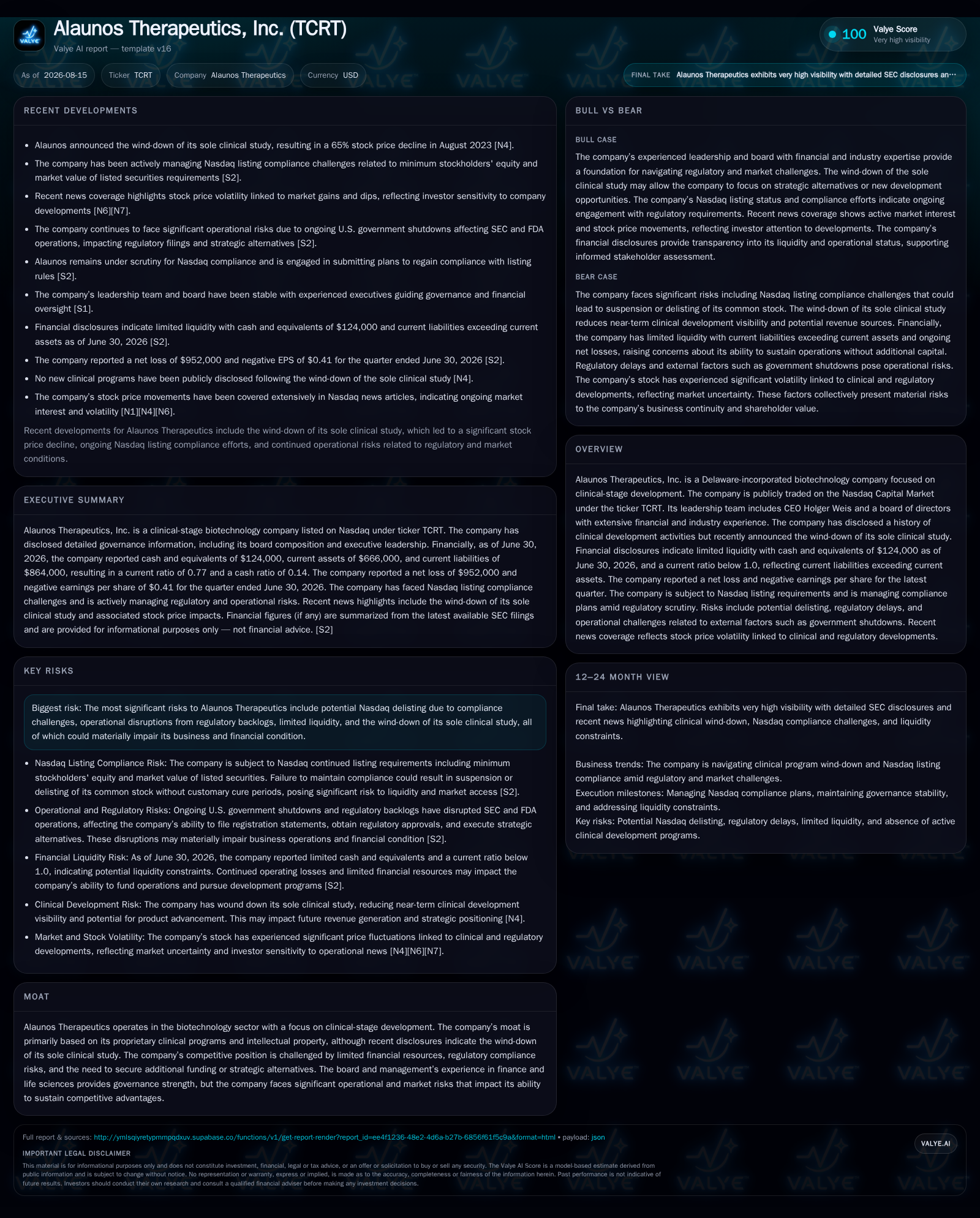
Alaunos Therapeutics disclosed the wind-down of its only active clinical study in its August 2026 quarterly filing, eliminating its near-term clinical catalysts and revenue prospects. The company’s cash reserves eroded to $124,000 as of June 30, 2026, with a current ratio under 1.0, signaling imminent financial distress. Concurrently, new Nasdaq rules mandating a minimum Market Value of Listed Securities (MVLS) of $5 million pose immediate delisting risks given the company’s subthreshold market capitalization. Without fresh capital or strategic alternatives, Alaunos faces critical viability challenges amid regulatory scrutiny and halted drug development.
Latest Quarterly Filing Reveals Clinical Program Termination Forces Strategic Reckoning
Alaunos Therapeutics’ August 14, 2026 Form 10-Q crystallizes a pivotal shift in its operational landscape: the wind-down of its sole active clinical trial program [S2]. This decision extinguishes the company's principal near-term catalyst for value creation through clinical milestone achievements or licensing engagements. Such trial cessation effectively halts the forward momentum essential in biotech development timelines for advancing novel therapeutics toward regulatory approval. The impact is immediate — future revenue streams tied to successful trial progression or partnership triggers dissipate
"Sole Clinical Asset Wind-Down Undermines Future Development Value and Revenue Prospects"
Historically, Alaunos’ business hinged on proprietary investigational oral small-molecule candidates targeting obesity and related metabolic disorders via a non-hormonal mechanism. While promising preclinical data from diet-induced obesity mouse models were reported earlier in the year [S3], no human trials are ongoing following the recent study termination. Consequently, the absence of active clinical assets undermines the company's core biotech model premised on phased progression through clinical trials to unlock licensing deals or commercial opportunities. The pipeline is effectively dormant with no disclosed alternative programs advancing toward IND-enabling studies [S1, S3]. This stagnation sharply curtails any potential near- or mid-term value uplift.
"Critical Nasdaq MVLS Rule Activation Adds Immediate Regulatory Pressure on Listing Status"
Coinciding precariously with operational contraction is an intensified regulatory compliance challenge. As detailed in the latest filing, the SEC-approved Nasdaq rule change codified as Listing Rule 5550(a)(6) mandates that companies listed on the Nasdaq Capital Market maintain a Market Value of Listed Securities (MVLS) of at least $5 million beginning July 22, 2026 [S2]. Should Alaunos’ MVLS fall below this threshold for a continuous period of thirty business days—a plausible scenario given market conditions—the stock faces instant suspension and delisting with no automatic cure window. Although a hearing panel may grant exceptions in limited cases, there is no assurance such relief will be awarded. This strict enforcement reflects a tightening regulatory environment that disproportionately burdens micro-cap biotechs lacking scale or liquidity [S20].
"Biotech Model Clashes with Funding Shortfall: Implications for Cash Runway and Operational Continuity"
Financial disclosures reveal Alaunos is confronting an acute liquidity crisis. At June 30, 2026, cash and equivalents were reported at a scant $124,000 against $864,000 in current liabilities—a current ratio of just 0.77 exposes an imminent mismatch between near-term obligations and liquid assets [F1]. Operating losses remain significant given ongoing R&D costs necessary to sustain even minimal operations. This persistent cash bleed contradicts the typical biotech growth trajectory that depends on milestone-driven funding or capital raises timed with successful clinical advancements.
Without meaningful cash reserves or immediate capital infusions surfaced in filings or press releases to bridge this gap, the company risks operational disruption or insolvency should liabilities accelerate beyond available resources [S2]. Such disproportionality between burn rate and cash availability is frequently cited in sector distress analyses as predictive of impending business viability challenges.
"Navigating Industry Context: How Alaunos Compares to Peers Facing Clinical Stress and Compliance Risks"
Among peer clinical-stage biotechnology firms targeting metabolic disorders with small-molecule candidates, a sustainable cash runway extending at least twelve months post-financing is a sector norm maintained by leading companies to navigate long regulatorily intensive cycles. Additionally, robust pipelines comprising multiple preclinical or early-phase assets diversify risk exposure compared to Alaunos’ single active candidate approach.
Competitor biotechs facing Nasdaq MVLS compliance usually pursue prompt financing rounds or strategic partnerships to stabilize liquidity profiles; some also broaden intellectual property portfolios or adjust trial designs to accelerate milestones—strategies not visibly underway at Alaunos based on public disclosures [S1,S3]. These contrasts emphasize Alaunos’ fragile position within an industry defined by capital intensity and protracted development timelines.
Growth Pathways Severely Curtailed Absent Funding or Strategic Partnerships
Significantly absent from recent SEC reports are indications of new collaborations or licensing agreements critical for bolstering either developmental momentum or extending financial runway. Despite previous exploratory efforts including a terminated engagement letter with Cantor Fitzgerald for strategic alternatives as of early January 2026 [S11], subsequent filings have not reported renewed partnership pursuits.
While preclinical proof-of-concept remains documented in non-GLP mouse studies for ALN1003—the lead oral metabolic candidate—progression into IND-enabling studies remains contingent upon securing supplemental capital and bridging operational funding gaps. Without such means materializing promptly through equity raises or business combinations, further development ceases leaving growth avenues effectively shuttered [S3,S27].
Primary Risks Intensify: Delisting, Liquidity Drain, and Clinical Validation Gaps
These compounding pressures crystallize significant existential risks for Alaunos Therapeutics. The newly operative Nasdaq MVLS rule dramatically elevates delisting probability absent rapid market cap restoration via financing or share price appreciation [S2,S20]. Concurrently, exhausted cash reserves paired with mounting liabilities expose imminent threats to cover payrolls, contractual obligations with contract research organizations (CROs), and other fixed overheads essential for preserving corporate operations.
In parallel stands validation risk wherein halted clinical activity prevents generation of data required for both investor confidence building and regulatory pathway advancement—an essential feedback loop for biotech valuation dynamics. Without corrective interventions—whether via capital influxes or asset sales—the likelihood increases for involuntary dissolution scenarios outlined prominently in risk disclosures [S2]
Key Milestones and Triggers for Near-Term Monitoring Include Financing Windows and Regulatory Updates
Investors tracking Alaunos should monitor several discrete inflection points indicative either of stabilization or further deterioration:
- Execution of successful equity financing transactions sufficient to extend cash runway well beyond current quarters.
- Resolution of SEC reviews impacting Nasdaq’s stay on the MVLS rule enforcement which currently remains under Federal review pending petitions filed post-July approval [S2,S20].
- Any announcements regarding renewed IND filings or reactivation of clinical programs signifying possible revival.
- Public statements regarding alternative strategic options including asset sales or business combinations capable of resetting capital structure.
Each event would materially influence both operational viability assessments and stockholder value expectations.
Financial Snapshot Discussion: Raw Numbers Illuminate Imminent Capital Heap Challenges
Concretely expressed financial metrics anchor the bleak projection: With just $124,000 in liquid assets against nearly sevenfold higher short-term liabilities as June closed—the last reported period before this analysis—Alaunos operates under severe solvency strain requiring urgent remedy [[F1],[S2]]. Operating losses recorded previously set a backdrop of continuous expenditure that likely consumed lower preceding cash balances rapidly towards this nadir.
In summary, Alaunos Therapeutics has transitioned from an early-stage clinical entity advancing proprietary metabolic treatments into a firm grappling with existential hurdles precipitated by ceased trial activity coupled with dangerously inadequate liquidity amidst freshly enforced stock exchange listing thresholds. Its survival now hinges on swift capital raising actions or restructuring initiatives capable of repositioning it within the fiercely competitive biotechnology ecosystem where long-lived cash runways underpin value creation potential.
This analysis synthesizes official SEC disclosures up to August 14th, 2026 without investment research views but highlights critical operational junctures shaping Alaunos Therapeutics' viability within biotech sector dynamics.
Disclaimer: This is research-only, informational analysis and not investment advice. It may include AI-generated interpretation and general industry context. Always verify important details using primary sources.

Comments