
MOZAYYX Acquisition Corp. Shows Robust Liquidity as SPAC Clock Ticks
Latest filings reveal MOZAYYX's strong cash position and typical SPAC capital structure, underscoring execution challenges ahead.
MOZAYYX Acquisition Corp., a newly public Special Purpose Acquisition Company (SPAC), reported substantial liquidity and maintained a standard capital structure blending ordinary shares and redeemable warrants as of mid-2026. Having raised $300 million in its IPO through units combining shares and warrants with an over-allotment exercised, the company sits well-positioned financially to pursue its planned business combination. However, like all SPACs, MOZAYYX faces the ticking deadline to complete a merger within approximately two years, balancing shareholder redemption risk and market conditions that could affect deal execution and post-merger performance. The lack of operational disclosures maintains opacity, making milestones on deal announcements and shareholder votes critical near-term events for stakeholders.
Liquidity Strength at Quarter-End: Cash on Hand Supports De-SPAC Options
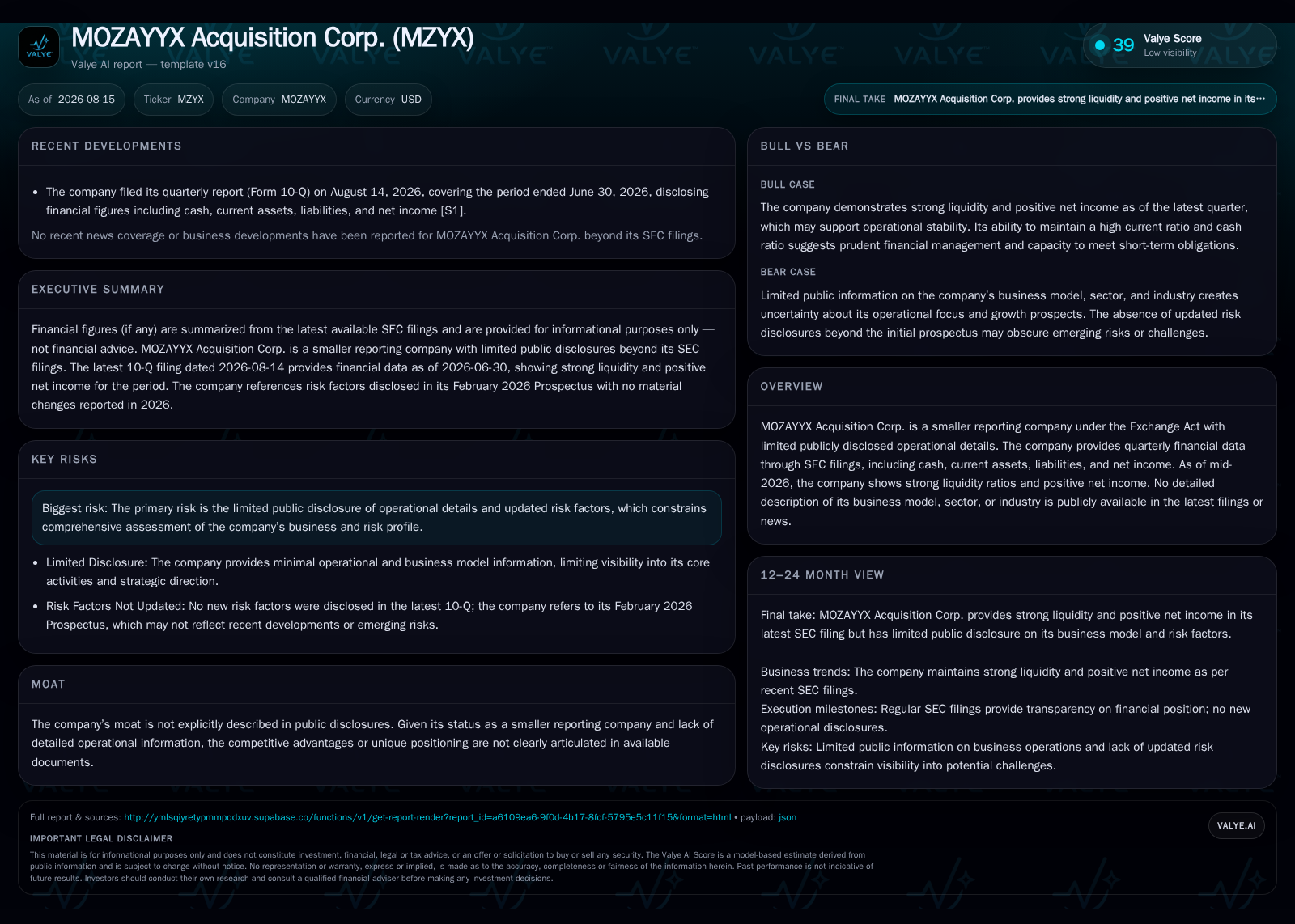
MOZAYYX Acquisition Corp.'s latest balance sheet as of June 30, 2026, shows cash and equivalents of approximately $1.22 million alongside current assets totaling about $1.43 million against current liabilities of roughly $193 thousand, resulting in a current ratio north of 7.4 [F1]. This level of liquidity underpins the company's capacity to cover administrative expenses and absorb investor redemptions preceding any business combination closing.
Such liquidity strength is characteristic of SPACs shortly after their IPO phase but before successfully securing merger partners—reflecting conservatism needed to avoid forced liquidation scenarios common if deals are not executed within prescribed timeframes.
SPAC Capital Structure Under the Microscope: Units, Warrants, and Sponsor Stakes
MOZAYYX's IPO was consummated on February 26, 2026, with the sale of 30 million units priced at $10 each, including nearly four million units issued under an over-allotment option exercised by underwriters—an upsizing indicative of investor interest at launch [S9], [S13]. Each unit consists of one Class A ordinary share coupled with one-quarter of one redeemable warrant; thus four units represent entitlements for one full warrant exercisable at a strike price of $11.50 per share—a strike positioned above IPO price but reflecting common market practice among SPACs [S3], [S5].
Additionally, MOZAYYX sold approximately 3.6 million private placement warrants contemporaneously with its IPO to its sponsor and underwriting representatives for $2 each—a mechanism that grants sponsor economic stakes incentivizing active pursuit of value-accretive targets but also dilutes shareholders post-merger if exercised [S14]. This dual issuance of public warrants alongside private placement warrants follows structural norms found within large peers such as Churchill Capital Corp or Pershing Square Tontine Holdings.
The separation trading introduced in April 2026 allows investors enhanced control over their exposure by enabling separation of units into tradeable ordinary shares and warrants on the NYSE under distinct symbols [S6], [S11]. However, no fractional warrants are issued upon separation.
Understanding MOZAYYX’s Business Model: Fundraising Today, De-SPAC Tomorrow
By design as a Special Purpose Acquisition Company, MOZAYYX operates predominantly as a capital-raising conduit funneling funds from public markets into a trust account until identifying an acquisition or merger partner—commonly termed a de-SPAC transaction [S13]. No revenue-driven operations exist pre-merger; instead, value creation hinges prominently on successfully sourcing an attractive private company target willing to become publicly listed via MOZAYYX’s shell.
This model garners revenue indirectly through sponsor shares (at discounted cost), exercisable warrants offering leveraged equity upside post-merger, and fees tied to consummating the business combination. Until then, all capital excluding permitted interest is escrowed in trust accounts managed by third-party trustees providing security to public investors while restricting premature fund access [S13], which fortifies investor protections but delays revenue recognition.
Industry Structure and Typical Competitive Nuances for Emerging SPAC Players
MOZAYYX joins a growing ecosystem comprising dozens of contemporaneous SPAC sponsors competing against alternatives like traditional IPO underwriters facilitating slower but more established going-public routes. Peers such as Pershing Square Tontine Holdings illustrate scale advantages through larger capital pools and high-profile sponsors enhancing deal pipeline quality while smaller players like MOZAYYX must demonstrate nimble sourcing capabilities against regulatory headwinds.
Regulatory scrutiny today intensifies transparency demands concerning valuation methodologies for targets and conflict-of-interest disclosures between sponsors wielding founder shares versus outside investors evocative across this sector’s maturation phase. Redemption rights held by common shareholders leverage substantial influence over available post-merger proceeds by potentially withdrawing invested capital before deal close—a fundamental risk impacting deal structuring strategies across SPACs broadly.
Decoding Key Growth Catalysts: Pipeline Quality and Market Conditions for Business Combinations
While MOZAYYX has not publicly disclosed its target sectors or specific acquisition pipeline details yet—the most significant growth drivers visible industry-wide encompass macroeconomic appetites favoring rapid public listings facilitated by SPAC structures rather than traditional channels burdened by underwriter roadshows or volatile pricing dynamics.
Experienced sponsors backed by credible investment networks enhance pipeline quality assuring potential targets seek them preferentially. Concurrent availability of PIPE (Private Investment in Public Equity) financing provides supplemental capital injections post-announcement mitigating redemption dilution risks during de-SPAC transactions.
Expansion into new technology sectors or geographic markets further fuels demand for such vehicles as corporations look for expedited liquidity events amid shifting market cycles promoting alternative exit routes for private equity holdings.
Risks Amplified by Limited Disclosures: Redemption Rights, Timeline Pressure, and Regulatory Environment
Despite robust initial capitalization and liquidity measures evidenced so far, MOZAYYX embodies typical vulnerabilities intrinsic to SPAC operations compounded here by sparse disclosure around ongoing risk dynamics beyond the original prospectus dated February 24, 2026—which remains unchanged per latest quarterly filings [S2]
The primary operational risk revolves around the mandated timeframe—usually between eighteen and twenty-four months—where failure to consummate an initial business combination obliges liquidation returning funds net expenses to shareholders yet wiping out sponsor stakes entirely. Concurrent market volatility can adversely affect investor sentiment driving elevated redemption rates whereby common shareholders reclaim invested funds pre-merger thereby shrinking the target merger equity pool jeopardizing deal viability.
Additionally, evolving SEC rules impose heightened compliance demands especially regarding valuation transparency relating to private company mergers raising execution complexity further complicating timely closings.
The absence of detailed updates compounds uncertainty around pipeline quality or negotiation progress necessitating reliance on corporate announcements as critical information inflection points.
"What to Watch": Milestones Toward Business Combination and Shareholder Decision Points
Key upcoming metrics will emerge from concrete indicators including:
- Official announcement or signing press releases confirming selected business combination target
- Scheduling and outcome of shareholder votes authorizing proposed combinations which directly influence redemption behavior patterns
- PIPE financing arrangements supplementing equity commitments enhancing deal stability post-announcement
- Any amendments modifying timeframes granting extension or altering redemption rights signaling operational flexibility These events will heavily shape MOZAYYX’s ability to adhere to contractual obligations mandating mergers within the specified window while maximizing value realization for both sponsors and public shareholders. Monitoring trading behavior surrounding separated ordinary shares versus warrants may also yield insights into market sentiment shifts ahead of critical vote dates or merger closings.
Financial Profile Discussion: Current Liquidity Readiness as Execution Support
Synthesizing MOZAYYX’s latest balance sheet snapshot underscores prudent cash stewardship reflective of early-stage SPAC profile: holding $1.22 million cash balanced against nominal liabilities approximating $193 thousand culminating in a current ratio exceeding 7.4 highlights substantial financial runway coverage beyond expected administrative expenses alone [F1]. Such liquidity buffers are imperative given transactional uncertainties inherent before de-SPAC completion where costs such as legal fees, advisory payments, potential shareholder redemptions necessitate robust readily accessible funding absent operating cash flow generation. Ultimately this balance sheet posture aligns with peer SPACs immediately post-IPO yet presupposes successful deployment toward approved business combinations within residual allowable time horizons underpinning survival.
Disclaimer: This is research-only, informational analysis and not investment advice. It may include AI-generated interpretation and general industry context. Always verify important details using primary sources.

Comments