
LGL Group Balances Precision Instrument Manufacturing with Merchant Investment Expansion
The latest quarterly update highlights LGL’s dual-segment strategy amid evolving technological needs and investment risks.
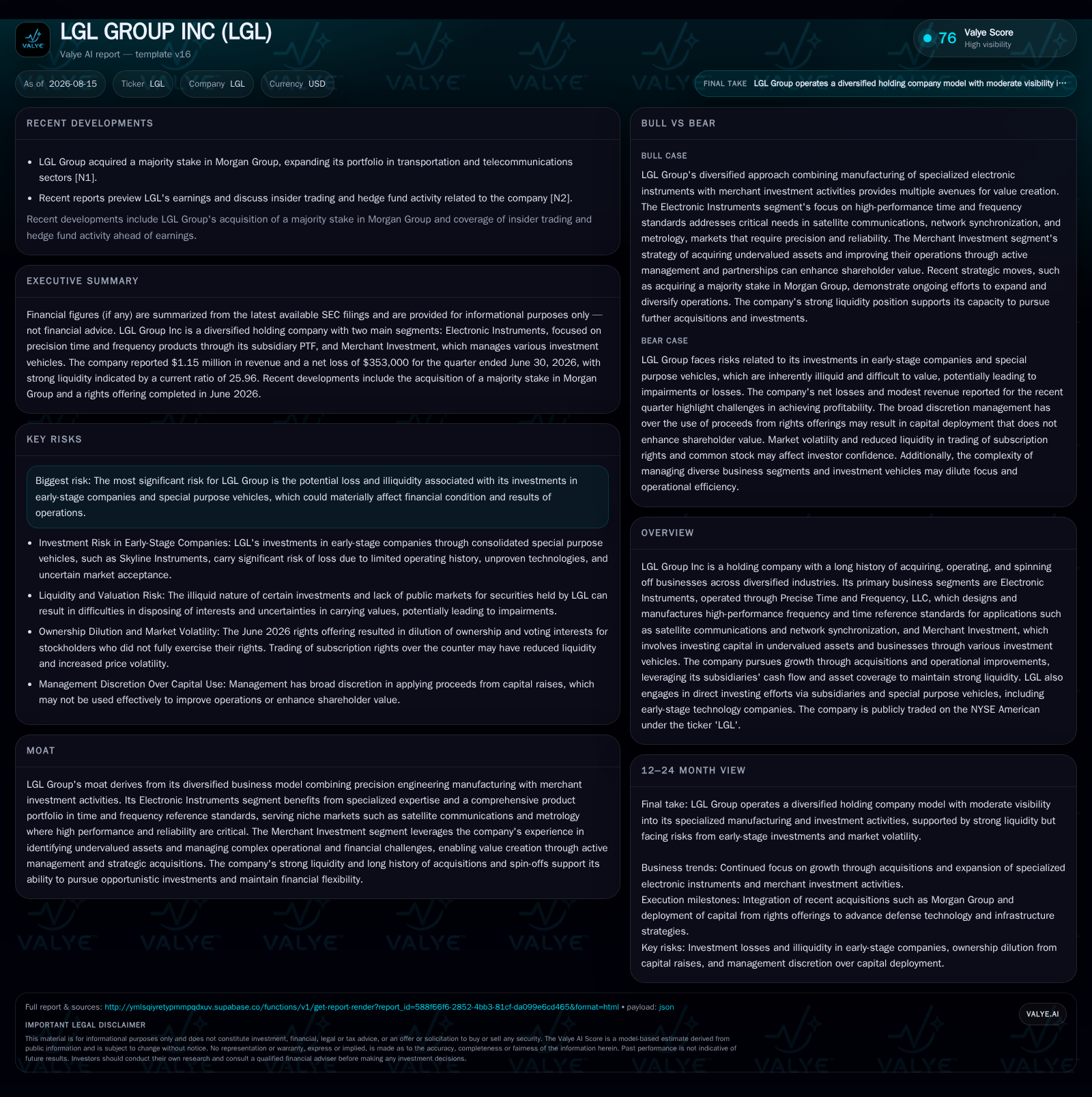
LGL Group Inc operates through a distinct two-pronged business model combining precision electronic instruments manufacturing and merchant investment activities. The company’s Electronic Instruments segment, led by its subsidiary Precise Time and Frequency (PTF), delivers customized high-performance frequency and timing solutions targeting satellite communications, metrology, and network synchronization markets. Concurrently, the Merchant Investment segment pursues value creation in undervalued assets and early-stage ventures via special purpose vehicles. The recent second quarter report underlines continued backlog growth in precision products alongside increased investment exposure to riskier early-stage companies, demanding close liquidity management. Customer concentration and regulatory risks related to investment classification remain key watchpoints.
Recent Operating Update: Dual-Segment Dynamics Underlying Growth
LGL Group’s Q2 2026 filing continues to reflect its strategic focus on balancing operational execution within its two core segments: Electronic Instruments and Merchant Investment [S2]. The Electronic Instruments segment, led by Precise Time and Frequency, LLC (PTF), reported sustained order backlog growth representing firm orders considered likely to be fulfilled mainly within the next 12 months. The backlog grew from $336K at year-end 2024 to $625K at year-end 2025, signaling robust demand momentum amid a cyclical market where precise timing instruments are crucial for satellite communication systems and metrology applications [S6]. This backlog fuels near-term revenue visibility but remains subject to customary cancellation or deferral risk given OEM customers’ production schedules.
Meanwhile, the Merchant Investment segment continues expanding through investments in early-stage technology firms via specialized pooling structures—specifically special purpose vehicles (SPVs). Notably, LGL consolidated vehicle Skyline SPV carrying an $850K investment targeting Skyline Instruments Corporation—a developer of GPS-denied sensing technologies—and acknowledged the illiquid nature of such holdings as well as potential for impairment losses should expected commercialization or contract wins fail to materialize [S2]. These investment activities introduce valuation uncertainties absent public market pricing, obligating conservative liquidity management amid uncertain payoff timing.
Business Model: Precision Engineering Meets Opportunistic Investing
LGL’s business model leverages a hybrid structure common among diversified industrial hardware manufacturers combined with merchant investment firms. On one hand, PTF designs and manufactures frequency reference standards known for their critical role in highly reliable time synchronization use cases spanning telecom network synchronization, electric utilities distribution, broadcasting, and defense sector calibration systems. Products range from frequency standards to complex digital distribution amplifiers often requiring custom engineering configurations tailored per client specifications—a competitive differentiator when serving specialized industrial OEMs seeking minimal phase noise and long product life cycles [S1][S17][S11].
On the other hand, LGL deploys capital via multiple wholly owned subsidiaries such as Lynch Capital International LLC into undervalued operating businesses or early-stage venture funds using SPVs designed to optimize structuring flexibility. Revenues stem from investment income, realized gains/losses on asset dispositions, and management fees tied to syndicated investments. The holding company benefits from subsidiary operating cash flows that underpin a strong consolidated balance sheet capable of sustaining opportunistic acquisitions or funding organic research & development initiatives within PTF [S1][S10][S14]. This dual model inherently mixes capital-intensive manufacturing with variable financial returns linked to asset valuation dynamics.
Industry Structure & Competitive Positioning
LGL inhabits niche precision instrumentation submarkets where superior product reliability and customization capabilities dominate buyer decisions. Its peers include companies like M-tron Industries who also target sophisticated satellite ground stations and defense-related timing solutions. Competition hinges heavily on engineering expertise as well as service capacity through distributor networks capable of technical pre-sales consultation [S4][S11]. LGL’s strategy emphasizes innovation upgrades focused on signal distribution products—which constitute about 40% of net sales—to improve cost efficiency without compromising quality thresholds required in mission-critical applications
Simultaneously, merchant investment operations place LGL alongside specialized industrial holding companies who manage diverse portfolios including early-stage tech ventures where valuations lack liquidity benchmarks [S1][S16]. These activities amplify regulatory scrutiny risks due to potential classification as an investment company under the Investment Company Act if asset allocation thresholds toward securities holdings exceed prescribed levels. Failure to prevent such designation would impose substantial structural restrictions limiting management autonomy over acquisitions or capital deployment strategy
Growth Drivers
Structural demand for precision frequency reference standards is propelled by expanding global reliance on resilient telecommunications infrastructure requiring exact time synchronization for data integrity. Satellite communications systems utilize these instruments to achieve high stability in uplink/downlink timing cycles. Additionally, electric utilities increasingly deploy such technologies to monitor grid distribution timing enhancing operational efficiency. Defense spending trends favoring advanced calibration and mobile satellite terminals augment addressable market size further.
Complementing organic product demand is LGL’s tactical use of acquisitions and operational improvements within subsidiaries designed to broaden product integration levels and extend product life cycles—key levers for margin enhancement over time [S1]. Merchant Investment growth prospects hinge on sourcing undervalued assets amenable to value enhancement via advisory support or minority positions advancing transformative mergers or joint ventures leveraging broader capital syndication opportunities.
Capital raised through the June 2026 rights offering ($6.90 per share price) targets advancing technologies around resilient infrastructure and defense relevant critical timing solutions—signaling intent toward accelerating innovation investments aligned with sector demand shifts [S2][S19]
Risks & Watchpoints
Key vulnerabilities include concentration risk given that the top four customers accounted for over half of total revenues (~54%) as of FY2025—exposing LGL to adverse impact should one or more large OEMs reduce orders or renegotiate contract terms unfavorably amidst procurement pressures common in competitive instrumentation markets [S4][S5]. Customer demands for extended payment terms, discounts, or return rights have compressed margins historically.
The most salient company-specific risk arises from the Merchant Investment portfolio's significant exposure to early-stage companies evidenced by Skyline SPV’s consolidation which carries illiquidity challenges compounded by valuation uncertainties absent standardized secondary markets. Any failure in anticipated commercialization milestones or financing rounds may lead to write-downs materially affecting earnings volatility [S2].
Additionally, ongoing risk around classification as an investment company imposes regulatory compliance complexity requiring active asset allocation management; an adverse designation could derail the current operating model reliant on fluid acquisitions and cross-entity transactions otherwise prohibited under registered investment company status [S1].
Manufacturing-side risks include technological obsolescence pressure necessitating consistent R&D investment alongside managing supply chain volatility especially in raw materials influenced by tariffs—cost factors that may erode profit if not offset by pricing power or productivity gains [S6]
What to Watch Next
Key near-term metrics will include monitoring order backlog fulfillment rates during FY2026 given inherent cancellation risks tied to customer production schedules—a direct indicator of Electronic Instruments revenue sustainability [S6]. Furthermore, progression updates on PTF's technological enhancements for signal distribution products will indicate competitive sharpening impacting margins.
On the merchant side, valuation shifts within early-stage investments including Skyline SPV will be pertinent alongside any impairment recognition or capital calls that might affect cash flow usage profiles [S2]. Liquidity trends reflected through cash equivalents balances relative to short-term liabilities should also signal ability to withstand potential operational headwinds.
Tracking capital deployment outcomes from proceeds raised via the recent rights offering will reveal management’s effectiveness in translating funding into technology advancements or strategic acquisitions enhancing portfolio diversification [N/A since no press citations exist beyond filings].[S19]
Financial Profile Discussion
As of the latest quarter ending June 30, 2026, LGL holds $45.1 million in cash and cash equivalents against minimal current liabilities approximated at $1.8 million—yielding a current ratio near 26x underscoring an exceptionally liquid balance sheet supportive of operational flexibility across segments [F1]. Total debt has been reported modestly at approximately $0.6 million (March 2022 figure), indicating very low leverage relative to assets.
Overall liquidity strength affords LGL the ability to prudently manage acquisition pipelines while absorbing episodic fluctuations from early-stage investment outcomes—all pertinent metrics given its hybrid business model blend combining precision manufacturing requirements with merchant capital cycling challenges.
Disclaimer: This is research-only, informational analysis and not investment advice. It may include AI-generated interpretation and general industry context. Always verify important details using primary sources.

Comments