
Pioneer Power Solutions Faces Structural Profit Challenges and Customer Concentration in Critical Power Segment
Following divestiture of its PCEP operations, Pioneer Power Solutions focuses on a critical power business with high customer concentration and persistent operating losses.
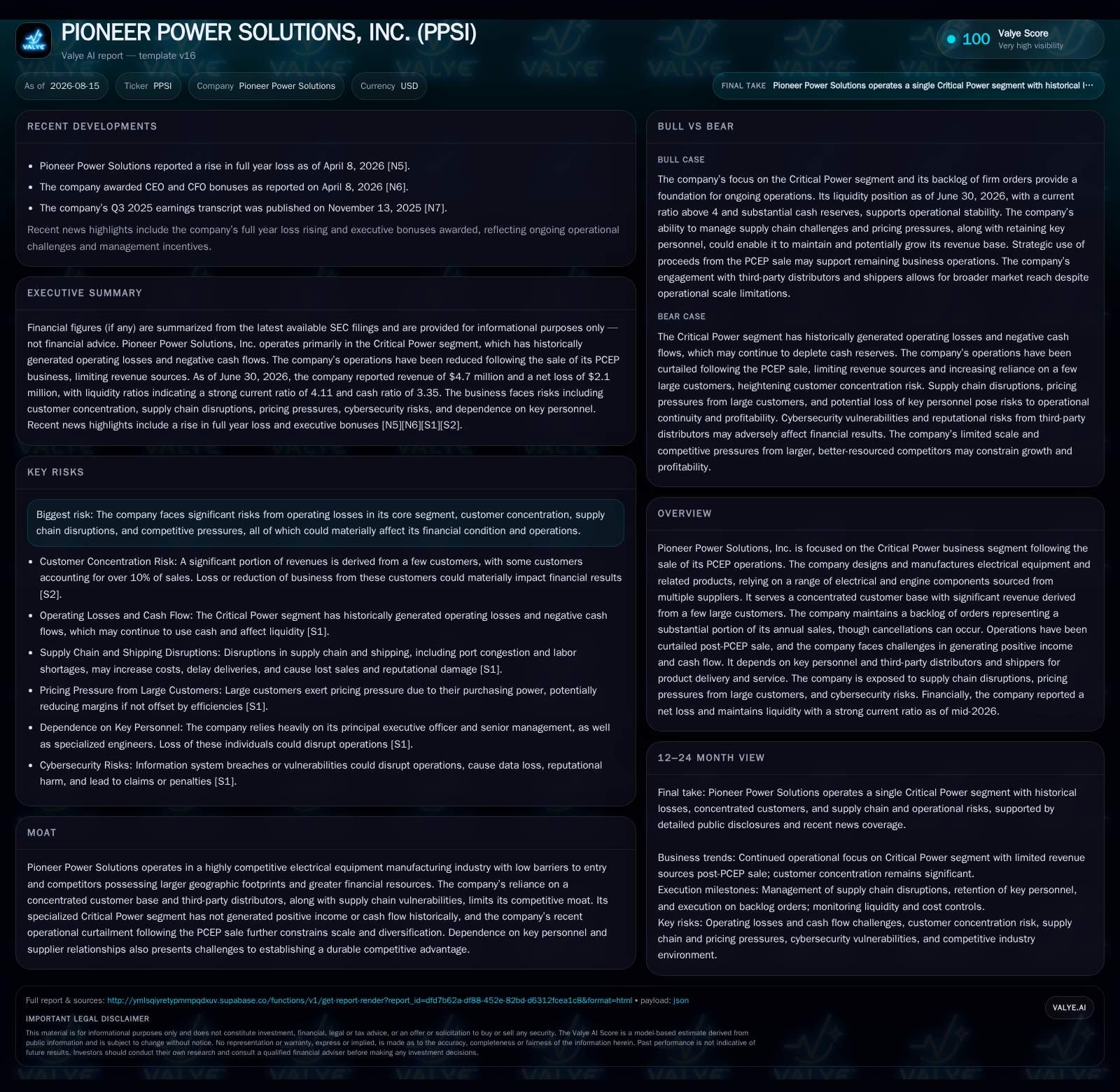
Pioneer Power Solutions has streamlined into a single segment—Critical Power—after selling its PCEP business, but continues to grapple with limited revenue diversity and ongoing operating losses. Its backlog remains a significant sales driver, although cancellations risk revenue realization. The company's reliance on a concentrated customer base and third-party suppliers exposes it to notable pricing pressure and supply chain disruptions. In a competitive electrical equipment manufacturing sector dominated by larger players, Pioneer’s ability to achieve positive income and sustainable cash flow is unproven, underscoring key risks related to talent retention and market scale.
Latest Operating Developments Highlight Customer Concentration and Revenue Constraints
Pioneer Power Solutions’ August 2026 quarterly filing reiterates the company's concentrated revenue profile: three customers accounted for approximately 37% of second-quarter revenues in aggregate, with a single customer representing all lease receivables as of June 30, 2026 [S2]. This customer concentration underscores significant revenue volatility risk, where order level fluctuations or contract cancellations from a few clients could materially disrupt cash flow and earnings. Furthermore, the company operates primarily through project-based contracts that contribute to an order backlog—a key short-term indicator of revenue visibility—estimated at $12.6 million at the end of 2025 [S1]. However, the conversion of backlog value into recognized revenue is inherently uncertain given possible cancellations or delays.
The divestiture of its previously larger PCEP operations has left Pioneer focused solely on its Critical Power segment—a business unit historically unable to generate positive operating income or cash flow [S1]. This operational curtailment reduces scale advantages and intensifies risks tied to limited product breadth and revenue sources. Notably, the company reported an operating loss of approximately $6.6 million on trailing twelve-month basis ending December 2025, alongside negative net income near $6 million [F1]. These results emphasize the ongoing challenge Pioneer faces in achieving profitable growth within its niche in the electrical equipment manufacturing industry.
Business Model Centered on Critical Power OEM Manufacturing with Supply Chain and Pricing Pressures
Pioneer operates primarily as an original equipment manufacturer (OEM) designing and assembling critical power solutions such as transfer switches, generators, electric vehicle chargers, and related power distribution equipment [S1]. The revenue mechanics rely heavily on winning project contracts which feed the order backlog—a typical industry practice reflecting pipeline robustness. Customers typically include industrial facilities, utilities, data centers requiring backup power infrastructure, reflecting demand driven by reliability needs in critical applications.
Component sourcing is a pivotal vulnerability; electro-mechanical parts stem from multiple suppliers operating in competitive markets. Yet price fluctuations in these components or supply shortages can inflate production costs or cause delays that hinder contractual delivery schedules [S1]. Moreover, Pioneer faces pricing pressure from larger customers who have significant negotiation leverage given their importance to total sales volume [S1]. Dependency on third-party distributors and shippers adds complexity around logistics reliability and cost control.
Talent retention constitutes another operational lever: senior management and specialized design engineers play vital roles in execution continuity. Pioneer admits risk related to losing key personnel who are difficult to replace quickly given niche expertise requirements [S1]. In turn, such human capital constraints limit scalability and innovation capacity compared with larger peers possessing deeper bench strength.
Industry Structure: Competitive Electrification Sector with Larger Diversified Peers
The electrical equipment manufacturing industry presents low barriers to entry but is fiercely competitive with extensive fragmentation. Pioneer’s narrower geographic footprint contrasts sharply against diversified incumbents like Emerson Electric (EMR) offering comprehensive energy management solutions globally or Eaton Corporation which combines scale with broad product portfolios including critical power systems. Similarly, Generac Holdings’ focus on backup power generation equipment showcases scale economies complemented by substantial R&D investment.
Relative to these players who benefit from robust distribution networks and service contracts enhancing recurring revenues and margin stability, Pioneer’s reduced size post-divestiture restricts its market presence. The company primarily competes in midstream assembly leveraging sourced engine components but lacks broad service ecosystem integration common among leading peers. Such scale disadvantages amplify exposure to price competition from OEM suppliers as well as bargaining power asymmetries with large customers.
Growth Drivers Remain Linked to Infrastructure Modernization but Are Uncertain in Timing
Key secular growth vectors for companies like Pioneer include increased spending on critical power infrastructure driven by data center expansion supporting cloud computing and AI workloads [S1]. Edge computing proliferation demands highly reliable localized power solutions enhancing demand visibility for transfer switches and generators. Additionally, regulatory mandates imposing backup power requirements for safety-critical facilities further underpin growth prospects.
However, Pioneer cautions that uncertainty clouds these projections stemming from variable adoption rates of AI/Edge technologies combined with changing regulatory landscapes or improvements in energy efficiency potentially reducing immediate infrastructure upgrades [S1]. These factors introduce timing ambiguity over when demand materializes into firm order flows capable of alleviating current operating losses.
Replacement cycles for aging electrical infrastructure also offer recurring opportunity if Pioneer can expand service offerings or secure long-term contracts—a strategy employed effectively by larger peers through integrated maintenance solutions rather than solely capital equipment sales.
Risks: Backlog Realization, Supply Chain Fragility, Customer Dependence & Cybersecurity Threats
Beyond customer concentration risk evident in recent quarters [S2], backlog reliability remains a key watchpoint since cancellations would erode forward revenue visibility vital for operational planning [S1]. Supply chain disruptions—prevalent across the industrial hardware sector—pose additional threats; any delays increase production costs or cause missed delivery deadlines affecting customer satisfaction and reputation.
Pricing pressure from dominant customers compresses gross margins amid fixed overhead costs inherent in OEM manufacturing processes. Combined operating losses limit Pioneer’s capacity to self-fund strategic initiatives reducing flexibility compared with cash-generative peers [F1]. Loss of key personnel jeopardizes continuity particularly because specialized engineering talent underpins product development pipelines.
Cybersecurity risks also loom over IT systems managing design data encrypted communications reflecting broader digital threats within industrial manufacturers potentially causing operational interruptions [S1]. Finally, fluctuations in raw material prices beyond Pioneer’s control further challenge cost predictability impacting profitability metrics.
What To Watch Next: Backlog Conversion Metrics & Talent Stability
The company's ability to convert the sizable $12.6 million backlog into booked revenue without significant cancellation will be an essential signal of near-term demand strength [S1]. Monitoring changes in customer diversification beyond currently concentrated top accounts could indicate progress toward mitigating revenue volatility risks detailed in recent filings [S2].
Financially viable progress necessitates reducing operating losses via margin improvement initiatives while leveraging any proceeds from the prior PCEP sale wisely to fund productivity enhancement programs [S1]. Retention of key engineering staff or hiring success will serve as crucial human capital KPIs signaling operational continuity essential for sustaining deliveries amid competitive pressures.
Additionally, insight into supply chain lead times or inflationary pressures on input costs would help assess ability to maintain stable margins under pricing negotiations with major clients. Given broader sector moves observed among peers like EMR showing steady margin resilience through diversification strategies [N2], Pioneer’s strategic responses will bear watching closely.
Financial Profile Discussion
At June 30, 2026, Pioneer displayed robust liquidity metrics characterized by current assets totaling approximately $22.6 million against current liabilities near $5.5 million translating into a healthy current ratio of about 4.11 [F1]. This strong short-term position provides a buffer against immediate solvency risks despite ongoing operating deficits.
Cash balances stood at roughly $18 million at mid-2025 year-end indicating sufficient runway relative to minimal debt levels reported historically ($21 thousand total debt as of year-end 2015) suggesting low leverage burden currently [F1]. However, persistent trailing twelve-month operating losses exceeding $6 million highlight significant challenges converting liquidity into sustainable free cash flow generation required for autonomous growth investments or shareholder value creation without external capital infusion or margin recovery [F1].
Overall financial metrics reflect typical early-stage industry exposure focusing on scaling profitability amidst market concentration risks rather than balance sheet distress concerns.
This analysis synthesizes recent SEC filings through August 2026 supplemented by proprietary industry context framing electrical equipment manufacturing dynamics emphasizing critical power OEM operations. It does not constitute investment advice but aims to provide rigorous insight into business model viability within sectoral forces shaping Pioneer Power Solutions’ development trajectory.
Disclaimer: This is research-only, informational analysis and not investment advice. It may include AI-generated interpretation and general industry context. Always verify important details using primary sources.

Comments