
Franklin Crypto Trust Advances Regulated Digital Asset Exposure with Steady Quarterly Operations
Latest quarterly filing confirms operational stability for Franklin Crypto Trust’s ETF amid ongoing digital asset market challenges and evolving regulatory landscape.
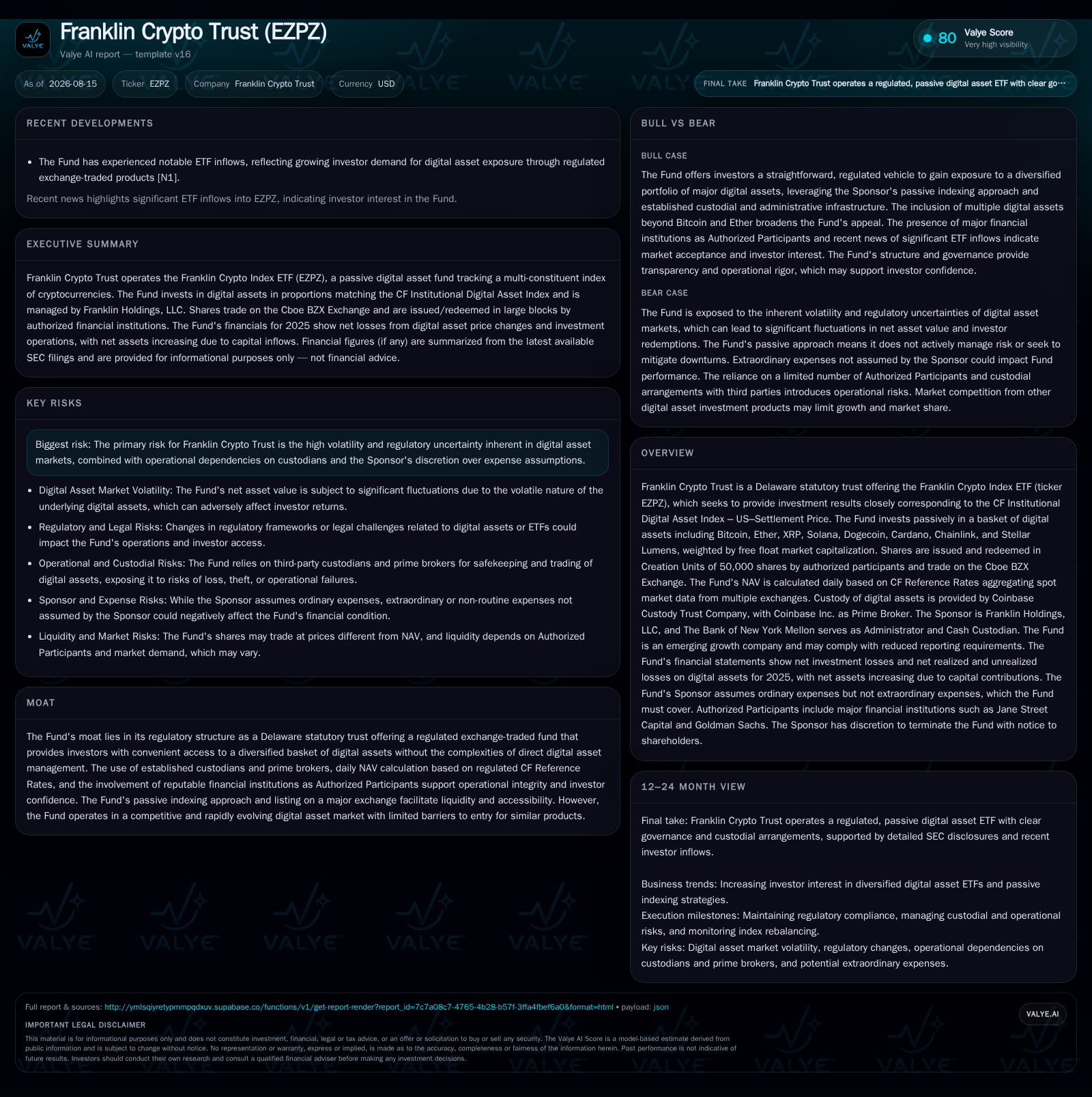
Franklin Crypto Trust’s August 14, 2026, 10-Q filing reports no material changes in risk factors or operational disruptions, reaffirming the Fund’s stable execution of its passive digital asset index tracking strategy. The Fund offers diversified crypto exposure through an ETF structure that relies on authorized participants for share creation and redemption, with custody services provided by Coinbase Custody. While competition intensifies in the digital asset ETF space, regulatory clarity and institutional adoption underpin growth prospects. Key risks remain digital asset volatility, custody complexities, and regulatory uncertainty. Monitoring tracking error, creation/redemption activity, and NAV premium/discount will be crucial to assessing ongoing performance.
Latest Quarterly Filing Affirms Operational Stability
Business Model: Passive Tracking of a Diversified Digital Asset Index
The Fund offers a single series—the Franklin Crypto Index ETF (ticker EZPZ)—which seeks to replicate the performance of the CF Institutional Digital Asset Index – US–Settlement Price [S1]. As of December 31, 2025, this index includes eight cryptocurrencies: Bitcoin (BTC), Ether (ETH), XRP, Solana (SOL), Dogecoin (DOGE), Cardano (ADA), Chainlink (LINK), and Stellar Lumens (XLM). These are weighted by free float market capitalization to reflect investable market segments.
This passive investment approach enables investors to access diversified crypto exposure without the complexities of direct custody or blockchain interaction. The Fund achieves its objective by holding underlying digital assets approximately in line with index weights [S1]. The ETF shares trade on the Cboe BZX Exchange with liquidity maintained through creation/redemption mechanisms executed exclusively by authorized participants—registered broker-dealers approved under agreements with the Sponsor
Custodial Infrastructure: Coinbase Custody and Prime Brokerage Nuances
Custody of the Fund’s digital assets is outsourced primarily to Coinbase Custody Trust Company—a recognized leader in institutional-grade crypto custody solutions [S6]. The custody model blends cold storage wallets for security alongside hot wallets for liquidity needs. Holdings may temporarily reside in omnibus accounts managed by Coinbase acting as Prime Broker. In this setup, the Fund holds pro rata entitlements rather than direct title to specific tokens during trading balance periods.
Prime brokerage services facilitate efficient processing of creation/redemption transactions involving large blocks of shares (Creation Units) and enable trade financing via Trade Credit arrangements [S6]. While these layers enhance operational agility and market responsiveness, they also raise counterparty concentration risks given reliance on a single custodian/prime broker entity. Security protocols and regulatory compliance at Coinbase thus represent critical operational risk factors.
Complementing this infrastructure is Bank of New York Mellon acting as cash custodian and fund administrator—integrating traditional financial institution rigor with digital asset operations [S1]
Competitive Landscape: Positioning Within Growing Digital Asset ETFs
Franklin Crypto Trust competes alongside established players such as Grayscale Bitcoin Trust (GBTC), Bitwise ETFs, and VanEck’s crypto offerings. Unlike GBTC—which historically experienced persistent discounts/premiums due to closed-end trust structure—EZPZ is structured as an exchange-listed ETF facilitating daily liquidity through creation/redemption processes designed to keep share prices close to NAV.
EZPZ differentiates itself by offering a broader basket of eight cryptocurrencies versus peers focused primarily on Bitcoin or Ethereum exposures. This diversification appeals to investors seeking comprehensive crypto market coverage while mitigating concentration risk.
While exact fee structures are not disclosed here, Franklin Resources’ involvement lends traditional asset management expertise relative to some crypto-native competitors. However, reliance on Coinbase Custody introduces counterparty concentration compared with alternatives like Fidelity Digital Assets or Anchorage Digital.
Growth Drivers: Regulatory Clarity Supports Institutional Adoption
Operating as a Delaware statutory trust exempt from full Investment Company Act registration yet listed on a major exchange provides EZPZ with favorable accessibility while maintaining regulatory compliance [S1]. This hybrid structure appeals particularly to institutional investors seeking regulated vehicles offering transparent pricing and governance.
Investor demand is buoyed by increasing appetite for cost-efficient vehicles providing diversified blockchain exposure without self-custody risks. Innovations in custody technology and prime brokerage services improve operational efficiency supporting secondary market liquidity—a key factor given underlying crypto volatility.
Potential growth opportunities include cross-exchange listings enhancing accessibility and expanded marketing efforts leveraging Franklin Distributors LLC as Marketing Agent affiliated with the Sponsor [S1].
Risks: Market Volatility, Regulatory Flux & Operational Dependencies
The Fund’s direct holdings expose it fully to price fluctuations of volatile digital assets impacting NAV per share directly [S1][S22]. Regulatory uncertainty remains significant; unfavorable rule changes could restrict trading venues or affect index composition.
Operationally, dependence on Coinbase Custody’s security measures and prime brokerage omnibus account structures imposes counterparty credit risk [S6]. Tracking error risk arises if index rebalancing is not replicated promptly or if pricing sources become unreliable requiring Sponsor intervention for fair value adjustments [S1][S16].
Liquidity stresses could impair creation/redemption activity causing ETF shares to trade at wider premiums or discounts relative to NAV—potentially undermining investor confidence.
Fee pressure from competing products also poses margin compression risks affecting net returns.
Performance Monitoring: Key Indicators for Investors
Investors should monitor several KPIs reflecting fund health:
- Tracking Error: Measures how closely NAV returns follow the underlying CF Institutional Digital Asset Index post-expenses.
- Creation/Redemption Volume: Sustained activity signals engaged authorized participants enabling supply-demand balance critical for price stability.
- Market Price Premium/Discount: Persistent divergences from NAV can indicate liquidity stress or structural inefficiencies.
- Index Composition Changes: Quarterly rebalancing announcements reveal shifts in exposure breadth or concentration.
- Custodial Risk Events: Any disruption reported involving Coinbase Custody would heighten operational concerns.
Regular review of SEC filings alongside exchange volume data will help gauge institutional adoption trends supporting the Fund’s growth trajectory.
This analysis synthesizes insights from Franklin Crypto Trust's latest quarterly report filed August 14, 2026 [S2], underpinned by foundational business model context from its annual report dated March 30, 2026 [S1]. It highlights how EZPZ combines regulated ETF mechanics with leading custodial solutions while navigating inherent risks typical of emerging digital asset investment vehicles.
Disclaimer: This analysis is informational only and does not constitute investment advice or research views.
Disclaimer: This is research-only, informational analysis and not investment advice. It may include AI-generated interpretation and general industry context. Always verify important details using primary sources.

Comments