
Healthy Choice Wellness Corp. Balances Niche Organic Retail with Expansion Amid Liquidity Constraints
HCWC’s latest quarter underscores operational challenges and a strategic pivot toward store growth and margin improvement in natural organic retail.
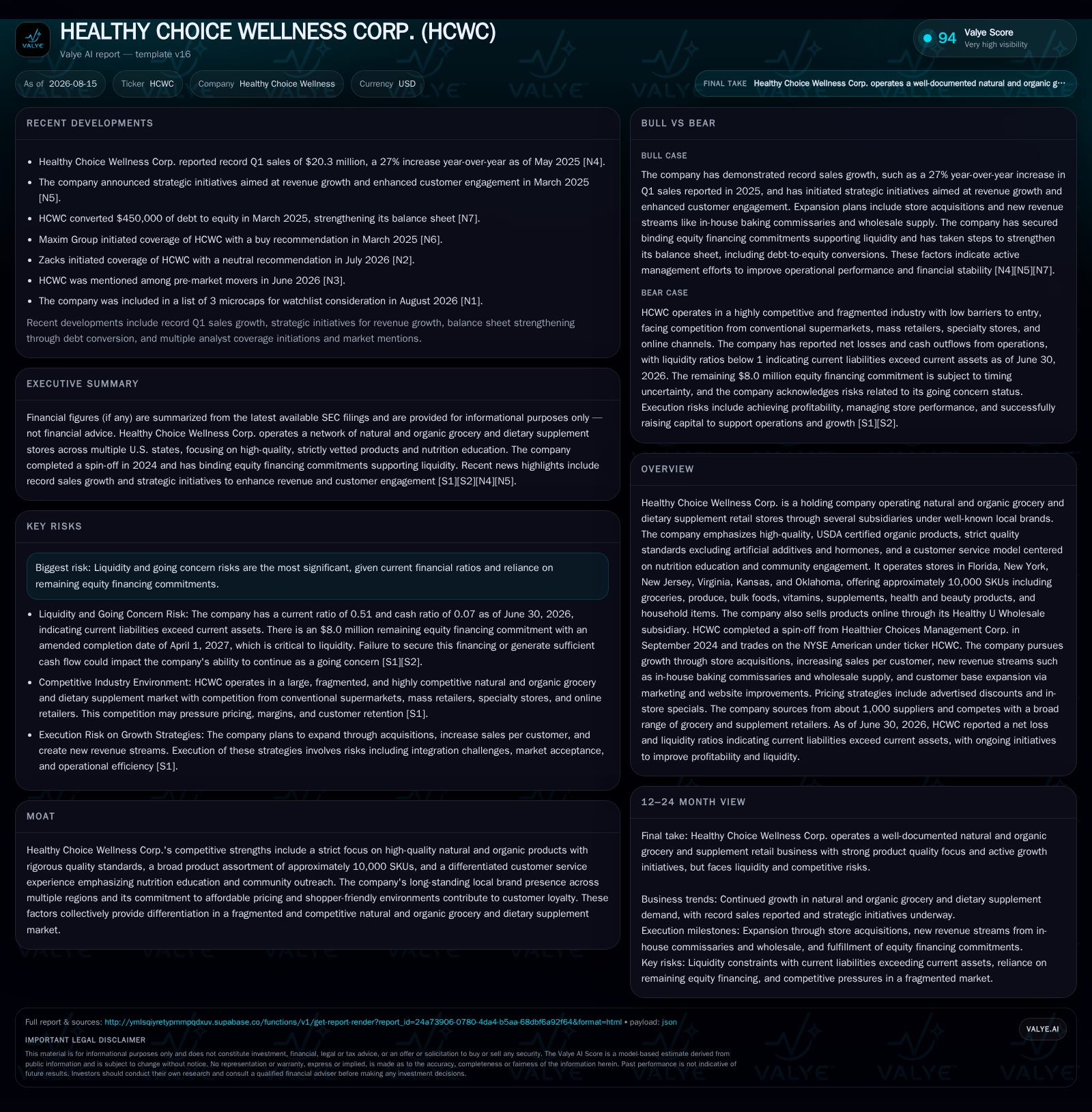
Healthy Choice Wellness Corp. (HCWC) operates multiple regionally branded natural and organic grocery stores across six states and an eCommerce supplement channel, emphasizing strict product quality standards and nutrition education. The company’s Q2 2026 filing reveals ongoing net losses but management plans to improve operating margins through fixed cost leverage, expansion via acquisitions, and new revenue streams like in-house baking commissaries. However, HCWC faces material liquidity constraints with a current ratio of 0.51 and significant debt load, relying heavily on committed equity financing that remains partly unfulfilled. The competitive landscape requires maintaining rigorous USDA organic standards and differentiation via customer education to build loyalty amid larger mass-market retailers and eCommerce competition.
Recent Operating Update: Balancing Losses with Expansion Initiatives
Healthy Choice Wellness Corp.'s latest quarterly filing for Q2 2026 signals continued operational losses but progressive cash flow improvements driven by strategic cost controls and sales momentum enhancements [S2],[F1]. The company does not report any new risk factors this quarter, reflecting stable business conditions albeit during financial tightness. A major development is HCWC's announcement of a merger agreement with Host Digital Infrastructure LLC, intending to merge via a wholly owned subsidiary under HCWC's umbrella [S3],[S28]. This transaction aims to diversify earnings with long-term contracted revenues from a significant cloud infrastructure lease commencing early 2027—potentially altering the firm's risk/revenue profile profoundly in the near future.
Although this merger is pending customary approvals and includes a lease valued at $1.25 billion over 15 years ($3.2 billion if extended to 30 years), it represents a sharp departure from HCWC's traditional natural grocery retail base characterized by modest scale operations across multiple regional brands [S3],[S28]. This pending diversification underscores both an opportunity for revenue stabilization beyond retail's cyclical pressures but also raises execution risk given the capital-intensive nature of data center infrastructure.
Business Model: Localized Organic Grocery Retailing with Differentiated Customer Engagement
HCWC operates primarily as a holding company for six subsidiaries running about 18 branded stores including Ada's Natural Market (FL), Green’s Natural Foods (NY/NJ), Paradise Health & Nutrition (FL), Mother Earth’s Storehouse (NY), Ellwood Thompson’s (VA), and GreenAcres Market (KS/OK) as well as an eCommerce platform via Healthy U Wholesale for vitamins/supplements sales [S1],[S22].
The firm distinguishes itself through rigorous product selection criteria emphasizing USDA certified organic produce, non-GMO items, prohibition of artificial additives/preservatives/hydrogenated oils, and ethically sourced meats/dairy products. Such standards require deep vendor relationships as evidenced by key suppliers comprising about 25% UNFI, 17% Four Seasons Produce, and 12% KeHE, supplemented by self-distribution options to support freshness controls especially for refrigerated private label items like nuts, trail mixes, and flours stored in temperature-controlled environments [S19].
Revenue is primarily generated through direct consumer purchases in-store augmented by online sales [S19]. Pricing leverages affordability within an organic niche while striving for customer loyalty via an upgraded VIP membership program replacing points rebates with immediate purchase discounts — reducing contract liabilities but aiming to enhance shopping frequency
Service excellence goes beyond checkout through educated employees delivering science-based nutrition consultations, free classes, cooking demos, newsletters, community outreach events, and one-on-one health coaching designed to foster long-term customer relationships anchored on wellness education rather than purely transactional engagements [S29],[S25]. These elements jointly create differentiation versus mass-market grocers where price dominates.
Industry Structure & Competitive Positioning
The natural and organic grocery retail sector is highly fragmented with variably sized operators ranging from local independent chains such as Natural Grocers to large national platforms like Whole Foods Market (Amazon-owned). Additionally, online specialty retailers such as The Vitamin Shoppe or Amazon’s health vertical represent growing competitive threats due to convenience-driven consumer behavior shifts.
HCWC's multi-brand regional footprint spanning six diverse states offers localized brand equity advantages absent in national chains; each banner maintains some autonomy tailoring assortments to local taste preferences within strict quality guidelines [S22]. Approximately 10,000 SKUs across groceries, fresh produce, bulk foods, supplements, health/beauty products create breadth comparable with mid-sized regional players — enabling cross-category shopping opportunities critical to increasing average basket size.
However, compared with peers like Sprouts Farmers Market or Whole Foods Market which benefit from scale economies in sourcing/distribution networks leading to better gross margins and omnichannel penetration, HCWC is smaller (~430 employees) with limited capital resources impacting its ability to rapidly expand or invest heavily in IT infrastructure beyond incremental improvements planned for margin efficiency gains [S1],[S29]. Competition also arises from larger mass-market grocers increasingly expanding their organic offerings at aggressive price points — necessitating HCWC's focus on product authenticity, freshness control (e.g., refrigerated private labels), and experiential engagement.
Growth Drivers: Store Expansion & Margin Enhancement Plans
HCWC identifies several levers intended to catalyze sustainable growth. First is geographic expansion through acquisition targeting complementary regional operators or independent stores meeting fit criteria [S29]. This relies on disciplined evaluation balancing incremental fixed cost absorption with mitigating integration complexity.
Second is deepening same-store penetration by improving average transaction value via enhanced nutrition education programs converting casual single-category shoppers into frequent multi-category purchasers; targeted marketing campaigns support this growth pathway within established trade areas [S25],[S29].
Third is operational margin improvement through investments in back-end systems enabling better inventory turns (critical given perishability), optimized labor scheduling aligned with traffic patterns, strategic pricing tactics balancing affordability with profitability; also leveraging economies of scale in sourcing/distribution expected as the store base grows [S1],[S29]. Newly implemented baking commissaries serving multiple banners add low-capital margin accretive revenue streams while attracting foot traffic supporting grocery sales — expanding the fresh prepared foods segment deemed highly profitable industry-wide.
Finally, Healthy U Wholesale eCommerce presents growth potential given rising consumer preference for digital channels particularly for vitamins/supplements though exact penetration rates were not disclosed [S22]. Expanding online presence coupled with high-touch in-store experiences creates omnichannel synergy—a growing hallmark among peer competitors.
Risks and Watchpoints: Liquidity Strains Amid Capital-Intensive Model
A primary structural risk facing HCWC is its liquidity position which remains precarious [F1]
Operational risks exist too including inventory obsolescence risk inherent in perishable organic produce categories requiring sophisticated supply chain controls; shrinkage/theft exposure at brick-and-mortar stores; pricing pressure from larger competitors capable of discounting aggressively; regulatory changes potentially altering organic certification demands; plus integration risks associated with acquiring new stores or merging unrelated business lines such as Host Digital’s cloud infrastructure assets presenting management bandwidth challenges amid evolving corporate complexity [S24]
What to Watch Next: Merger Execution & Capital Raising Milestones
Key forthcoming milestones include shareholder votes on the Host Digital merger anticipated during late 2026 or early 2027 per proxy filings signaling pivotal corporate strategy shifts potentially redefining HCWC from pure-play retailer towards diversified infrastructure operator providing long-dated contracted income streams beginning Q1 2027 [S28],[N2]. Monitoring consummation timing alongside regulatory approvals will clarify strategic credibility.
Simultaneously watch catalysts tied to closing remaining $8 million preferred stock commitments pivotal for near-term liquidity stability alongside operational indicators such as comparable store sales trajectory reflective of successful customer engagement strategies; gross margin trends evidencing sourcing leverage; inventory turnover ratios signaling improved inventory management; plus eCommerce revenue contribution metrics disclosing digital adoption gains [F1],[N2].[N1]
Lastly new revenue stream ramp-up from baking commissaries’ wholesale contracts merits attention as early evidence of margin-accretive diversification alongside conventional grocery revenues within core banners.
Financial Profile Discussion
At Q2-end June 30, 2026 HCWC holds $894k cash against roughly $4.9 million debt resulting in significant net leverage burden typical for small regional specialty retailers reliant on external funding given modest operational scale [F1]. The current ratio of approximately 0.51 flags working capital insufficiency largely driven by elevated current liabilities nearing $13.6 million surpassing current assets around $6.9 million—highlighting near-term liquidity stress points warranting close monitoring.[F1]
Operating income remained negative at approximately -$2.5 million year-end December 31, 2025 while net losses narrowed slightly to around -$3.9 million marking ongoing challenges achieving profitability consistent with broader industry dynamics for emerging chains investing ahead of scale benefits [F1].[S1] Management cites progress from implemented consultant-driven cost reductions alongside store base optimization intended to shift operating margins positively.[S5]
Capital structure features convertible preferred stock financing lines facilitating episodic equity injections yet contingent on investor commitments that remain only partly fulfilled risking dilution or funding gaps absent alternative sources.[S9] Liquidity constraints accentuate risk particularly given competitive pressures limiting pricing flexibility combined with high fixed costs intrinsic to multi-location grocery chains executing complex inventory assortments encompassing perishable organics.
Disclaimer: This analysis is based solely on publicly available SEC filings and related credible news sources as of August 15, 2026. It does not constitute investment advice or research views.
Disclaimer: This is research-only, informational analysis and not investment advice. It may include AI-generated interpretation and general industry context. Always verify important details using primary sources.

Comments