
Waste Energy Corp. Advances Modular Waste-to-Energy Deployment Amid Early-Stage Commercialization Risks
Waste Energy Corp. pursues commercialization of modular thermal conversion technology for waste tires and plastics at Midland, Texas.
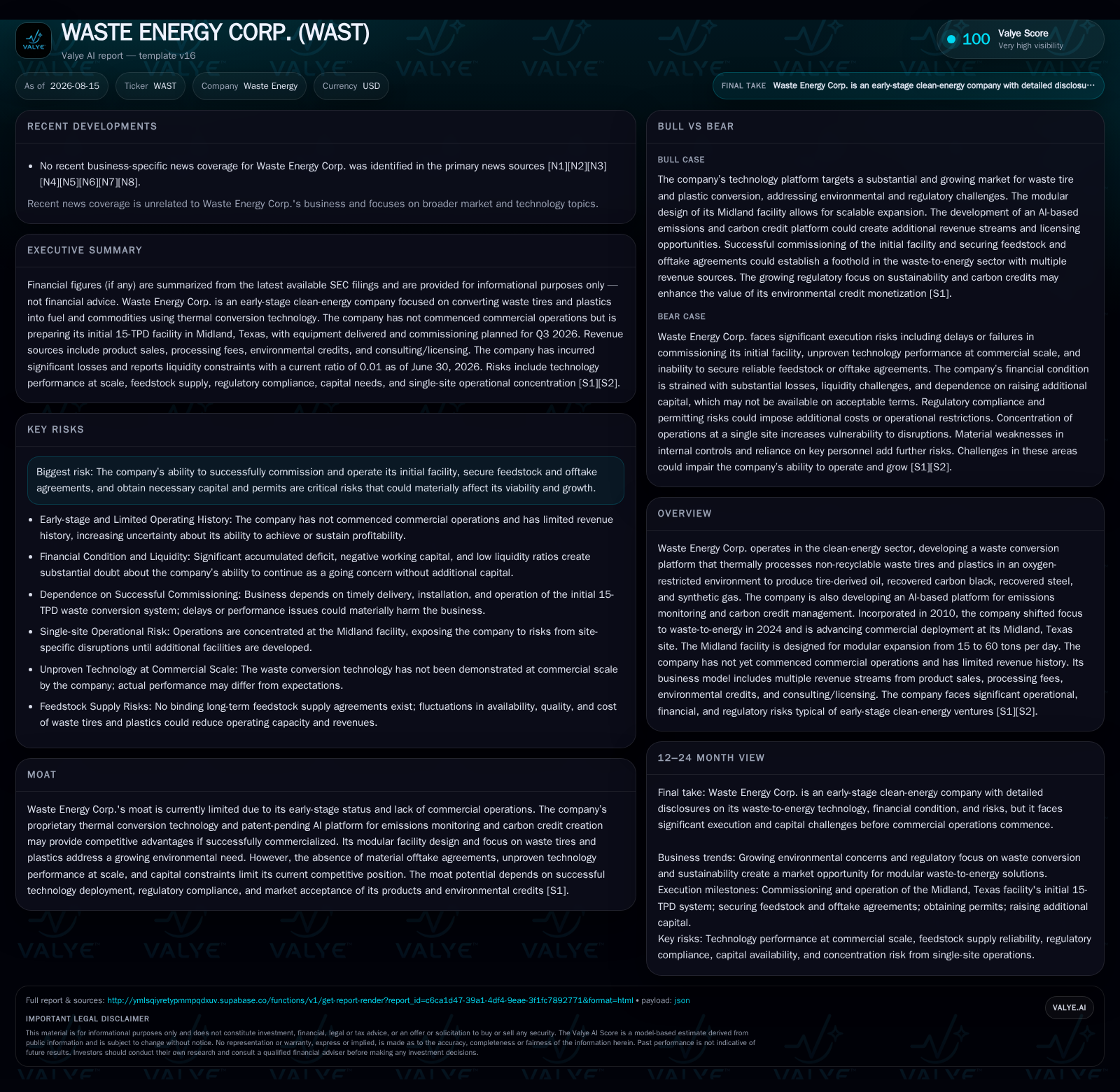
Waste Energy Corp., an early-stage clean-energy firm specializing in thermal conversion of non-recyclable waste tires and plastics, is progressing towards commercial operations at its Midland, Texas facility with a design modularly scalable up to 60 tons per day. The company’s multi-pronged business model anticipates revenues from product sales (tire-derived oil, recovered carbon black, steel), processing fees, environmental credit monetization, and AI-driven consulting/licensing services. Despite the upcoming commissioning milestone, Waste Energy faces significant risks typical for nascent waste-to-energy companies including technology scale-up uncertainty, feedstock and offtake agreement development, regulatory permitting challenges, and constrained liquidity with a precarious current ratio. Key industry drivers such as landfill reduction mandates and carbon credit market growth underpin potential growth if operational execution succeeds.
Recent Operating Update
Waste Energy Corp. reported in its latest quarterly filing that it is approaching the commissioning phase of its initial 15 tons-per-day (TPD) waste conversion system at its Midland, Texas site, targeting operational capability in the third quarter of 2026 [S2][S6][F1]. This milestone marks a crucial transition from development to commercial deployment for the company’s proprietary thermal conversion technology that uses elevated temperatures in an oxygen-restricted environment to process non-recyclable waste tires and plastics into valuable outputs including tire-derived oil (TDO), recovered carbon black (rCB), recovered steel, and synthetic gas (syngas) [S1][S6].
Despite this progress, Waste Energy has not yet secured all required permits for full-scale operations at Midland nor contracted binding long-term feedstock or offtake agreements; existing arrangements remain contingent upon analytical validation of product outputs [S8][S10][S16]. The company’s ability to convert this near-term commissioning success into recurring revenue hinges critically on finalizing these commercial contracts and navigating complex environmental regulations imposed by state and federal agencies such as the Texas Commission on Environmental Quality (TCEQ) and EPA frameworks [S8].
Business Model Specifics
Waste Energy’s business model is structured around multiple complementary revenue streams typical within advanced waste-to-energy firms:
- Product sales: sale of tire-derived oil primarily targeting industrial users or refiners who may further distill TDO into diesel-equivalent fuels; recovered carbon black aimed at polymers, pigments, coatings manufacturing; recovered steel sold as scrap metal;
- Feedstock processing fees: tipping fees charged to municipalities, tire haulers, transfer stations, industrial generators for accepting waste feedstock;
- Environmental credits: anticipated generation and monetization of carbon credits, plastic credits, and other sustainability-linked incentives through both regulated markets and voluntary transactions;
- Consulting/licensing: leveraging its developing AI-based platform for emissions monitoring, PFAS detection in feedstock, and automated carbon credit tracking which may be licensed or offered as a service.
Revenue recognition occurs upon shipment or delivery of products for sales streams and upon acceptance of feedstock for processing fees. Environmental credit revenue depends on certification milestones while licensing income will vary based on contract terms [S1][S10]. Such diversification can improve resilience but also introduces complexity in monetization particularly given evolving regulatory standards around credits.
Industry Structure and Competitive Positioning
Operating within the waste-to-energy sector focusing on non-recyclable tire/plastic thermal conversion situates Waste Energy among a select emerging peer group tackling challenging mixed waste streams through advanced technologies. The industry is capital-intensive with high barriers due to regulatory compliance demands and technology scalability needs. Companies like Enerkem focus on bioconversion to fuels while Covanta provides traditional waste-to-energy incineration services; Waste Energy differentiates by pursuing a modular system emphasizing near-waste source siting to lower logistics costs.
However, Waste Energy's competitive position is limited by its early stage—commercial operations have not commenced and there is no proven track record of steady-state throughput or product quality at scale yet [S6][S16]. The absence of finalized long-term supply/offtake agreements means key commercial validation remains pending unlike some more established peers who benefit from integrated contracts securing feedstock volume stability.
Its patent-pending AI emissions monitoring platform could provide a strategic edge if successfully implemented as regulation increasingly demands transparent environmental reporting; however, commercialization timing here is still uncertain.
Growth Drivers
Several structural trends support demand expansion:
- Increasing regulatory pressure on municipalities and industries to reduce landfill use and mitigate pollution drives demand for scalable waste conversion solutions addressing tires/plastics that traditional recycling routes cannot handle effectively.
- The projected tripling of global plastic waste by 2060 underscores mounting urgency for innovative remediation technologies [N/A - Industry context].
- Expansion of carbon credit markets, especially under tightening climate policies in North America and globally, could generate supplemental high-margin revenue streams via verified emissions reductions tied to operations.
- Modular facility design offers flexible scalability allowing incremental capacity additions aligned with feedstock availability and regional partnerships minimizing upfront capital burden.
- Ongoing technological advances improving yield efficiencies for critical products like TDO and rCB enhance unit economics when operational reliability is demonstrated.
- Growing corporate sustainability commitments create potential demand pull for environmentally differentiated recovered materials bundled with verified environmental credits.
Risks and Constraints
Waste Energy confronts significant risks typical of early-stage waste-to-energy ventures:
What To Watch Next
Key milestones will focus heavily on commissioning progress at Midland:
- Actual start date of commercial operations beyond mere equipment installation reported traction would mark credibility gain.
- Progress securing binding long-term feedstock supply contracts sufficient to support ramped processing capacity scales.
- Finalization of material offtake agreements including buyers interested in TDO derivatives or recycled materials at commercially viable pricing levels.
- Receipt of all necessary permits validating regulatory compliance enabling unrestricted operations.
- Demonstration metrics such as sustained throughput rates approaching design capacity lines (initially 15 TPD), stable product yield per ton processed (oil %, rCB %, steel %), emissions levels meeting permit limits.
- Development pace of AI emissions monitoring/credit platform including prototype deployments or third-party licensing commitments providing alternate revenue sources beyond physical processing.
- Capital raise announcements or debt financing deals reflecting enhanced liquidity accommodating operating cost coverage estimated around $900K annually plus facility completion capex needs as disclosed [S11]
Financial Profile Discussion
As of June 30, 2026, Waste Energy held approximately $26K in cash against over $5 million in current liabilities translating into a distressed liquidity position marked by a current ratio near 0.01—a critical red flag suggesting urgent financing requirements just to maintain minimal ongoing obligations [F1]. Total debt stands at about $87K with modest net debt after cash offset though overshadowed by payables principally related to accrued expenses tied to affiliated parties under dispute [F1][S20]. Historical losses totaled approximately $4 million over the last two years with no positive EBITDA generation so far highlighting ongoing burn rate without offsetting operating revenue apart from limited legacy consulting income [$424K in 2025] [F1][S1].
The company openly acknowledges substantial capital needs primarily focused on completing facility commissioning plus scaling up capacity sequentially toward their envisioned network rollout strategy centered on modular deployment near core waste sources favorable from feedstock logistics cost perspectives [S7]
While equity or debt raises are planned options along with credit facilities attempts may be hampered by penny stock classification/small market capitalization status compounded by going-concern auditor statements raising cost/risk premiums considerably for new investors funding bridge needs [F1][S11]. Dilution will be inevitable if equity issuances occur reflecting typical capital challenges faced by early-stage infrastructure-heavy cleantech startups.
This analysis incorporates only publicly filed SEC disclosures through August 14th, 2026. The company remains highly speculative pending successful commercialization execution. Investors should monitor tangible operating progress alongside financial developments carefully before considering exposure.
Disclaimer: This is research-only, informational analysis and not investment advice. It may include AI-generated interpretation and general industry context. Always verify important details using primary sources.

Comments