
Piermont Valley Acquisition Corp’s Approaching Deadline Tests Redemption Vulnerability and Control Weaknesses
Recent surge in shareholder redemptions and material internal control deficiencies heighten risks to Piermont Valley’s pending business combination.
Piermont Valley Acquisition Corp, a Cayman Islands-incorporated SPAC focused on completing a business combination, faces significant execution pressure as its redemption activity has accelerated. The latest 10-Q reveals that substantial Class A shares have been redeemed, materially reducing trust account liquidity critical for deal funding. Concurrently, management disclosed ongoing material weaknesses in disclosure controls and financial reporting, magnifying investor uncertainty. These developments underscore heightened risks amid the narrowing window to consummate a transaction and raise questions about the feasibility of completing a de-SPAC merger without further extensions or recourse.
During the relevant period, holders of over 18.75 million Class A ordinary shares redeemed their shares at roughly $10.51 each for a total withdrawal of about $197.2 million from funds reserved specifically for acquisition purposes [S2]. Post-redemption, only approximately 204,450 Class A shares remain subject to possible redemption [S2], signaling mass divestment among the public investors as speculation or doubts mount regarding the company's ability to consummate its targeted merger.
This level of redemptions substantially diminishes the capital base retained in the trust account dedicated for funding an acquisition transaction. Since SPACs rely on pooling IPO proceeds within these segregated accounts—typically invested conservatively in U.S. Treasury Bills—to maintain deal currency and pay redemptions upon shareholder exercise of their rights, this outflow poses direct threats to financing capacity at closing [S2]. The depletion intensifies pressure on management to either find a viable acquisition swiftly or seek extensions that lengthen the timeframe to secure an operating company partner
Given that shareholder redemption rights are contractually protected and exercisable within defined windows ahead of merger votes, high redemption rates are strongly correlated with waning investor confidence in proposed deals and often portend financing challenges absent robust PIPE (Private Investment in Public Equity) support or sponsor capital infusions.
Complexities of Accounting for Redeemable Class A Shares Under ASC 480 Challenge Financial Clarity
Piermont Valley accounts for its redeemable Class A ordinary shares in line with ASC Topic 480-10-S99 guidance on accounting for redeemable equity instruments not solely under company control [S2]. This mandates that such shares be classified outside permanent equity as temporary equity because shareholders maintain redemption rights independent of management decisions.
In practice, this classification entails initially allocating IPO proceeds between Class A shares subject to redemption and attached freestanding Public Warrants using relative fair value measures under ASC Topic 470-20. For Piermont Valley’s recent reporting period, approximately $12.6 million was allocated to these redeemable shares and recorded against temporary equity balances while warrant liabilities impacted earnings by roughly $800,505 [S2]
This delicate fair value allocation creates inherent earnings statement volatility pre-business combination since changes in fair values reflect market perceptions of redemption likelihood and warrant exercisability rather than operational performance. Investors should interpret fluctuations in temporary equity levels as proxy signals regarding expected deal outcomes and prevailing redemption dynamics.
SPAC Model Review: Trust Account Integrity and Sponsor Alignment Define Merger Success
Piermont Valley Acquisition Corp's foundational IPO structure deployed standard SPAC mechanics: issuance of Units comprising one Class A ordinary share coupled with half a Public Warrant priced initially at $10 per Unit generating gross proceeds exceeding $230 million inclusive of over-allotments [S1]. Funds were held securely in a Trust Account predominantly invested in short-term U.S. Treasury securities ensuring preservation ahead of deployment for business combinations.
The Sponsor group transitioned via a Founder Conversion involving issuance of over five million Class A ordinary shares replacing Class B founder shares thereby realigning ownership stakes ahead of merger activities [S2]. Sponsor shares typically embed economic incentives aligned with consummating deals before deadlines through governance influence and potential post-merger upside participation but also represent dilution risk for public shareholders when converted.
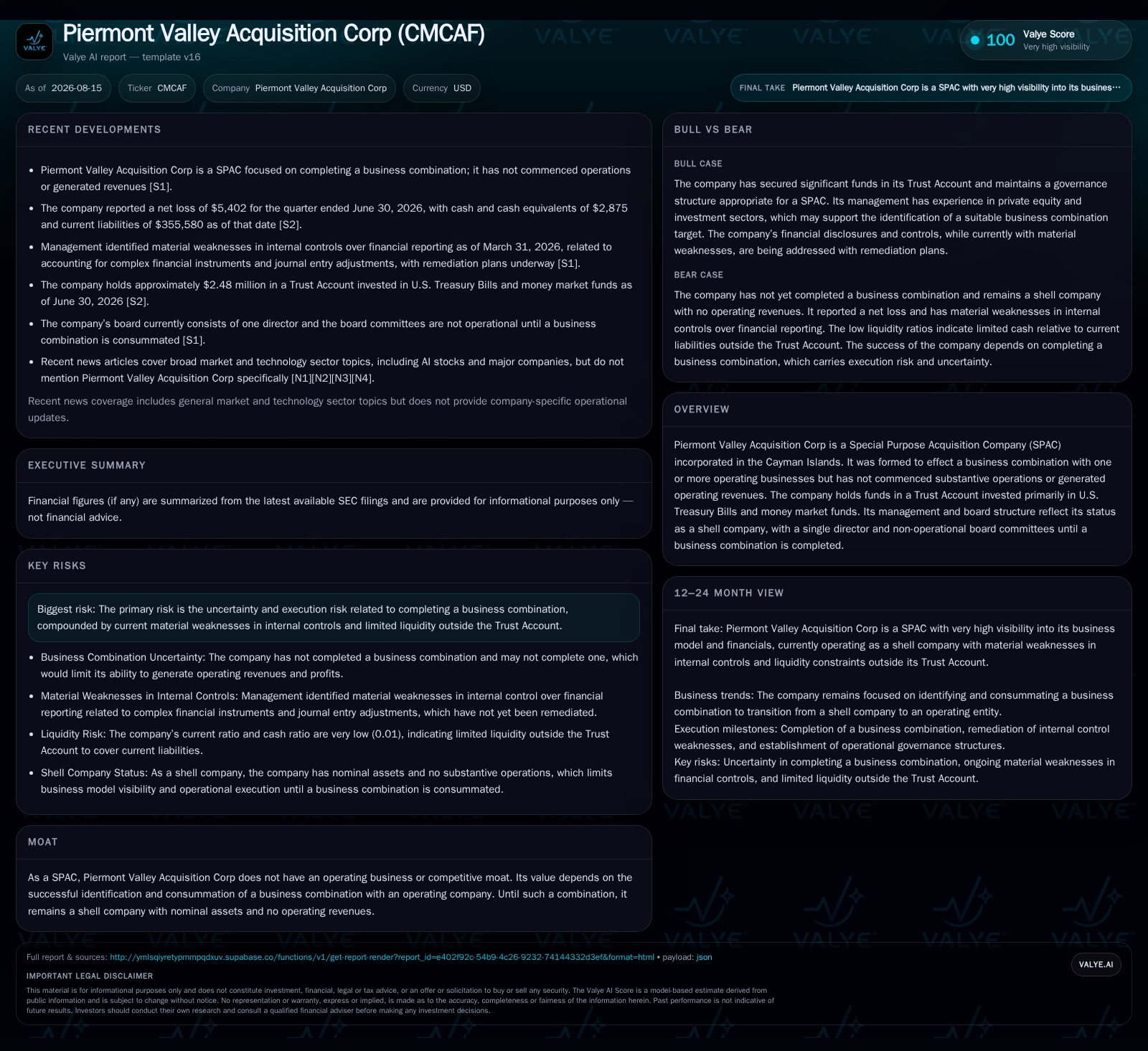
The Board's composition reflects classic SPAC governance—a single director until acquisition closure—placing substantial reliance on Sponsor management expertise.
Redemption Impact Benchmarked Against Peer SPAC Experiences and Market Expectations
Elevated redemption rates at Piermont Valley parallel phenomena witnessed in peer SPACs confronting imminently expiring business combination windows. Pershing Square Tontine Holdings notably confronted hyper-redemption pressures necessitating protracted negotiations and sponsor-led capital commitments to sustain sufficient deal funding levels.
Industry practice underscores that rampant shareholder redemptions constrain available transaction capital unless offset by external PIPE investments or sponsor bridge loans which can mitigate closure risks but add complexity around dilution and governance reconfiguration. As such, high redemption can compress valuation multiples negotiated with target companies and pressure sponsors toward concessions or seeking regulatory extensions.
Execution Risks Heightened by Internal Control Weaknesses and Limited Operating History
Piermont Valley disclosed material weaknesses in both disclosure controls and internal control over financial reporting as evaluated by management at March 31, 2026 [S1]. Such findings often arise from minimal operational infrastructure inherent to shell companies lacking substantive transactions or systems pre-acquisition but highlight potential vulnerabilities in financial statement accuracy or timeliness during critical reporting periods.
This deficiency introduces audit risk factors especially when transparency is paramount amid investor scrutiny ahead of vote solicitations for mergers. Combined with an absence of revenues or diversified operations typical for SPACs navigating early life stages prior to combination, these control issues accentuate investor wariness.
Growth Limited to Management's Deal Flow Capacity and Shareholder Approval Dynamics
Piermont Valley’s pathway toward growth remains contingent on securing business combination agreements alongside shareholder voting approvals within compressed timeframes established by Nasdaq listing rules extending only until March 2025 after several granted extensions [S2], [S1]. Each extension option necessitates affirmative shareholder consent while imposing additional costs and reputational hurdles.
Management experience emerges as a pivotal KPI given its direct link to identifying viable targets amid competitive acquisition environments where private companies increasingly prefer direct IPOs or private equity exits absent SPAC intermediaries. Deal flow quality and speed coupled with maintaining supportive investor sentiment through transparent communications form key execution levers for eventual de-SPAC success.
Watchpoints: Extension Filings, Redemption Trends, Warrant Exercise Activity, and Announced Target Updates
Key upcoming indicators include whether Piermont Valley petitions shareholders for further extensions beyond current deadlines which would provide breathing room but reflect fragile deal fluidity [S2]. Continued monitoring of redemption trends will reveal if erosion stabilizes or accelerates—critical for judging achievable transaction sizes.
Exercise activity on Public Warrants also warrants attention since high exercise rates could inject liquidity but simultaneously dilute existing shareholders affecting ultimate ownership post-merger [S1]. Lastly, any announcements updating progress relating to Tigerless AI Holdings Inc., the announced acquisition target from earlier filings yet not consummated as of mid-2026, will materially shift valuation assumptions and risk outlooks
Financial Profile Discussion: Liquidity Concentration Informing Viability Under Redemption Pressures
As of June 30, 2026, Piermont Valley reported cash and cash equivalents totaling only $2,875 outside its Trust Account balanced against current liabilities approximating $355,580 yielding an acute current ratio near 0.01 highlighting severe short-term liquidity constraints unrelated to trust monies directly set aside for deal funding [F1]
Net income remained negative at roughly -$1.7 million reflecting ongoing operating expenses encompassing legal fees, professional services related to merger efforts, corporate overheads plus costs tied to maintaining regulatory compliance [F1]. While typical for non-operating SPACs during formation phases, these figures spotlight cash burn necessity careful stewardship particularly given dwindling external liquidity beyond safeguarded trust funds.
In sum, Piermont Valley Acquisition Corp navigates a precarious intersection where surging redemptions compound structural financial fragility intensified by control environment deficiencies stressing delivery windows mandated by listing requirements. Management’s ability to arrest capital erosion through deal closure or strategic extension solicitations alongside credible execution sets immediate assessment benchmarks moving forward.
Disclaimer: This is research-only, informational analysis and not investment advice. It may include AI-generated interpretation and general industry context. Always verify important details using primary sources.

Comments