
XBP Global Holding Growth Amid AI-Enabled Workflow Transformation
XBP Global's latest quarterly results underscore its strategic execution of AI-driven automation in regulated workflows while managing capital intensity and cybersecurity risks.
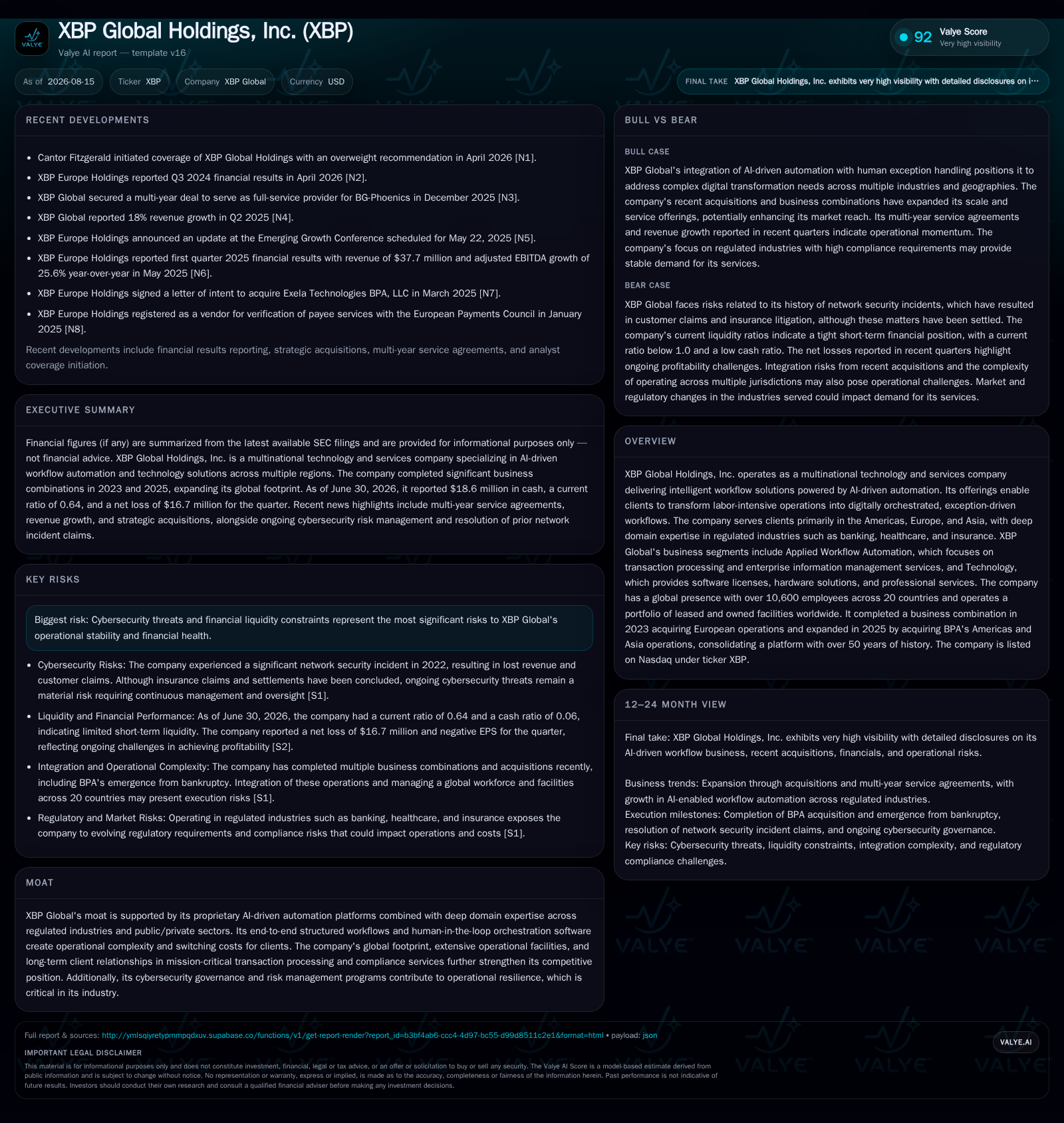
In its August 2026 quarterly report, XBP Global Holdings demonstrated ongoing commitment to its AI-enabled workflow automation business model centered on regulated industries. The company balances recurring SaaS licensing and managed transaction processing with a capital-intensive global footprint, supporting scalability and compliance demands. Cybersecurity governance remains a core pillar mitigating operational risks, critical in maintaining client trust in mission-critical workflows. Liquidity constraints and competitive pressures from SaaS pure-plays highlight near-term challenges amid an expanding digital transformation market.
Recent Second Quarter Operating Developments Validate Business Strategy Execution
Client engagement dynamics underscore the importance of long-term contract renewals typical of multi-year agreements prevalent in this sector. The company's human-in-the-loop orchestration platform imbues complex compliance controls directly into workflows, enhancing stickiness by cultivating switching costs associated with vendor lock-in around operationally critical processes [S1]. This dynamic partly shields XBP from disruption by pure-play SaaS providers despite evolving technology landscapes.
However, no sharp inflection or large new contract announcements are evident from the filings, indicating a more incremental expansion pattern consistent with the high-touch B2B nature of these contracts that often involve prolonged sales cycles but stable renewal profiles [S2]. Net revenue retention rates, if reported in future filings, would be a valuable metric to assess this underlying client base health.
AI-Driven Automation and Regulated Sector Focus Define XBP’s Competitive Moat
XBP's moat is multifaceted stemming from proprietary AI-driven automation platforms tightly integrated with domain-specific regulation expertise. Its offerings convert labor-intensive manual processes into digitally orchestrated workflows driven by exception management and compliance requirements—a niche where nuanced industry knowledge meets tech innovation [S1].
The company's core advantage lies in layering human-in-the-loop orchestration on configurable intelligent workflows enabling real-time exception handling within transactional workloads bound by strict regulatory frameworks such as anti-money laundering (AML), HIPAA for healthcare data privacy, and insurance claims adjudication.
These intricate combinations produce operational complexity that raises barriers to entry for competitors lacking the scale or domain expertise to replicate comparable end-to-end automation solutions. Furthermore, deep integration with client IT systems fosters ecosystem entrenchment via multi-year contracts which drive predictable revenue streams despite partial industry disruption from newer cloud-native SaaS players. Such differentiated service delivery models generate switching costs beyond software licensing alone—involving trust in compliance stability and data security.
In light of increasing regulatory scrutiny worldwide, this dual focus on technology innovation aligned with governance standards positions XBP competitively within the broader AI-enhanced business process outsourcing space.
Balancing Software Licensing Growth Against Capital-Heavy Managed Services Operations
XBP monetizes its solutions primarily through two segments as detailed in the annual 10-K: Applied Workflow Automation encompassing transaction processing and enterprise information services, contrasted with Technology segment revenues driven by software licenses, hardware sales, and professional services engagements [S1]
This structure creates a tension characteristic of hybrid SaaS/BPO business models: software licenses typically yield higher gross margins due to scalable distribution but represent only part of total revenue. Conversely, the Applied Workflow Automation segment demands significant capital investment to maintain global operational facilities that manage high-volume transaction processing. This leads to depressed overall margin profiles due to fixed cost absorption tied to leased and owned properties plus labor-intensive service components.
XBP's portfolio includes over 1.8 million square feet spanning 83 leased facilities and five owned properties strategically located globally including primary data centers [S1]. Facility utilization rates—critical KPIs influencing profitability—are not quantified explicitly but can materially affect operating leverage given the high fixed-cost base.[F1] Capital efficiency depends on balancing geographic delivery capability against growing transaction volumes from existing clients and new wins.
Global Delivery Model Efficiency Underpins Scalability During Industry Digital Transformation
The company’s extensive worldwide footprint supports regional compliance adherence while facilitating proximity for large-scale client engagements [S1]. Facilities span primarily North America (California, Connecticut, Illinois), Europe (France, Germany), Asia (India), and other regions including the Philippines. The presence of fiber connectivity across sites underpins system uptime crucial for mission-critical workflow processing.
This diversified geography limits overreliance on any single regulatory jurisdiction but requires complex coordination overhead internally—especially as clients demand scalability alongside localized compliance customization. Multi-regional operations also hedge against geopolitical or policy upheavals impacting individual markets.
Operational scalability hinges on increasing utilization rates at existing facilities supported by continued transaction volume growth coupled with efficiency gains via automation upgrades. Given the capital intensity inherent in facility management versus purely cloud-based SaaS providers, monitoring utilization metrics is essential to evaluate incremental operating margin improvement potential.
Navigating Cybersecurity Governance as Both Risk Mitigation and Client Retention Lever
Cybersecurity remains central both as an operational risk factor and competitive differentiator for XBP given its clientele’s exposure to highly sensitive data sets under stringent legal frameworks [S1]. The company's governance model delegates risk oversight to the Board's Audit Committee supported by the CTO’s seasoned security leadership who manages cross-functional teams specialized in threat detection, prevention, response, and recovery.
Historical precedent includes a notable network outage incident in late 2022 causing revenue disruption and customer claims settlements totaling approximately $1.9 million accrued liabilities at year-end 2025 [S1]. Insurance recoveries have partially mitigated financial impacts through litigation settlements with excess insurers initiated subsequently.
The absence of recent reported cybersecurity incidents post-2022 suggests effective remediation though vigilance remains critical given evolving threat landscapes. Stringent cybersecurity measures bolster trust especially among financial services clients where compliance breaches carry heavy penalties. Consequently, cybersecurity program robustness influences customer churn rates positively by reducing incident-induced contract non-renewals.
Growth Opportunities Anchored in Regulated Industry Demand for Intelligent Workflows
Digital transformation within heavily regulated industries like banking, healthcare, and insurance drives sustained demand for XBP’s intelligent workflow orchestration solutions. Growing regulatory complexity necessitates exception-driven automation embedding compliance checks directly into transaction lifecycles—a growing market trend aligning perfectly with XBP’s product roadmap.
Market expansion opportunities exist geographically across emerging markets where regulatory frameworks are maturing, creating demand for vendor expertise combining technological sophistication with compliance enforcement. Additionally, ongoing enhancements to AI platform capabilities broaden use cases beyond basic transaction processing toward analytics-driven decision support improving client operations further.
Repeatable multi-year contracts anchored around subscription-based SaaS licenses combined with managed services rollout support stable ARR growth potential if sales execution sustains momentum [S2]. An exact pace depends still on new contract bookings metrics not presented yet but anticipated to be key disclosures going forward.
Operational Risks: Liquidity Constraints, Cybersecurity Incidents, and Competitive Dynamics
Material risks highlighted include liquidity pressure illustrated by a current ratio calculated near 0.64 as of June 30, 2026 based on current assets ($196.8 million) versus current liabilities ($307.9 million) [F1], underscoring constrained short-term financial flexibility that could hamper aggressive investment initiatives or capex scaling.
Further compounding financial stress is elevated net debt approximating $356 million against modest cash reserves ~$18.6 million reflecting capital-intense operations requiring careful debt management amidst platform R&D spend commitments [F1].[S2]
Competitive pressures emerge both from dedicated enterprise SaaS workflow architecture vendors deploying cloud-native models prioritizing lower fixed cost bases as well as integrated BPO firms augmenting traditional outsourcing with technology overlays—challenging XBP’s hybrid model status quo.
Continual innovation coupled with tightly monitored cybersecurity safeguards will be crucial defensive pillars alongside optimized facility utilization standards to mitigate margin erosion risks.
Financial Profile Discussion: Capital Structure amidst Growth Investments
The latest quarter reveals that XBP operates with approximately $18.6 million in cash equivalents against $374.5 million total debt as of June 30, 2026 signaling significant leverage tied primarily to its capital-heavy managed services infrastructure [F1]. This leverage posture necessitates disciplined liquidity stewardship particularly given suboptimal current ratio dynamics near two-thirds coverage of short-term obligations by liquid assets alone.[F1]
While substantial debt levels constrain free cash flow flexibility somewhat relative to pure software peers with lighter balance sheets, they reflect necessary funding for global facility leasing/ownership supporting large transaction volumes integral to core client offerings [F1]
Linking finance to operations underscores imperative balance between sustaining R&D investment cycles critical for AI platform enhancement—with associated long development timelines—and prudent working capital management protecting operational continuity amid external shocks or cyclical demand shifts noted historically.[F1]
This analysis consolidates insights drawn strictly from recent SEC filings ([S1], [S2], [S3]) supplemented by company facts ([F1]) without speculative extrapolation beyond documented evidence. Valye News presents this report solely for informational purposes without offering investment research views or advice.
Disclaimer: This is research-only, informational analysis and not investment advice. It may include AI-generated interpretation and general industry context. Always verify important details using primary sources.

Comments