
Franklin XRP Trust's Passive Crypto ETF Model Highlights Custody and Liquidity Challenges
The Fund offers regulated, exchange-listed exposure to XRP but faces risks from custody mechanics and XRP price volatility.
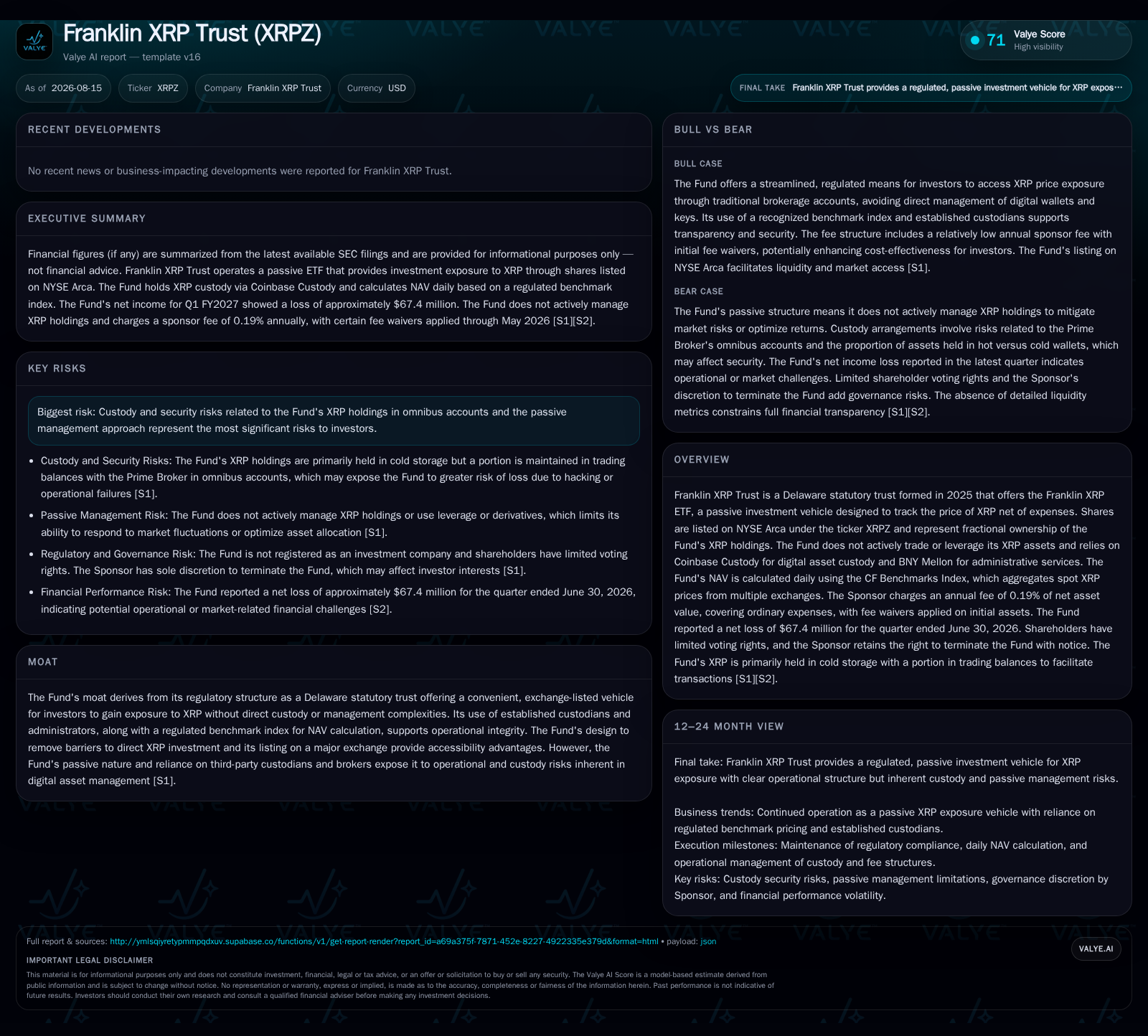
Franklin XRP Trust (XRPZ) is a Delaware statutory trust offering the Franklin XRP ETF, a passive investment vehicle designed to track the price of XRP net of expenses. The Fund relies on Coinbase Custody for digital asset custody and BNY Mellon for administration, issuing shares on NYSE Arca. While the structure enhances investor access to XRP without direct ownership complexities, it entails significant operational risks tied to custody arrangements, reliance on third-party service providers, and volatility in XRP prices. The Fund employs no active trading or leverage, and creation/redemption processes depend on Authorized Participants and prime brokers, adding layers of operational complexity.
Recent Operating Update
No new operational developments or litigation emerged this quarter. The Fund continues relying on Coinbase Custody for secure digital asset storage and BNY Mellon for administrative duties. Daily NAV calculations remain anchored to the CF Benchmarks Index that aggregates spot XRP trades across multiple exchanges during a defined afternoon window ([S1],[S6]).
Business Model Overview
Established as a Delaware statutory trust in early 2025 with its ETF shares listed on NYSE Arca under ticker XRPZ ([S1]), Franklin XRP Trust offers investors regulated exposure to XRP without requiring direct ownership or self-custody. Investors hold shares representing fractional undivided beneficial interests in the Fund’s aggregate XRP holdings rather than owning tokens outright ([S1]).
The Fund operates as a passive vehicle: it does not actively manage or leverage its holdings but instead seeks to track XRP’s price minus expenses. Revenues derive primarily from an annual management fee of 0.19% of net assets, with initial fee waivers covering ordinary expenses including custody fees payable to Coinbase Custody and administrative fees paid to BNY Mellon ([S1]).
NAV calculation depends on CF Benchmarks—a regulated pricing index that computes volume-weighted median prices aggregated from constituent exchange platforms between 3:00 p.m. and 4:00 p.m. daily—ensuring consistent valuation critical for investor confidence ([S1]).
Liquidity is provided through Authorized Participants—registered broker-dealers such as Virtu Americas LLC and Jane Street Capital LLC—that create or redeem shares exclusively in Creation Units of 50,000 shares ([S6]). These participants transact directly with the Fund via in-kind delivery or receipt of exact quantities of XRP or cash equivalents reflecting NAV plus transaction costs ([S1],[S22]).
Operationally distinctive is the dual custody model: Coinbase Custody serves as primary custodian holding assets largely offline in Vault Balances (cold storage), while an affiliated Prime Broker maintains Trading Balances in omnibus accounts used for facilitating creations/redemptions and fee payments ([S5],[S18]). Neither Sponsor nor Fund controls how much XRP is held in cold versus hot wallets within these omnibus accounts, exposing investors to tradeoffs between liquidity needs and security protocols inherent in crypto custodianship.
Industry Structure and Competitive Context
Franklin XRP Trust exemplifies a growing category bridging traditional ETFs with digital asset exposures. By providing regulated securities traded on established exchanges that hold cryptocurrencies directly, it addresses investor challenges related to custody complexity, tax treatment, regulatory compliance, and operational burdens associated with direct crypto ownership.
Peers include trusts like Grayscale Bitcoin Trust (GBTC), which offer passive exposure but have faced discount/premium volatility partly due to limited redemption options. Other competitors encompass diversified crypto ETFs such as Bitwise Crypto Industry Innovators ETF.
The use of reputable custodians like Coinbase Custody alongside benchmark providers like CF Benchmarks aligns with industry efforts towards transparency and security credibility. Authorized Participants from established broker-dealers enhance secondary market liquidity.
Industry-wide challenges persist around tracking error risks stemming from timing differences in NAV calculation windows versus real-time spot prices, custody vulnerabilities inherent in omnibus account structures lacking full segregation, regulatory uncertainty over digital asset products, and competitive pressures driving fee compression.
Franklin XRP Trust’s regulatory structure as a Delaware statutory trust combined with NYSE Arca listing provides broad market accessibility while outsourcing custody complexities to specialized third parties.
Growth Drivers
Structural trends supporting demand for products like Franklin XRP Trust include:
- Increasing institutional adoption seeking regulated cryptocurrency exposure amid improving regulatory clarity;
- Expansion of Authorized Participant networks enhancing creation/redemption volumes and liquidity;
- Investor preference shifting toward low-cost passive vehicles offering simpler access compared with direct token purchases;
- Advances in custodial technology improving security assurances;
- Growth in overall digital asset market capitalization bolstering ETF AUM potential.
For investors targeting XRP specifically, this Trust offers a streamlined alternative that avoids blockchain interaction complexities yet provides daily tradability on NYSE Arca ([S1]). Cost-efficient passive fee structures appeal broadly amid retail cost sensitivity.
Risks and Constraints
Custody arrangements present key risks: assets held in omnibus hot wallets managed by the Prime Broker lack segregation guarantees, raising counterparty exposure concerns ([S5],[S18]). Regulatory changes could impose new compliance burdens or restrict operational flexibility.
Tracking error arises from NAV calculation methodology relying on a one-hour afternoon trading window via CF Benchmarks Index rather than continuous spot pricing ([S1]), compounded by market spreads affecting Authorized Participant creation/redemption economics.
Legal risks are minimal currently; no material litigation has been disclosed ([S8]). Nonetheless, evolving regulatory scrutiny remains an important watchpoint given shifting policy landscapes around crypto investment products.
Initial Seed Capital Investor underwriting provided early funding stability at IPO stage ([S1]), but future growth depends entirely on market acceptance amid competitive crypto investment alternatives.
What to Watch Next
Investors should monitor:
- Creation Unit flow patterns indicating shifts in investor demand;
- Changes or additions among Authorized Participants influencing liquidity dynamics;
- Updates regarding fee waiver status or expense ratio adjustments impacting cost competitiveness;
- Any modifications to custodian or prime broker arrangements potentially enhancing asset segregation or security;
- Regulatory developments affecting trust classification or reporting obligations;
- Tracking error analyses comparing NAV versus spot XRP performance revealing index replication fidelity;
- Market volatility events influencing NAV per share beyond baseline expectations.
While no forward guidance is provided explicitly ([S2]), quarterly disclosures of fund flows and NAV trends will signal ongoing operational health.
Disclaimer: This is research-only, informational analysis and not investment advice. It may include AI-generated interpretation and general industry context. Always verify important details using primary sources.

Comments