
Franklin Templeton Holdings Trust Spurs ESG Leadership with Responsibly Sourced Gold ETF
FGDL maintains steady operational execution with a low-fee structure while differentiating through responsible sourcing in a competitive gold ETF market.
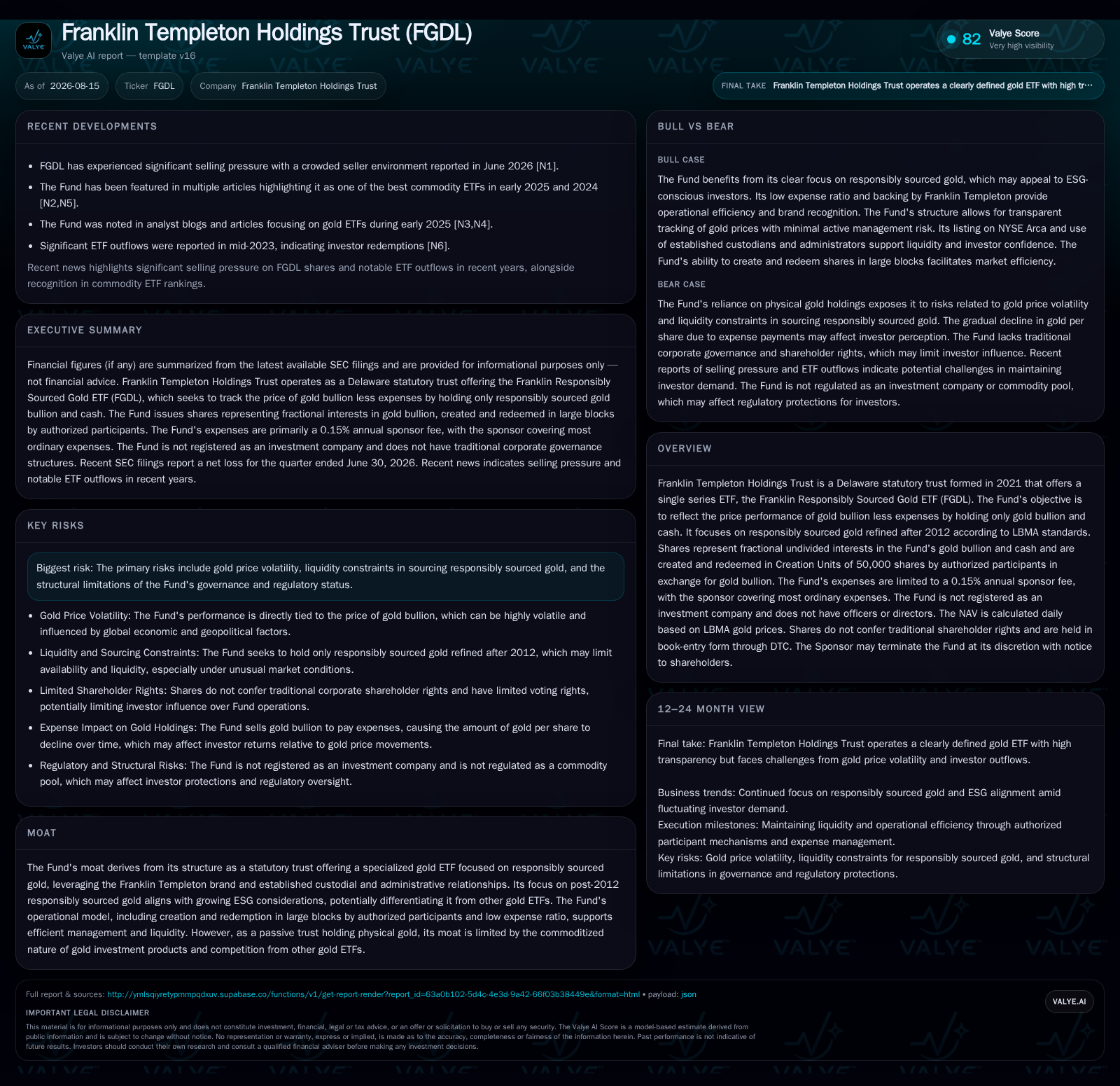
Franklin Templeton Holdings Trust’s Franklin Responsibly Sourced Gold ETF (FGDL) reported stable quarterly operations with consistent creation and redemption activity and NAV fluctuations closely tracking LBMA gold prices [S2]. The Fund's focus on post-2012 London Bullion Market Association (LBMA) certified responsibly sourced physical gold uniquely positions it within the commodity ETF sector amid rising ESG investor demand [S1]. Its passive structure, minimal expense ratio maintained through a 0.15% sponsor fee, and creation/redemption framework support efficient NAV tracking and liquidity. Key risks include gold price volatility and potential challenges in sourcing sufficient responsibly sourced gold during periods of market stress. Important near-term indicators include monitoring creation/redemption volumes and sponsor fee revenue trends as proxies for asset growth and investor adoption.
Quarterly Operating Stability Reinforces Passive Gold Exposure with ESG Focus
The Fund’s NAV movements remain tightly correlated with fluctuations in LBMA PM gold prices. The Fund holds only physical gold bullion plus minimal cash for operational needs. This direct backing ensures that FGDL operates as a pure passive vehicle reflecting actual commodity pricing less modest expenses. Sponsor fees accrue predictably as a fixed percentage of NAV.
Business Model Rooted in Physical Gold Backing and Low Fee Structure
Organized as a Delaware statutory trust since April 2021, FGDL differs structurally from traditional corporate or open-ended funds by lacking officers or directors and featuring limited shareholder governance rights [S1]. It offers a single series ETF designed solely for direct ownership of allocated physical gold bars refined under London Bullion Market Association (LBMA) Responsible Gold Guidance since January 1, 2012.
This emphasis on post-2012 refined bars addresses growing investor demand for ethically sourced commodities amid increasing scrutiny of mining supply chains. The Fund’s allocated bars are custodied by JPMorgan Chase Bank’s London vaults under audited third-party verification procedures that identified no non-conformities [S22]. This custody arrangement bolsters transparency and security essential for tangible asset-backed ETFs.
Authorized Participants create or redeem shares only in Creation Units by delivering or receiving the equivalent quantity of physical bullion based on daily NAV pricing. This mechanism limits secondary market inefficiencies while preserving narrow bid-ask spreads typical of liquid commodity ETFs.
A critical competitive advantage is the Fund’s modest annual sponsor fee of 0.15%, which covers nearly all ordinary expenses including administration, custody fees paid to BNY Mellon Asset Servicing (the Administrator), trustee indemnification costs, NYSE Arca listing fees, SEC registration fees, audit expenses, legal fees up to $500k annually, and licensing costs [S3]. By internalizing these expenses rather than passing them directly onto investors beyond the stated sponsor fee, FGDL maintains a lower effective expense ratio than many peers.
Competitive Positioning: ESG Differentiation Amidst Larger Commodity ETFs
Within the physical-gold-backed ETF landscape dominated by products like SPDR Gold Shares (GLD) and iShares Gold Trust (IAU), FGDL stands out through its environmental, social, and governance (ESG) commitment requiring responsible sourcing certified under LBMA standards post-2012 [S1]. While GLD and IAU benefit from scale-driven liquidity and broad institutional adoption, they do not impose explicit vintage or ethical sourcing restrictions.
FGDL leverages Franklin Templeton’s brand recognition and sustainability orientation to attract investors prioritizing impact-aligned commodity exposure fully backed by tangible assets without derivative overlays common elsewhere.
Nevertheless, competition remains intense given scale advantages enjoyed by larger ETFs that translate into tighter bid-ask spreads and lower implicit costs. The largely commoditized nature of physical gold investing means differentiation relies mainly on brand credibility, custody reputation (e.g., JPMorgan), expense efficiency, product transparency, and compliance with responsible sourcing standards.
Growth Drivers Linked to ESG Demand and Macroeconomic Uncertainty
Macro trends support FGDL’s growth prospects amid heightened volatility in equity markets coupled with sustained inflation concerns that enhance interest in tangible portfolio diversifiers like gold.
Simultaneously, heightened attention on environmental and social impacts within mining sectors fuels demand for ETFs guaranteeing responsibly sourced metals compliant with LBMA’s post-2012 refinements criteria [S1]. This aligns well with institutional mandates increasingly integrating ESG factors.
Liquidity enhancements may arise from expanding Authorized Participant networks facilitating higher Creation Unit volumes. This expansion improves market depth allowing sizeable flows without disrupting pricing.
Its filings highlight multiple variables influencing spot gold prices including large-scale sales by official holders such as central banks; fluctuating hedge activities among producers; speculative sentiment shifts; geopolitical events disrupting supply chains; inflation expectations; interest rate changes; trading activities by hedge funds; plus unforeseen shocks such as sanctions limiting Russian-origin bullion availability following exclusion of Russian refiners from LBMA lists [S1], [S28].
The Fund’s commitment to holding only responsibly sourced post-2012 refined bars introduces an additional layer of liquidity risk absent in generic commodity ETFs. Supply constraints during abnormal market conditions may force temporary holdings of pre-2012 or alternative inventory until normalcy returns [S25], potentially causing minor tracking deviations mitigated through custodial best efforts.
The statutory trust structure also means shareholders have limited voting rights or protective claims typical in corporate entities which could affect recourse options under adverse circumstances.
Counterparty risks center on custodian solvency exposures related to allocated/unallocated accounts where smooth redemption depends on coordinated operations among fund administrators and Authorized Participants acting as intermediaries [S16], [S21].
Monitoring Indicators: Creation/Redemption Volumes & Sponsor Fee Trends
Investors should track quarterly disclosures detailing Creation Unit issuances versus redemptions reflecting aggregate inflows or outflows that directly modulate Assets Under Management (AUM) impacting sponsor fee revenues proportional to NAV.
Premium/discount spreads between market share price versus NAV provide real-time insights into secondary market liquidity efficiency signaling arbitrage opportunities that Authorized Participants exploit to maintain close pricing convergence.
Sponsor fee accruals reflect both AUM movement patterns alongside any adjustments related to extraordinary expense coverage provisions within limited discretionary scope favoring sponsor interests.
Given its recent establishment approaching five years since inception in April 2021 combined with disciplined cost controls embedded within sponsor agreements covering essentially all recurring expenses except limited extraordinary legal claims ensures sustained efficient margin profiles closely tied to AUM fluctuations documented via creation/redemption activity reported quarterly ([S3], [S7]).
Disclaimer: This analysis is based exclusively on public SEC filings dated August 14, 2026 ([S2]) and June 29, 2026 ([S1]), supplemented by company facts data ([F1]). It does not constitute investment advice but provides an analytical overview grounded solely on disclosed information.
Disclaimer: This is research-only, informational analysis and not investment advice. It may include AI-generated interpretation and general industry context. Always verify important details using primary sources.

Comments