
ASP Isotopes Advances Helium Production and Radiopharmacy Amid Merger and Commissioning Uncertainties
Recent quarterly updates reveal ASP Isotopes progressing toward helium project production with notable liquidity but faces merger-related execution risks.
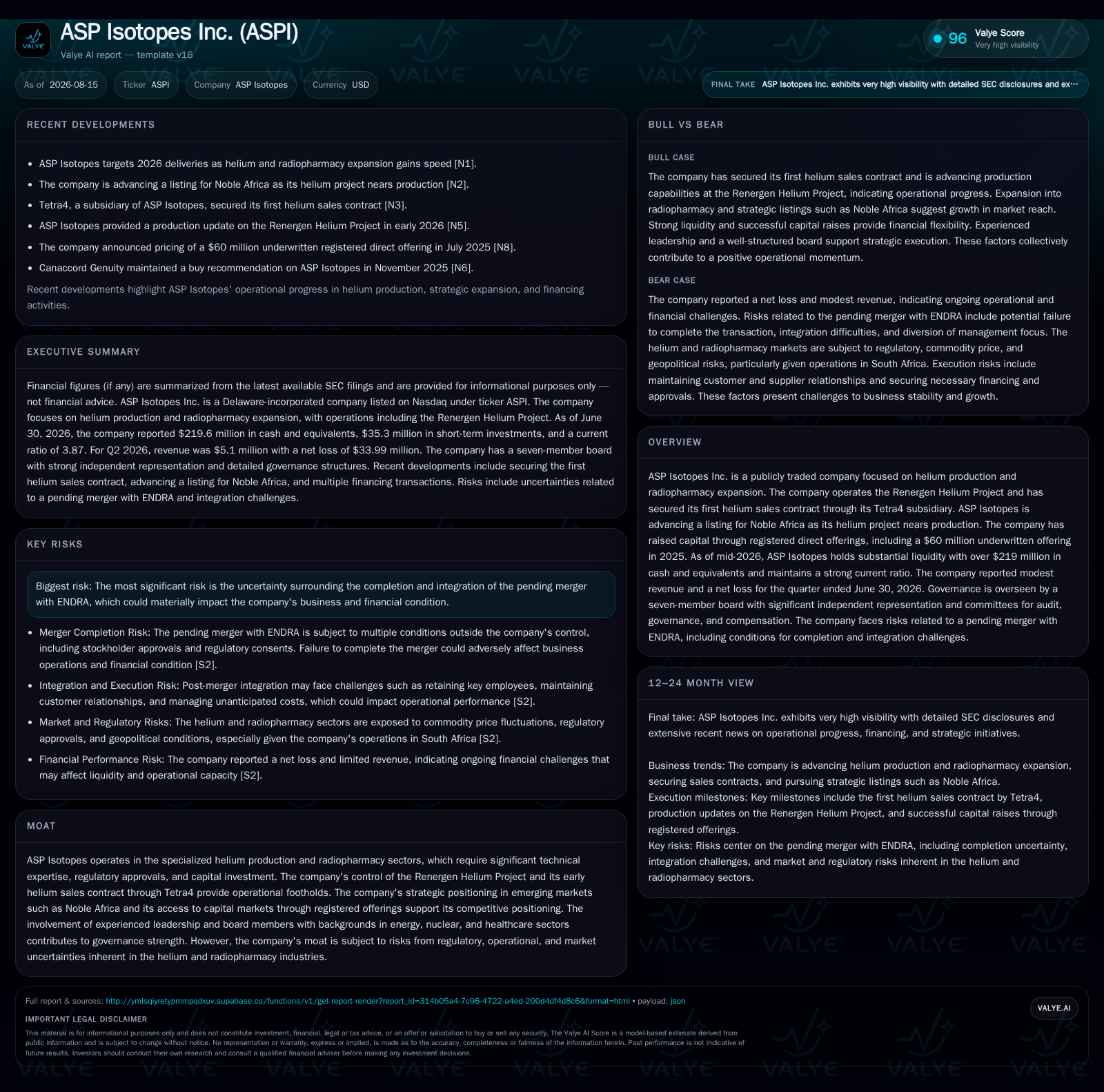
ASP Isotopes Inc. reported continued development of its Renergen Helium Project and expansion in radiopharmacy through its subsidiary Tetra4, including securing its first helium sales contract. Despite modest revenue and ongoing net losses in the latest quarter, the company benefits from strong liquidity and a robust current ratio, positioning it for capital-intensive growth. However, the pending merger with ENDRA introduces execution risks that could materially alter the business profile. ASP’s dual focus on helium extraction and isotope production requires navigating complex regulatory and operational challenges inherent to both industries.
Recent Operating Update
ASP Isotopes’ latest quarterly filing for Q2 2026 underscores ongoing advancement toward production readiness at its flagship Renergen Helium Project [S2]. The company also confirmed a key milestone securing its first commercial helium sales contract through its Tetra4 subsidiary specializing in liquefied natural gas (LNG) and related helium products [S3]. This contract validates the company's efforts to monetize its helium reserves during project commissioning, expected to unfold across late 2026 into early 2027. Concurrently, ASP is progressing plans for listing Noble Africa on the Nasdaq as the vehicle that will hold equity interests in Renergen, aimed at enabling clearer capital market access to finance expansion [N2].
Business Model
ASP Isotopes pursues a dual business model straddling upstream helium extraction via its Renergen Helium Project and midstream radiopharmacy operations centered on isotope production and distribution [S1]. The helium segment’s revenue derives primarily from gas sales under offtake contracts—which provide volume commitments at contracted pricing—and spot market transactions. Helium extraction depends heavily on capital expenditure deployment for well drilling, extraction facilities, purification processes ensuring helium purity levels meeting industrial standards, plus logistics for delivering liquefied or compressed gas to customers
On the radiopharmacy side, ASP delivers radiopharmaceutical isotopes mainly to healthcare providers and research institutions through controlled supply chains sensitive to regulatory approval timelines around radioactive handling licenses. Monetization from isotope sales typically involves contracts aligned with hospital or clinical purchasing cycles. Both segments share elevated capital intensity but benefit from differentiated technical expertise requirements serving distinct end markets—industrial gas consumers versus medical diagnostic sectors.
Industry Structure and Competitive Position
The helium industry is characterized by scarce global supply constrained by limited reserves geographically clustered in select regions such as the US Southwest and parts of Africa. Competitors include established industrial gas conglomerates like Air Products & Chemicals and Linde plc that command broad scale advantages, established purification infrastructure, long-term customer relationships, and cost-curve leadership. ASP’s positioning leverages emerging African reserves through Renergen while seeking niche differentiation by coupling helium production with LNG outputs integrated into its Tetra4 platform.
In the radiopharmacy arena, competition involves specialized manufacturers like Cardinal Health or Curium Pharma who have entrenched regulatory compliance frameworks and extensive product pipelines in medical isotopes. ASP’s entry into this segment benefits from growing healthcare demand for advanced diagnostics but faces challenges scaling capacity amidst strict governmental oversight.
Growth Drivers
Structural growth drivers across ASP’s segments comprise rising global demand for high-purity helium used extensively in electronics manufacturing (e.g., semiconductor fabrication), cryogenics for MRI machines, and scientific research applications. Securing long-term offtake contracts will underpin sustained revenue flows amid volatile spot pricing.
Radiopharmaceutical demand growth is driven by expanding diagnostic imaging adoption worldwide combined with novel therapeutic applications increasing radioactive isotope usage. Regulatory approvals facilitating new isotope products or geographic expansions could significantly expand addressable markets.
Technological advancements that improve extraction efficiency or reduce purification costs can enhance margins over time. Additionally, successful commissioning milestones as indicated by stable operational throughput at the Renergen project will prove foundational before scaling output volumes meaningfully.
Risks / Watchpoints
The predominant near-term risk remains the uncertainty around timely execution of the merger with ENDRA [S2]. Completion depends on multiple contingencies beyond ASP's direct control—including shareholder approvals at ENDRA’s side, requisite cash thresholds particularly relating to a $50 million investment into Noble Africa's financing structure, U.S. International Development Finance Corporation consents tied to existing finance agreements with Tetra4 subsidiaries, plus Nasdaq listing effectiveness [S2]. Failure to satisfy these conditions or delays could divert management attention away from core operations while imposing sunk costs without merger synergies materializing.
Operationally, both segments face regulatory hurdles: helium extraction requires environmental permits; radiopharmacy development hinges on stringent nuclear medicine licensing. Supply chain reliability for critical inputs such as specialty equipment or raw materials represents additional points of vulnerability given recent global disruptions.
Commodity price volatility presents margin risk on the helium side if ASP lacks tariff structures insulating contracted sales volumes versus spot exposure. Moreover, integration risks post-merger may affect workforce stability or customer retention if prolonged uncertainty persists.
What to Watch Next
Key upcoming milestones include successful commissioning events at Renergen confirming sustainable operational throughput aligned with design parameters around volume and purity standards—critical indicators signaling progress toward meaningful helium revenues [N1]. Progress updates regarding Noble Africa's listed status and receipt of associated capital investments should clarify project financing visibility.
Closely monitor regulatory approvals related to radiopharmaceutical product launches or expansions that would signal material revenue diversification potential beyond energy resource dependence.
Merger-related developments remain a central watchpoint: shareholder voting outcomes at ENDRA alongside clear disclosures on financing tranches release timing will define whether deal closure proceeds or complications emerge impacting ASP's standalone strategy execution capacity.
Financial Profile Discussion
ASP Isotopes enters the transition toward commercialization backed by substantial liquidity totaling approximately $220 million in cash equivalents against total debt near $60 million as of June 30, 2026 [F1]. This net cash position provides necessary runway for ongoing ramp-up capex commitments essential in both helium infrastructure buildouts and radiopharmaceutical capacity expansions.
Capital markets access remains vital—the successful raising of $60 million through registered direct offerings during 2025 offers evidence of external investor confidence supporting developmental milestones [N2]. Future capital raises or strategic partnerships may be required depending upon timing shifts in project commissioning or potential merger outcomes.
Conclusion
ASP Isotopes operates at an inflection point balancing promising advances toward operational production in its dual-focused business model against persistent execution and integration risks tied chiefly to a pending complex merger transaction.
The niche combination of upstream helium exploration coupled with midstream radiopharmaceutical isotope services creates opportunities aligned with evolving market needs across industrial gases and healthcare sectors yet demands careful navigation amidst competitive pressures from established global players bearing cost leadership advantages.
Investors and industry observers should focus closely on operational throughput metrics for pure helium volumes delivered under contract obligations alongside clear signals regarding regulatory certifications relevant to expanding radiopharma footprint. Success in these domains alongside clarity around the ENDRA merger's completion dynamics will define medium-term value creation potential while underscoring sector-specific volatility inherent in these specialized energy resource markets.
Disclaimer: This is research-only, informational analysis and not investment advice. It may include AI-generated interpretation and general industry context. Always verify important details using primary sources.

Comments