
TSS, Inc. Leverages AI Integration Facility Upgrade Amid Customer Concentration Risks
Following a major $40 million facility upgrade enabling AI rack integration scale, TSS must manage significant dependency on its single dominant OEM customer.
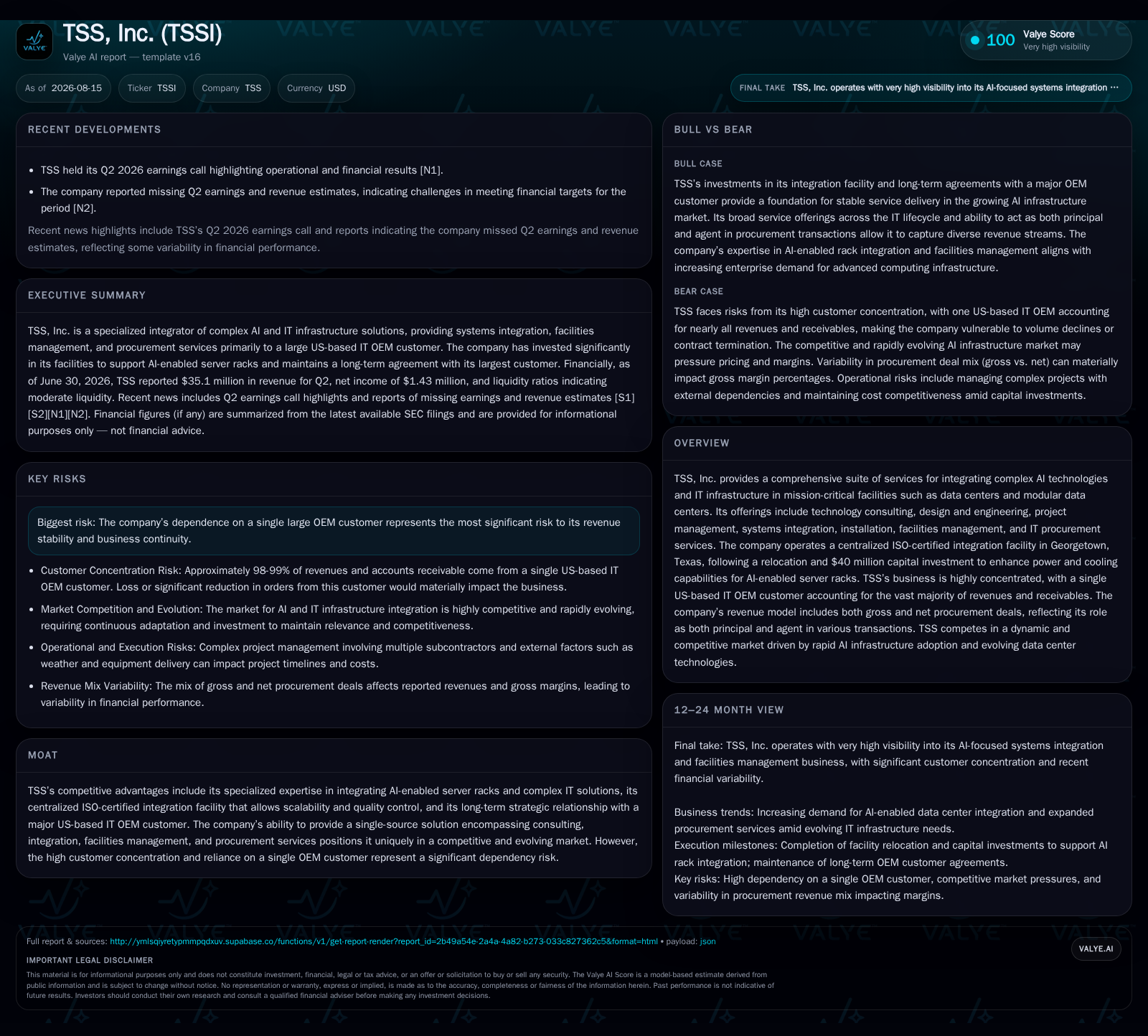
In its Q2 2026 filing, TSS, Inc. highlights completion of substantial capital investments in its Georgetown integration facility, expanding power and cooling capacity critical for AI-enabled server rack deployments. While the enhanced operational footprint supports rising demand for complex AI infrastructure integration, the majority of TSS's revenue remains tightly concentrated with one large U.S.-based OEM customer under a long-term agreement. This concentration creates meaningful revenue volatility risk despite contractual minimum payment safeguards. The company's full-spectrum offering—from consulting through facilities management—positions it well in a competitive market that increasingly values end-to-end AI infrastructure expertise. Key near-term focus will be on contract renewal developments and utilization rates at the upgraded facility as indicators of sustainable growth.
Q2 2026 Operational Update Validates Capacity Expansion for AI Rack Integration Demand
In its latest 10-Q filing dated August 13, 2026 [S2], TSS confirms the completion of significant capital expenditures totaling approximately $40 million at its Georgetown, Texas integration facility. This investment expanded the site's electrical power delivery and cooling infrastructure to support both air-cooled and direct liquid cooled (DLC) AI-enabled server racks — critical as next-generation AI hardware exhibits sharply increasing power and thermal density requirements [S1]. Notably, this centralized ISO-certified facility enhances TSS's ability to scale integrations with multiple testing and validation stations tailored specifically for demanding AI rack architectures. While no explicit utilization metrics were disclosed this quarter, operational commentary implies ramp-up is underway to meet anticipated volume growth from their primary customer. The sustained presence of minimum monthly payments under their long-term integration contract provides some revenue visibility but actual expansion will depend on how quickly utilization can scale alongside evolving AI hardware deployments [S3],[N1]. Confirmation of growth will be signaled by consistent backlog buildup and higher throughput at integration stations; conversely delays or softness in demand from the OEM partner would challenge this thesis.
TSS’s End-to-End Service Model Anchored by Deep Expertise and Robust Procurement Roles
TSS offers a comprehensive suite encompassing technology consulting, engineering design, project management, systems integration and installation services complemented by facilities management and IT procurement capabilities [S1],[S26]. This full lifecycle approach enables TSS to act as a single-source integrator capable of tailoring solutions for mission-critical facilities deploying cutting-edge AI infrastructure. Their procurement business uniquely operates on a mixed-model basis: in some transactions they act as principal—recognizing gross revenues when transforming products—while in others as agent—recording net fees when brokering third-party solutions without taking control [S15]. This dynamic shapes margin profiles across service lines.
Compared to peers such as Flex Ltd. and Celestica Inc., who provide broad-scale hardware manufacturing and assembly services but may lack specialized focus on AI rack environments or concentrated customer strategic partnerships, TSS leverages this niche technical expertise to differentiate itself. Similarly, modular data center providers like Vertiv underscore the industry emphasis on integrating advanced power and cooling technology—a domain where TSS's recent capital infusion concretely improves competitive positioning. The strategic alignment with their dominant OEM customer has allowed TSS to deepen consulting involvement early in technology deployment cycles enhancing demand forecasting fidelity.
High Dependency on Single OEM Customer Poses Material Revenue Volatility Risk
A critical structural risk is TSS's extreme revenue concentration: approximately 99% in both 2024 and 2025 derived from one large U.S.-based IT OEM customer per company filings [S14],[S16]. Despite diversification efforts via expanded procurement services targeting other OEMs or systems integrators, meaningful offset is not evident yet [S3]. The existing long-term AI rack integration agreement includes mandatory minimum monthly payments aimed at covering most fixed costs related to the $40 million grade-up facility lease and debt servicing obligations [S1],[S24]. However, either party may terminate the contract with 180 days' written notice which would relieve the obligor from future payments beyond that period.
This creates downside operational leverage risks: volumes falling short due to client strategy shifts or external market pressures cannot be quickly mitigated given fixed overhead tied to specialized power-intensive facilities. The potential disproportionate earnings impact underlines why close monitoring of contract renewals or amendments is paramount.
Market Dynamics Favor Specialized Integration Amid Rapid AI Infrastructure Advances
The broader industrial hardware landscape is experiencing accelerated change driven by increased adoption of AI workloads requiring GPU-intensive server architectures housed in purpose-built racks demanding superior power density and thermal solutions. This fuels demand for integrators capable of managing complex system assembly alongside sophisticated facilities planning involving liquid cooling technologies.
Emerging competition includes large-scale contract manufacturers like Celestica as well as modular data center specialists such as Vertiv who emphasize their own innovations in power distribution and thermal management. Nonetheless, many of these firms lack TSS’s concentrated experience integrating evolving rack-scale architecture specifically within mission-critical enterprise data centers.
Hence TSS’s single-source consulting-through-procurement service positioning taps into key pain points around rapid deployment timelines and lifecycle support for new generative AI computing infrastructure installations.
Facility Capacity and Technology Investments Poise TSS for Growth but Require Vigilant Execution
The $40 million capital commitment upgrading the Georgetown site notably advanced electrical provisioning and liquid cooling readiness—technologies essential given rapidly rising rack-level power demands from new GPU generations [S1]. This investment also expanded testing stations allowing multi-rack integrations simultaneously which should improve throughput efficiency once fully ramped.
However, successful execution depends on scaling skilled labor amid supply chain complexity highlighted in recent risk disclosures addressing workforce challenges and component availability hurdles [S3]. The capital intensity also means operating leverage could magnify earnings volatility if volume growth stalls or client contracts shift unexpectedly.
Monitoring KPIs such as testing station utilization rates alongside procurement deal volumes (both gross principal deals and net agency deals) will give actionable insight into how effectively these capacity enhancements translate into financial returns.
Critical Milestones: Contract Renewal Timing and Facility Utilization Rates to Watch Next
Given contractual termination contingencies coupled with material fixed costs from lease obligations at Georgetown facility [S1],[S24], upcoming renewal decision points represent key near-term milestones bearing on revenue stability. Any indication of early termination risk from either side must be closely tracked.
Similarly, deployment progress measurable by backlog levels under long-term agreements alongside ramped utilization metrics at the upgraded site will validate whether recent capital expenditures align with accelerating demand.
Expanding customer relationships beyond the dominant OEM remains an ongoing objective albeit without clear evidence yet that it offsets concentration vulnerability adequately [S3],[N1].
Financial Profile Discussion: Strong Liquidity Cushions Customer Concentration Risk But Capital Commitments Persist
As of June 30, 2026, TSS reported cash and cash equivalents of approximately $67.7 million versus current liabilities around $62.2 million yielding a comfortable current ratio near 1.66x indicating solid near-term liquidity coverage [F1]. Total debt levels appear modest relative to cash balances based on available data with best-effort total debt around $1.6 million last confirmed end-2021; current net debt is therefore strongly negative implying limited leverage burden [F1].
This liquidity strength offers some buffer against upside/downside swings related to OEM purchasing patterns or potential short-term working capital needs arising from contract modifications or supply chain disruptions noted in SEC disclosures [S3]. However, sizable ongoing capital obligations linked primarily to debt service supporting the Georgetown lease mandate continued prudent financial planning.
Overall financial positioning supports operational strategy providing runway for execution risks inherent in scaling capacity against concentrated customer flows while maintaining flexibility for diversification initiatives within a highly competitive integration services marketplace.
Disclaimer: This analysis is based solely on publicly available information including SEC filings through August 2026 combined with sector knowledge frameworks. It does not contain investment advice or research views.
Disclaimer: This is research-only, informational analysis and not investment advice. It may include AI-generated interpretation and general industry context. Always verify important details using primary sources.

Comments