
Valuence Merger Corp. I Extends SPAC Deadline Amid Nasdaq Listing and Redemption Challenges
The SPAC continues searching for a life sciences or sustainable tech target in Asia with extended deadlines and a diminished trust account.
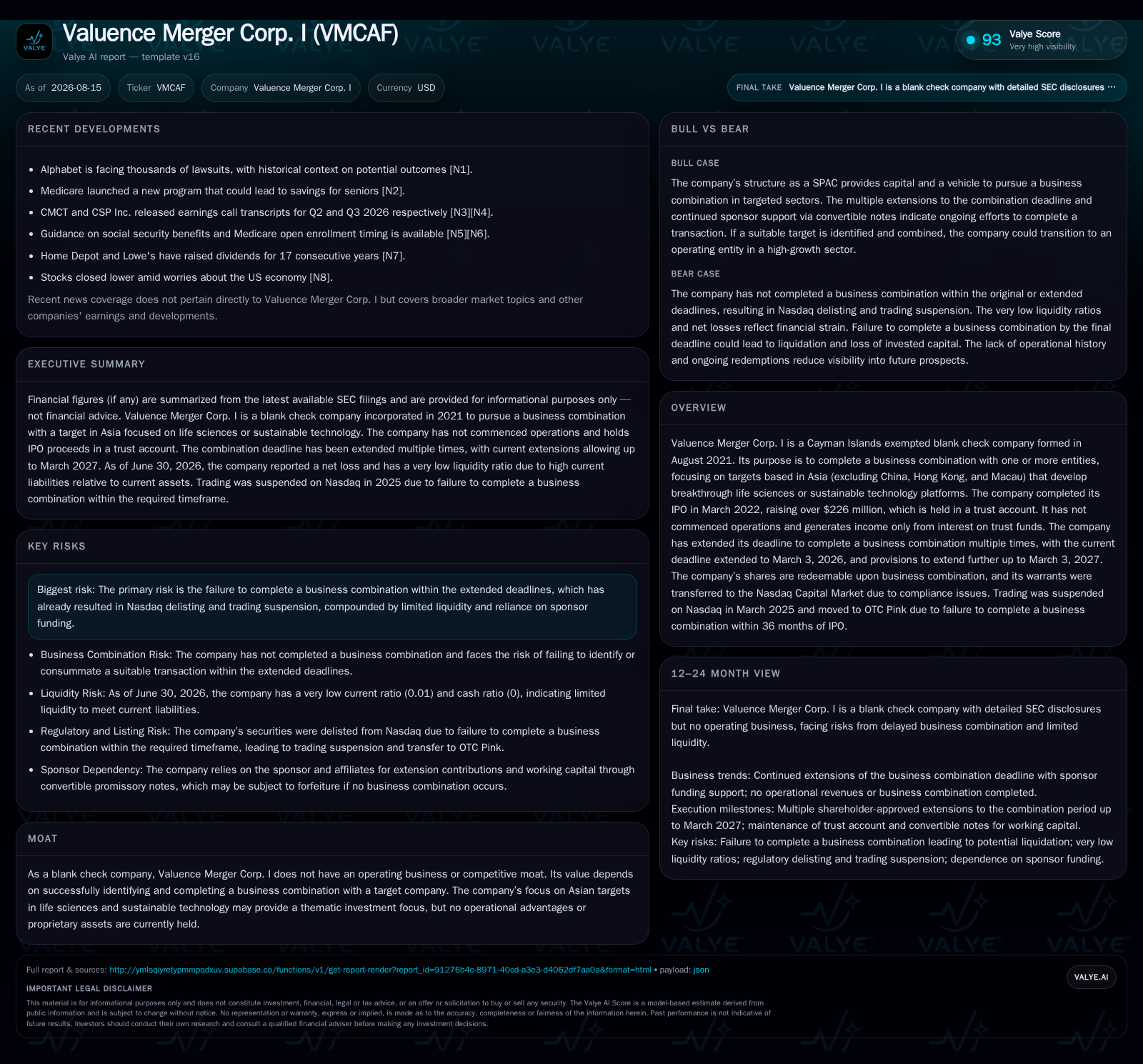
Valuence Merger Corp. I (VMCAF), a Cayman Islands exempted blank check company, is focused on acquiring an Asian-based life sciences or sustainable technology platform. Since its March 2022 IPO raising over $226 million held in trust, the SPAC has faced multiple deadline extensions, substantial shareholder redemptions, and compliance challenges resulting in a Nasdaq warrants listing transfer. As of August 2026, it extended its business combination deadline to September 3, marking the fourth one-month extension and underscoring ongoing execution risks. The company holds minimal unrestricted cash and depends on sponsor loans to fund operations while actively sourcing targets within its sector focus.
Recent Operating Update
Valuence Merger Corp. I’s latest quarterly filing dated August 14, 2026, confirmed no material changes to previously disclosed risk factors despite continued operational standstill [S2]. The Board approved a fourth one-month extension of the deadline to consummate an initial business combination—from August 3 to September 3, 2026—utilizing one of up to ten possible monthly extensions permitted under the company's governing documents. This extension was accompanied by an incremental deposit of approximately $13,900 into the Trust Account, a relatively modest amount compared to original IPO proceeds but reflecting ongoing efforts to preserve transaction flexibility [S3].
No definitive merger agreement has been announced publicly; however, the company remains engaged in sourcing targets aligned with its strategic focus on life sciences and sustainable technology platforms based in Asia excluding China, Hong Kong, and Macau. The absence of operating revenues persists as expected given the SPAC structure where commercial operations commence only post-business combination completion [S1].
Business Model Specifics
As a Special Purpose Acquisition Company (SPAC), Valuence Merger Corp. I raised capital through its March 2022 IPO by issuing units composed of Class A ordinary shares paired with half a public warrant each [S1][S16]. Concurrently, private placement warrants were sold at $1.50 apiece to the Sponsor and affiliates, generating total gross proceeds exceeding $226 million that were placed into a Trust Account invested conservatively in U.S. government securities or money market instruments until March 2024 when these holdings transitioned to interest-bearing bank deposits following amendments to investment guidelines
Revenue generation prior to business combination is limited exclusively to interest income earned on trust funds. The economic value creation hinges on consummating an initial transaction that brings private companies public via merger or acquisition, unlocking growth potential through access to capital markets.
The company emphasizes leveraging its management team’s M&A track record and broad network—including private equity firms, investment bankers, legal advisors—to identify high-potential targets within its stated sector and geographic focus [S1][S13]. Shareholder redemption rights present liquidity options but also pose risk by depleting capital available for deal financing.
Contingent deferred underwriting fees totaling roughly $8.1 million remain payable only upon successful completion of a business combination and are accounted for separately within the trust structure [S1]. To sustain operations amid protracted deal timelines, the Sponsor has extended multiple unsecured convertible promissory notes totaling several million dollars which provide working capital but carry dilution risk if converted into warrants under liquidation or failure scenarios [S5][S6][S16].
Industry Structure and Competitive Landscape
Within the SPAC ecosystem targeting sector-specific acquisitions—comparable examples include Pershing Square Tontine Holdings or Churchill Capital—success depends heavily on sponsor quality, pipeline strength of attractive private targets, market receptivity toward alternative listing routes versus traditional IPOs, and regulatory environment conditions.
Valuence Merger Corp. I’s niche in Asian life sciences and sustainability technology focuses on markets such as Japan, South Korea, and Singapore that are emerging innovation hubs outside China’s dominant presence. This regional specialization narrows but also differentiates its acquisition universe.
Competition arises from other SPACs pursuing overlapping sectors or geographies as well as from traditional IPO channels that have regained momentum following regulatory tightening around SPAC issuance globally.
Critical performance indicators include trust account size relative to redemptions (notably depleted here), number of extension periods utilized (four so far indicating execution challenges), shareholder redemption rates impacting deal funding capacity, pipeline robustness measured by potential targets evaluated (not publicly disclosed), and share price discount/premium relative to net asset value affecting investor sentiment.
Growth Drivers
The path forward depends fundamentally on executing a qualifying business combination within permitted timelines while managing shareholder redemption dynamics that can erode capital availability.
Management’s strategy centers on leveraging deep M&A expertise within Asia’s high-growth technology sectors; utilizing broad networks encompassing private equity funds and advisors; exercising flexibility offered by multiple extension provisions allowed up to March 3, 2027; and potentially accessing PIPE financing post-announcement to bolster transaction funding beyond trust assets.
These drivers face external headwinds including evolving regulatory scrutiny increasing disclosure demands for SPACs globally and fluctuating investor appetite between direct listings versus alternative vehicles.
Risks and Constraints
The principal risk is failing to close a business combination by the final deadline which would trigger liquidation procedures returning remaining trust assets after fees but at diminished scale due to prior redemptions [S14]
Historical redemptions have been substantial—over $167 million paid out representing more than two-thirds of initial IPO proceeds—intensifying funding pressures for any acquisition consideration [S1][S6]
Reliance on Sponsor-provided convertible promissory notes introduces leverage with potential dilution if converted into warrants should transactions fail or be delayed further [S5][S16]. Combined with minimal unrestricted cash (~$25k as of Q1 2024) against current liabilities exceeding $5 million mainly comprising accrued expenses and related party advances creates acute working capital deficits raising going concern considerations absent deal closure or new capital infusion [F1].
Regulatory compliance issues manifested in warrant listing transfers at Nasdaq underscore governance complexities potentially undermining investor confidence and liquidity dynamics [S16]
The lack of operating revenues prior to combination coupled with no definitive agreements heightens execution uncertainty amid competitive pressures from other SPACs and traditional IPO alternatives targeting similar sectors.
What to Watch Next
Key milestones include:
- Further deadline extensions beyond September 3, 2026: Up to six additional monthly extensions are available subject to board approvals requiring incremental financial contributions that extend operational runway but highlight integration stress.
- Announcement of definitive merger agreement(s): Disclosure will clarify target specifics enabling investor assessment against stated investment thesis.
- Shareholder vote outcomes on proposed business combinations: Redemption levels here will materially influence post-combination capital structure viability.
- PIPE financing commitments accompanying transaction announcements: Critical for augmenting deal size given depleted trust balances.
- Regulatory developments impacting SPAC operational rules: Potentially imposing enhanced disclosure or procedural burdens affecting timeline feasibility.
- Updates on trading status including potential relisting or further compliance actions at Nasdaq affecting liquidity.
- Cash flow trends reflecting administrative expense burn offset by sponsor loan availability remain important given looming deadlines without portfolio acquisitions yet realized.
Financial Profile Discussion
Latest available financial data reflect typical pre-deal SPAC liquidity challenges exacerbated by prolonged search durations.[F1] As of June 30, 2026: Current assets totaled approximately $56k including minimal cash equivalents ($25k reported at March 31, 2024), contrasted sharply by current liabilities exceeding $5.17 million primarily driven by accrued expenses and related party advances resulting in an extremely low current ratio near 0.01 indicating significant working capital deficiencies.[F1]
Trust account balances have been significantly drawn down due to shareholder redemptions though precise June quarter amounts are not detailed; initial allocations exceeded $220 million [S1][S6]
Deferred underwriting fees approximating $8.1 million remain contingent liabilities payable only upon successful business combination completion thereby limiting net distributable funds [S5]
Sponsor loans issued through convertible promissory notes since mid-2023 provide essential operational liquidity but pose dilution risk if converted into warrants upon liquidation or failed transactions [S5][S6][S16]
Interest income from trust investments has declined consistent with reduced principal amounts following redemption activity [S12]
Overall financial metrics underscore pressing liquidity management needs sustained primarily through sponsor funding arrangements pending either successful deal execution or orderly wind-down if deadlines expire unfulfilled.
Conclusion
Valuence Merger Corp. I exemplifies a late-stage blank check entity navigating typical sector maturation challenges: protracted target search durations leading to multiple deadline extensions; significant shareholder redemptions depleting core transaction funding; reliance on sponsor financing mechanisms accruing contingent dilutive claims; regulatory compliance hurdles impacting investor sentiment especially concerning warrant instruments; and execution uncertainty amid competitive pressures within targeted Asian life sciences and sustainability technology sectors.
While thematic alignment with innovation-driven environmental sustainability offers long-term appeal amid growing global ESG trends, near-term value realization critically depends on expeditious identification of suitable target(s), moderation of shareholder redemption levels preserving deal funding capacity, successful closing supported potentially by PIPE capital infusions, and effective management of regulatory compliance risks shaping market access.
Disclaimer: This is research-only, informational analysis and not investment advice. It may include AI-generated interpretation and general industry context. Always verify important details using primary sources.

Comments