
Security Midwest Bancorp's Local Market Focus and Governance Strength Under Recent Quarterly Lens
The latest quarterly filing highlights limited financial transparency but reinforces Security Midwest Bancorp’s governance and community banking positioning amidst evolving regional banking dynamics.
Security Midwest Bancorp, Inc.’s 10-Q for Q2 2026 reveals a net income of approximately $299,000 with minimal accompanying detail on core balance sheet metrics, reflecting typical disclosure constraints of smaller regional banks. The company leverages its local market expertise and a board with financial and real estate acumen to underpin risk oversight and strategic execution. Its business model, centered on net interest income from local lending and fee income from community-oriented banking services, competes in a landscape dominated by larger regional peers and fintech pressures. Growth prospects hinge on managing credit risk amid local economic conditions, navigating interest rate fluctuations, and expanding deposit bases, while key performance indicators around asset quality and loan-to-deposit trends remain critical to monitor.
New Operational Highlights from Q2 2026 Filing: Limited Detail but Key Governance Signals
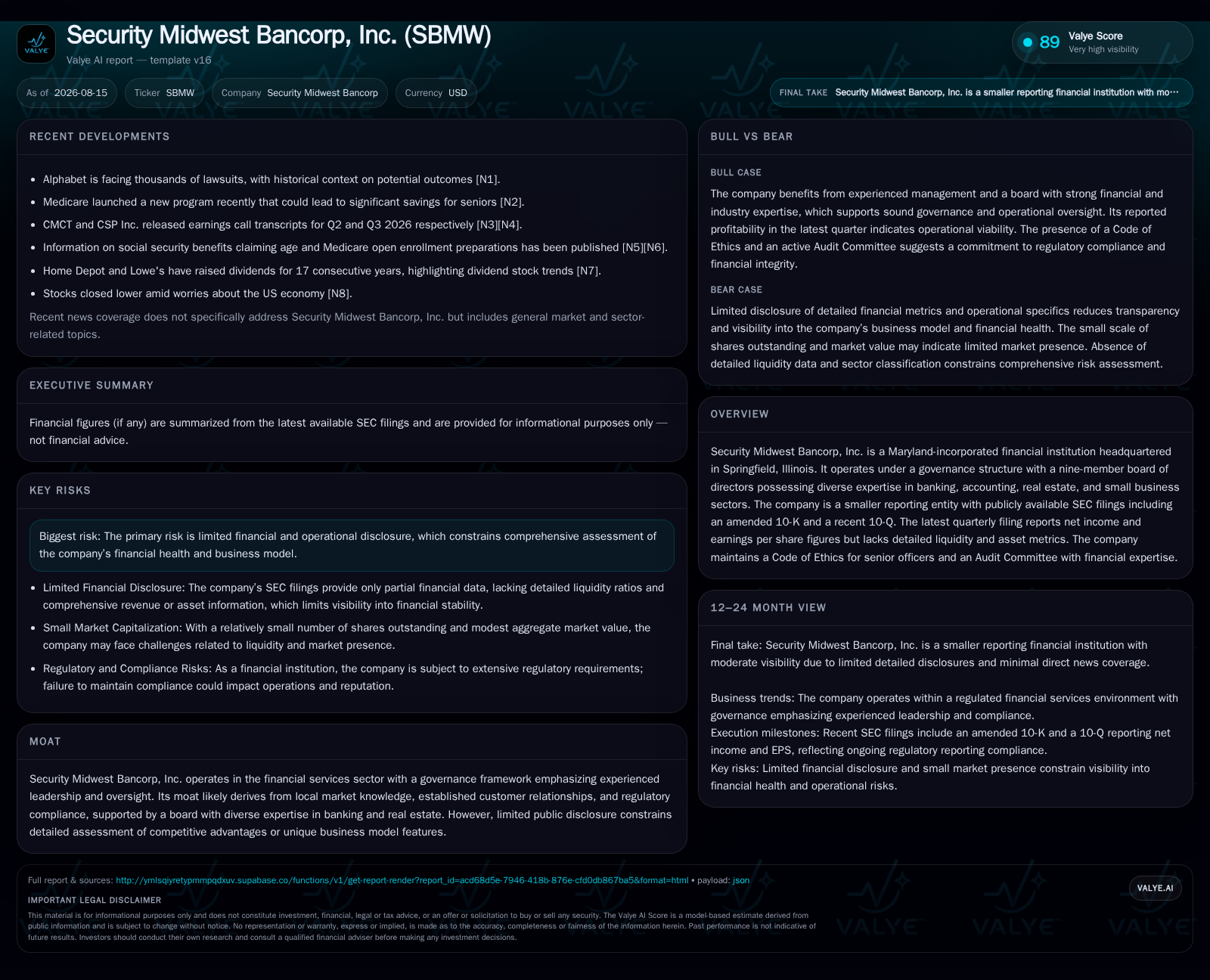
Notwithstanding these informational limitations, the governance framework emerges prominently as a lens through which operational stability can be inferred. The company maintains a nine-member board possessing diversified expertise spanning banking operations, accounting proficiency (including SEC audit committee financial experts), real estate market knowledge pertinent to collateral valuation and risk appraisal, alongside small business sector insights relevant to underwriting local commercial borrowers [S1]. This breadth supports effective risk oversight—a critical element given the inherently credit-risk exposed regional banking model.
The board’s composition also reflects active management engagement coupled with independent oversight typical of community banks seeking to navigate regulatory requirements while embedding local market knowledge into strategic decisions. This governance strength partially mitigates investor uncertainty created by the more limited quantitative data reporting.
How Security Midwest Bancorp Monetizes Its Community Banking Model Amid Disclosure Constraints
Security Midwest Bancorp operates as a classical community/regional bank focused on serving Springfield, Illinois and surrounding areas—a market strategy that prioritizes relationship-driven lending primarily to individuals and small-to-medium enterprises (SMEs) [S1]. The company’s revenue generation likely hinges on net interest income derived from originating loans at spread over cost-of-funds (deposit base largely comprising checking/savings accounts) balanced against interest paid on those deposits.
Given its scale and disclosure level, it is reasonable to assume modest net interest margins relative to larger regionals but supported by proximity-driven credit underwriting advantages. Ancillary fee income streams—transaction fees on deposits, loan servicing fees for mortgages or commercial loans—provide supplementary earnings that help diversify revenue but generally contribute less than core lending operations.
Regional Competitive Landscape: Positioning Against Numbered Peers in Local Lending Markets
Within the broader competitive matrix are substantial regional peers such as Regions Financial Corporation and Fifth Third Bancorp—institutions commanding greater scale economies enabling wider branch networks, more advanced digital platforms, and stronger balance sheets capable of absorbing macroeconomic shocks.
Security Midwest Bancorp’s small footprint necessitates concentration on deeply localized relationship banking—characteristic of traditional community banks. This niche incurs advantages in customer intimacy but conversely limits its ability to compete on price or digital convenience against fintech entrants aggressively capturing retail transactional flows. Springfield’s economic expansion or contraction directly influences credit uptake especially among SMEs—a traditionally reliable segment for community banks’ loan portfolios. Likewise, upward-trending macro interest rates can enhance net interest margin (NIM) upside if managed adeptly across evolving loan repricing cycles versus slower deposit cost adjustments.
Expansion of the deposit base remains essential not only as primary low-cost funding source but also for underpinning lending growth without excessive wholesale borrowing which elevates cost structure risks. However, deposit acquisition at meaningful scale often entails marketing outlays or competitive pricing pressures that strain smaller bank margins unless offset by volume gains or higher-yielding assets.
Additional growth avenues include intensifying cross-sell opportunities leveraging deposit relationships into mortgage loans or ancillary banking products although current disclosures do not detail such efforts explicitly [S1], [S2]. The interplay between credit risk management policies—especially provisioning against non-performing assets—and optimizing capital deployment will critically define future profitability pathways.
Risks Highlighted: Credit Risk Management, Interest Rate Sensitivity, and Regulatory Awareness
Risk factor disclosures remain broadly consistent with prior periods emphasizing typical sector challenges: credit risk stemming from borrower defaults linked to local economic downturns; sensitivity of net interest margins to volatile interest rate environments; evolving regulatory landscapes requiring compliance investments; liquidity management risks inherent in deposit-funded models; plus operational cybersecurity vulnerabilities [S5], [S3].
The limited public visibility into asset quality metrics increases investor reliance on governance quality and risk oversight competence exhibited by board members possessing relevant financial auditing and real estate expertise. In particular, tight scrutiny around non-performing loans is critical since understated asset deterioration could impact loss reserves abruptly affecting capital adequacy.
Furthermore, competition pressures from better-capitalized regional banks and fintech entrants may impose mid-term margin compression risks unless offset by enhanced customer segmentation strategies or digital innovation catching up with peer standards.
Key Indicators to Track Next: Portfolio Quality, Loan-to-Deposit Evolution, Dividend Signals
- Non-performing assets ratio: Critical for assessing asset quality shifts reflecting deteriorating borrower repayment capacity amidst changing economic cycles.
- Loan-to-deposit ratio: Key liquidity proxy indicating how effectively the bank transforms deposits into productive loans without over-reliance on costly external funding sources.
- Provision for loan losses: Fluctuations here foreshadow underlying credit stress impacting earnings sustainability.
- Dividend policy: While not detailed currently, dividend continuity or changes serve as proxy signals for management confidence in capital adequacy and cash flow robustness.
Subsequent SEC filings clarifying these variables or revealing shifts in loan portfolio composition would materially shape near-term perspectives on Security Midwest Bancorp’s resilience amid sector volatility.
Disclaimer: This analysis synthesizes publicly available SEC filings up to August 2026 without insider information. It does not constitute investment advice nor an endorsement. All opinions expressed herein reflect analytical judgment grounded in disclosed evidence only.
Disclaimer: This is research-only, informational analysis and not investment advice. It may include AI-generated interpretation and general industry context. Always verify important details using primary sources.

Comments