
Amaze Holdings Faces Capital and Listing Pressure While Building Creator Commerce Infrastructure
Amaze Holdings is evolving its SaaS-enabled commerce platform for the creator economy amid financial headwinds and leadership changes.
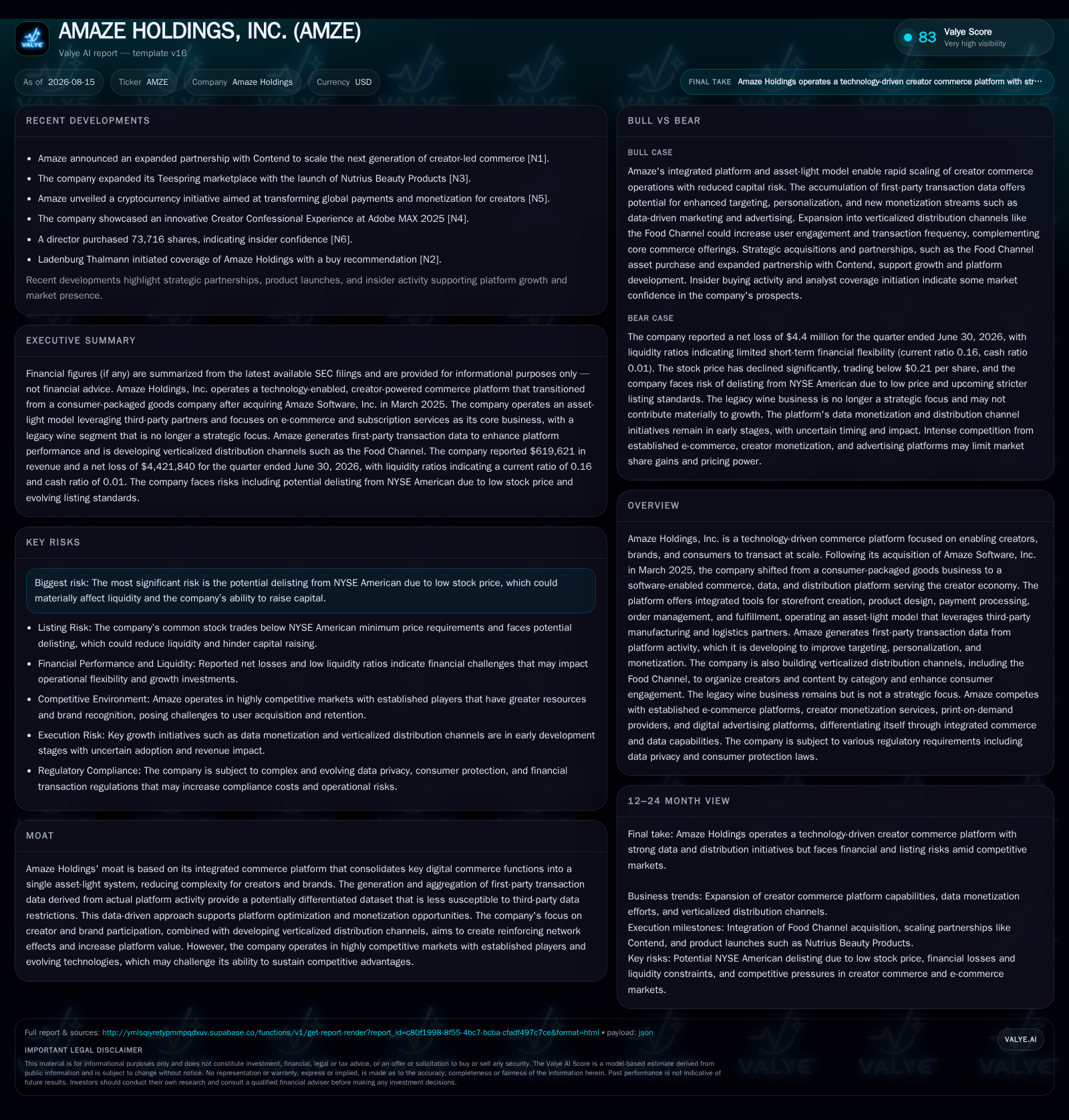
Amaze Holdings, after transitioning from a consumer goods company to a software-driven commerce platform via the March 2025 acquisition of Amaze Software, continues to develop integrated tools for creators and brands to operate scalable digital storefronts. The asset-light platform leverages third-party manufacturing and fulfillment, emphasizing first-party transaction data for monetization. However, Amaze faces critical near-term risks including sustained operating losses, liquidity constraints, and potential NYSE American delisting driven by a low stock price and limited reverse split flexibility. Recent management turnover underscores execution challenges as the company refines its verticalized distribution strategy, notably through acquisitions like Food Channel. Profitability remains distant with reliance on capital raises to support growth initiatives.
Recent Operating Update
Amaze Holdings’ latest quarterly filing dated August 14, 2026, foregrounds several critical operational and financial developments that shape the company’s near-term outlook [S2]. The filing highlights ongoing risks around maintaining NYSE American listing compliance due to prolonged low share prices; trading has dipped below $0.21 per share earlier in the year with imminent threat of falling under the $0.10 floor that triggers immediate delisting without cure opportunity. The company has executed two significant reverse stock splits—a 1-for-23 split in mid-2025 and a 1-for-8 split in July 2026—reaching a cumulative ratio of 184-to-1 which limits further split-based price correction options until mid-2027
July 31, 2026 witnessed a sudden leadership shift with CEO Aaron Day stepping down effective immediately while remaining on the board; simultaneously Michael Pruitt was elevated from Vice Chairman to Chairman of the Board [S3]. These simultaneous governance moves underscore potential strategic realignments or responses to execution challenges as Amaze seeks traction in its transformative phase post-acquisition
Business Model: Creator Economy Commerce Platform
Since acquiring Amaze Software in March 2025, Amaze Holdings repositioned itself from its legacy consumer-packaged goods origin into a software-enabled commerce platform aimed squarely at the burgeoning creator economy [S1][S9]. The platform provides creators and emerging brands with end-to-end digital commerce infrastructure encompassing storefront creation tools for branded presences, product design and catalog management modules for rapid iteration, integrated payment processing engines alongside advanced order management systems, all orchestrated via an asset-light approach relying on third-party manufacturers and logistics providers [S10][S17].
By not owning manufacturing or fulfillment assets directly, Amaze mitigates typical inventory risk and capex requirements common in traditional retail or CPG models but accepts dependencies on supplier reliability and operational coordination. This dynamic facilitates scalable onboarding of diverse creators offering niche products without heavy upfront investment.
Crucially, Amaze harvests extensive first-party transaction data generated across its platform’s activities—capturing purchase behavior nuances, engagement metrics linking creators with their audiences, geographic-demographic markers linked to consumer actions—forming a foundational dataset far less vulnerable to rising third-party cookie restrictions or data privacy policies affecting digital advertising ecosystems [S10][S17]. The company views this proprietary data pool as central to future monetization plans via enhanced targeting algorithms that drive conversion efficiency.
Beyond core functions, Amaze is developing verticalized distribution channels such as its newly acquired Food Channel brand within the digital media space aimed at focusing content creators by category to deepen consumer engagement—this strategy aims to maximize network effects by tightly integrating content curation with commerce flows for specific niches [S1][S4].
Industry Structure and Competitive Position
Amaze operates within the creator economy software platforms sector characterized by rapid innovation cycles and intense competition from established players like Shopify or BigCommerce offering commercial backends to creators as well as large e-commerce marketplaces such as Etsy or Amazon branching into direct brand partnerships. Additionally, digital content platforms like Patreon or OnlyFans provide indirect competitive pressure by merging content monetization with limited commerce solutions.
Distinctive attributes for success hinge on seamless integration of multifunctional services (design-to-fulfillment), efficiency of monetization (take rate optimization), platform scalability (creator onboarding/retention), depth of first-party data assets facilitating targeted marketing upgrades, plus ability to foster network effects linking creators with engaged consumers via verticalized channels. Amaze’s asset-light model aligns well with industry trends favoring flexible supply chains but increases reliance on third parties compared with peers holding fulfillment infrastructure.
Growth Drivers
Growth opportunities are anchored primarily in expansion of the creator economy globally—more individuals building audience-centric microbrands seeking polished commerce solutions—and rising consumer demand for personalized creator-driven product experiences unavailable on mass marketplaces. Amplification through verticalized distribution channels like Food Channel aims to create distinct buyer journeys boosting conversion rates and repeat engagement.
Technological enhancements leveraging first-party data promise improved pricing architecture, merchandising capabilities, and marketing automation supporting higher revenue per user (RPU). Strategic partnerships or targeted acquisitions remain avenues to extend platform functionalities or access new creator segments.
Risks and Watchpoints
The most immediate risk stems from financial sustainability concerns: liquidity constraints pose existential challenges given current cash levels are minimal ($156 thousand at end-2024) while total debt exceeds $5.8 million as of mid-2026 with current liabilities vastly outweighing current assets (current ratio ~0.16) [F1]. Failure to secure additional financing could precipitate drastic operational retrenchments.
Compounding financial strain is the threatened delisting risk from NYSE American due to prolonged share-price noncompliance heightened by impending stricter rules effective October 2026 raising minimum low price threshold from $0.10 to $0.25 per share plus limitations on further reverse splits curtailing straightforward corrective measures [S2]. Loss of exchange listing would dampen liquidity severely jeopardizing capital raising prospects.
Operationally, dependence on third-party manufacturing/logistics partners subjects the company to supply chain interruptions potentially impacting fulfillment reliability—a crucial customer retention driver in commerce frameworks [S16][S25]. The evolving regulatory environment around data privacy adds compliance complexity particularly since data monetization ambitions rely heavily on capturing sensitive transaction-level information across jurisdictions
Leadership instability evidenced by recent CEO departure may signal internal governance adjustments needed during this growth phase although continuation of Aaron Day on board provides some institutional memory continuity [S3].
What To Watch Next
Key milestones include tracking progress on vertical channel development effectiveness—specifically user engagement metrics and content-to-commerce conversion within Food Channel—to understand if these initiatives materially enhance monetization breadth.
Financially, upcoming quarterly filings should be scrutinized for signs of revenue growth acceleration against operating expense control alongside any disclosed capital raising activities given balance sheet pressures.
Market response regarding stock price trajectory post latest reverse split will indicate success at stabilizing listing compliance risk ahead of October’s more stringent standards.
Finally, leadership announcements or strategic partnerships/acquisitions could provide directional clarity reflecting management’s pathway toward sustainable profitability.
Financial Profile Discussion
Amaze Holdings continues grappling with high cash burn driven by substantial operating losses which totaled over $54 million operating loss during fiscal year ending December 31, 2025 [F1]. Total revenues remain modest under $2 million annually reflecting early-stage monetization within its SaaS-enabled commerce platform transformation [F1].
Balance sheet health signals notable stress: as of June 30, 2026 current liabilities approximated $22.9 million against current assets near $3.7 million resulting in a critically low current ratio around 0.16 that constrains liquidity flexibility particularly for working capital needs [F1]. Total debt near $5.85 million further imposes fixed obligations requiring cash flow allocation limiting reinvestment capacity; meanwhile cash balances reported at last available measurement were minimal ($156 thousand at end-2024), underscoring dependency on ongoing financing support [F1].
This profile suggests that despite asset-light operating advantages reducing capital expenditure burdens typical of commerce operators dependent on inventory management infrastructure, Amaze still confronts acute financing needs amidst competitive market pressures delaying scale economies realization.
This analysis synthesizes publicly filed SEC disclosures related to Amaze Holdings’ strategic pivot towards serving the creator economy through integrated SaaS commerce solutions combined with operational and financial risks inherent in its early scaling stage. No investment research views are offered herein.
Disclaimer: This is research-only, informational analysis and not investment advice. It may include AI-generated interpretation and general industry context. Always verify important details using primary sources.

Comments