
Franklin Ethereum Trust Solidifies Passive Crypto ETF Access through Regulated Custody and Fee Discipline
EZET’s quarterly report confirms steady passive management of ether assets, underpinned by regulated custody and sponsor fee controls.
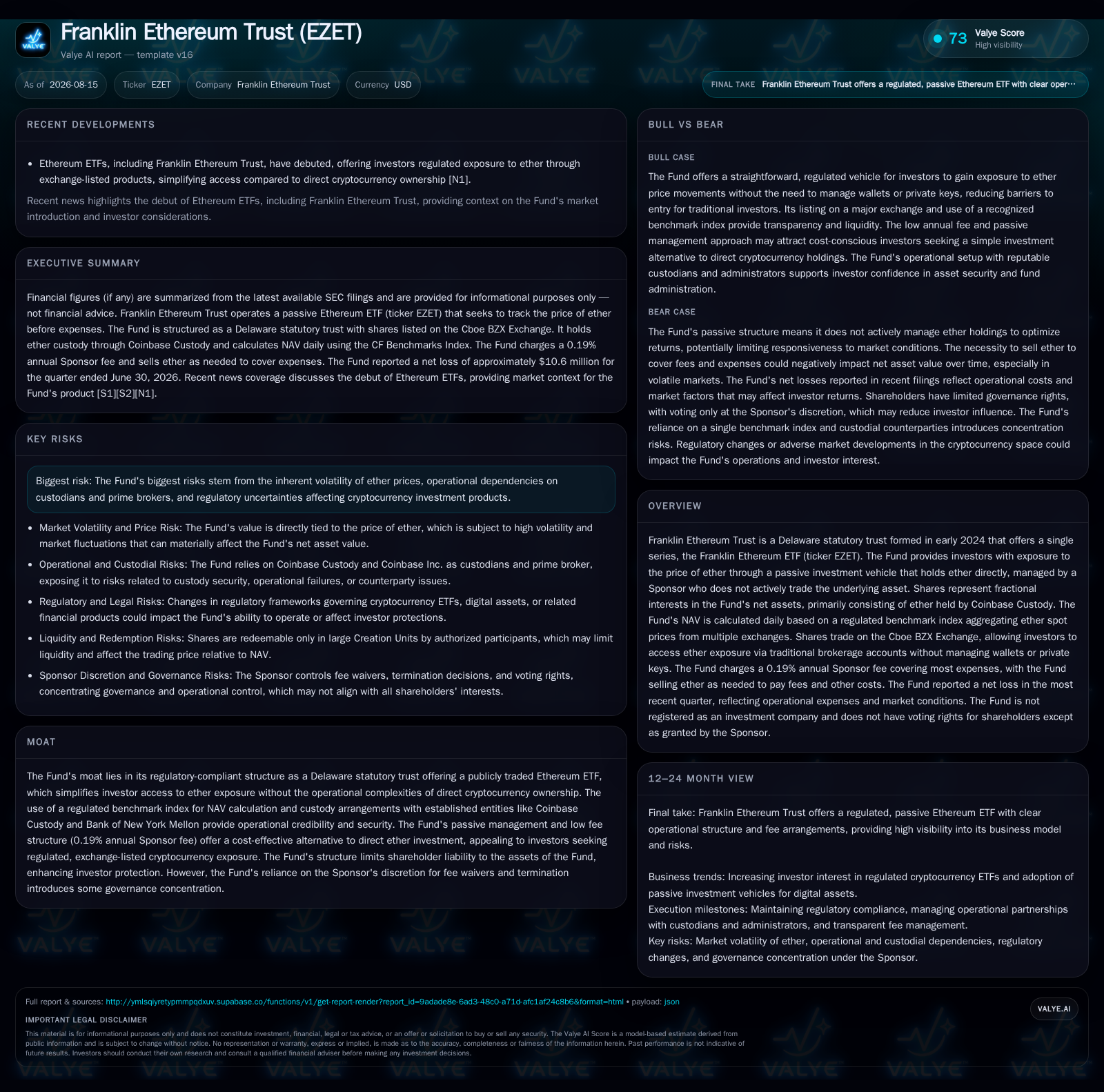
Franklin Ethereum Trust (EZET) continues to provide a streamlined, regulated vehicle for ether exposure via its Ethereum ETF, holding ether directly with Coinbase Custody and listing shares on Cboe BZX Exchange. The latest quarter highlights stable operations with no material changes in risks and ongoing reliance on authorized participants for liquidity. The Fund’s operational strength derives from its regulatory-compliant Delaware statutory trust framework and low-fee passive management approach, distinguishing it within the nascent cryptocurrency ETF landscape. However, inherent ether price volatility and custodial dependencies remain key considerations.
Recent Operating Update
The Franklin Ethereum Trust filed its latest quarterly report ending June 30, 2026, reconfirming the consistency of its passive investment approach and operational profile. No material changes were reported in risk factors compared to the prior annual filing, signaling stability amid an evolving crypto regulatory landscape [S2], [S23]. No new material legal proceedings affect the Fund, underscoring its clean status within typical trust litigation exposures [S5].
This steadiness matters because it supports investor confidence in relying on the Fund’s structure to deliver exposure to ether price movements without surprises from operational or regulatory shocks. Ongoing sponsorship by Franklin Holdings LLC retains control over fee waivers and fund governance but has not led to fee changes or structural amendments recently.
Business Model: Passive Exposure with Regulated Custody
EZET operates as a Delaware statutory trust formed in early 2024, offering a single series ETF providing direct exposure to ether cryptocurrency through passive holdings rather than derivatives or active trading strategies [S1]. Investors buy shares on Cboe BZX Exchange under the ticker EZET, which represent fractional undivided beneficial interests in the underlying net assets.
Revenue stems almost exclusively from an annual Sponsor fee fixed at 0.19% of net asset value (NAV), charged daily and payable quarterly in U.S. dollars [S4]. The Fund sells ether on an as-needed basis to cover these fees alongside ordinary expenses borne by the Sponsor — including custody fees paid to Coinbase Custody and administrative fees to Bank of New York Mellon — thereby maintaining smooth cash flow mechanics without dilutive transactions or periodic capital calls
Creation and redemption of shares occur exclusively through authorized participants—large financial institutions like Jane Street Capital, J.P. Morgan Securities, Virtu Americas, Citadel Securities, and Goldman Sachs who have formal agreements enabling them to transact directly with the Fund in blocks called Creation Units (50,000 shares each) for cash settlement. This mechanism anchors liquidity and helps align the market trading price with the NAV derived from underlying ether holdings valued daily against a CF Benchmarks Index aggregating spot prices across exchanges [S3], [S13], [S10].
The administrative layer is shared among specialist institutions that provide digital asset custody (Coinbase Custody), cash administration (BNY Mellon), prime brokerage (affiliate Coinbase Inc.), marketing (Franklin Distributors), and trustee services (CSC Delaware Trust Company). This combination reinforces operational security while bridging fintech expertise with traditional regulated financial services infrastructure—essential for institutional acceptance and regulatory adherence in this new asset class segment [S1], [S28].
Industry Structure and Competitive Position
EZET exists within the emerging sector of cryptocurrency exchange-traded funds (ETFs) that seek to provide regulated market access to volatile digital assets like ether. Unlike early digital currency trusts that sometimes rely on futures or derivatives or operate without transparent NAV references, Franklin Ethereum Trust’s model emphasizes direct custody of physical ether tokens with minimal active management.
Peers include Grayscale Ethereum Trust (ETHE)—a non-ETF trust gaining institutional reputation—and Bitcoin-centric products such as ProShares Bitcoin Strategy ETF (BITO). EZET differentiates itself through its Delaware statutory trust structure offering limited liability protection confined strictly to fund assets per series (inter-series liability limitation), coupled with transparent fee structures and well-recognized custodianship partners like Coinbase Custody and BNY Mellon.
Authorized participants supporting liquidity via creation/redemption activity are crucial industry pillars; their presence reduces tracking error by arbitraging share price deviations versus underlying asset NAVs [S3]. EZET benefits from notable APs such as Citadel and Goldman Sachs, enhancing secondary market confidence compared to more fragmented or less institutionally supported trusts
Within the broader crypto ETF landscape characterized by persistent challenges around custody security, regulatory uncertainty, volatile underlying asset pricing, and market adoption hurdles, EZET shows structural robustness through clear governance mechanisms—a critical moat given shifting regulatory scrutiny over digital asset products.
Growth Drivers
Several secular trends underpin potential growth for EZET despite crypto market cyclicality:
- Institutional adoption: Increasing interest among retail and institutional investors seeking regulated exposure to Ethereum aligns with EZET's straightforward product offering.
- Regulatory clarity: The Fund’s compliance with SEC requirements as a Delaware statutory trust facilitates investor trust relative to unregulated crypto access paths.
- Custody innovation: Partnerships with established custodians reduce operational friction—key given heightened cybersecurity concerns that often deter mainstream investors.
- Market accessibility: Listing on a major exchange like Cboe BZX enables convenient brokerage-based investing without owning wallets or private keys.
- Fee discipline: A relatively low 0.19% annual sponsor fee contrasts favorably against high-fee actively managed trusts or unregulated funds.
Operational KPIs influencing growth include Assets Under Management (AUM), net asset value per share reflective of ether price trends minus expenses, authorized participant transaction volumes influencing liquidity tightness, and maintenance of NAV-tracking fidelity minimizing investor cost via reduced tracking error.
Risks and Watchpoints
Despite structural strengths, risks inherent to this business model persist:
- Cryptocurrency volatility leads to material swings in AUM valuation that can trigger secondary market pricing inefficiencies affecting investor returns independent of Fund quality.
- Regulatory uncertainty regarding cryptocurrency investment vehicles could impose new compliance costs or restrict product viability.
- Custodial counterparty risk particularly linked to prime broker omnibus wallet arrangements may expose the Fund indirectly if affiliates experience operational failures.
- Liquidity dependency on authorized participants creates potential dislocation during market stress periods when creation/redemption activity might slow.
- Sponsor discretion over fee waivers introduces asymmetric risk if incentives diverge from shareholder interest.
- Technology & cybersecurity threats represent ongoing vulnerabilities requiring vigilance across all service providers handling fund assets or records.
Attention should be paid to shifts in authorized participant participation rates, unusual divergences between market share price versus NAV suggesting tracking challenges, any sponsor announcements concerning fee adjustments or waiver policies, evolving regulations impacting digital asset ETFs broadly, and upgrades or incidents involving Coinbase Custody or BNY Mellon affecting asset security perception.
What to Watch Next
Key milestones include quarterly reporting updates informing changes in risk disclosures or financial results; monitoring creation/redemption volumes that indicate institutional engagement levels; NAV versus ether spot pricing divergence metrics that quantify tracking accuracy; any filings signaling sponsor fee policy amendments; SEC regulatory guidance impacting crypto ETFs; and industry developments around custody standards or prime brokerage models enhancing operational resiliency.
These markers will help distinguish whether EZET can sustain competitive advantage amid market maturation while safeguarding investor protections through sound governance.
Financial Profile Discussion
Cash flow profiles depend heavily on creation/redemption activity managed by Authorized Participants settled in cash for Creation Units issued or redeemed at NAV-based valuations. Sponsor fee revenue is predictable but sensitive proportionally to AUM fluctuations due to crypto price swings rather than volume-driven growth alone.
It does not provide investment advice but aims to clarify operational drivers, risks, and strategic positioning within regulated cryptocurrency ETF frameworks.
Disclaimer: This is research-only, informational analysis and not investment advice. It may include AI-generated interpretation and general industry context. Always verify important details using primary sources.

Comments