
PAID INC Drives Revenue Growth via Shipping Platform Expansion and Warehowz Integration
PAID INC's latest quarter reveals solid volume growth in multi-carrier shipping and early contributions from its warehousing marketplace, offset by modest margin pressure.
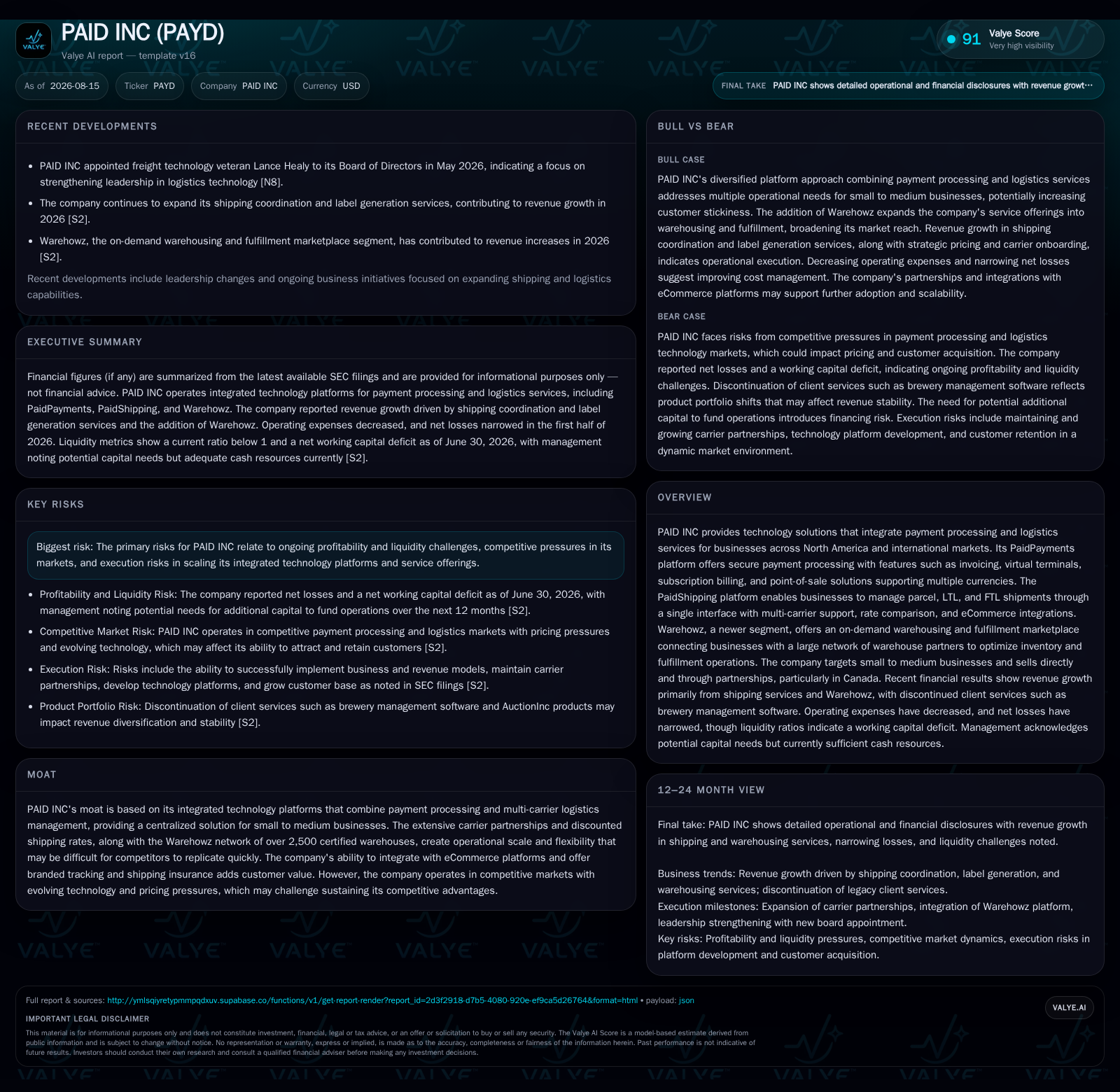
In Q2 2026, PAID INC reported an 8% revenue increase driven by higher shipping coordination and label generation volumes, with total six-month revenues up 14%. The strategic addition of the Warehowz warehousing platform contributed to growth but margins softened slightly. The company’s SaaS model blends subscription fees with transaction-based revenues across integrated payment processing and multi-carrier logistics solutions tailored for SMBs, primarily in North America. Operating expenses declined year-over-year on reduced stock-based compensation charges, while liquidity remains tight with a current ratio below 1. Competitive pressures and execution risks persist as the firm seeks to scale technology and customer adoption amid an evolving market.
Recent Operating Update
Business Model Overview
PAID INC operates an integrated SaaS-based technology platform targeting small-to-medium businesses (SMBs) across North America with a focus also extending internationally. The company monetizes through a combination of recurring subscription fees for software access and transaction-based charges related to payment processing as well as shipping label generation and logistics coordination.
The core ShipTime segment functions as a comprehensive multi-carrier logistics aggregator providing users with tools to quote, process shipments (parcel through LTL/FTL), generate labels with discounted carrier rates, track parcels, and manage dispatches from a single interface. This value proposition caters particularly well to SMBs challenged by complex shipping arrangements or seeking cost savings via negotiated carrier discounts. PAID also offers integration into e-commerce shopping carts which further facilitates online selling—a critical channel for growth-minded SMBs today [S1], [S2].
Complementing ShipTime is PAID's PaidPayments platform which delivers secure invoicing, virtual terminal access, subscription billing capabilities, hosted checkout pages supporting multiple currencies (USD/CAD/EUR), and point-of-sale interfaces. Together these solutions offer a unified commerce infrastructure that lowers friction for merchants managing payments alongside logistics.
In early 2026, PAID expanded its platform ecosystem through its investment in Warehowz—a marketplace connecting businesses directly with over 2,500 certified warehouse partners across the United States. This addition aims to address inventory storage and fulfillment needs dynamically without requiring traditional warehouse leases or capital expenditures from client companies. Warehowz's recurring fee structure based on active warehousing usage enriches PAID's revenue mix while enhancing the platform’s value for e-commerce merchants seeking end-to-end supply chain technology support [S9],.
Industry Structure and Competitive Position
The markets PAID INC competes in bridge SaaS payment technologies and shipping/logistics aggregation—two sectors driven heavily by cloud adoption among SMBs seeking flexible digital commerce solutions. Major players with overlapping features include Shopify (platform commerce plus payments), Stripe (payments API-driven), Square (integrated point-of-sale/payments), along with logistics-focused providers such as ShipStation or EasyPost offering shipping label generation services.
PAID differentiates itself through the depth of its multi-carrier network integrations combined with embedded discounted rates negotiated directly with couriers and freight carriers—a level of operational scale that provides real cost benefits that are tough for new entrants or smaller aggregators to replicate quickly. Its channel strategy leveraging direct sales plus partnerships mainly focused on Canada consolidates regional strengths.
However, competition remains fierce especially regarding pricing power amid commoditized payment transaction fees and rising service expectations from merchants who demand seamless API connectivity with evolving e-commerce platforms. Technology agility is critical given rapid innovation cycles involving AI-driven shipment optimization or payments fraud prevention tools.
Growth Drivers
Several growth vectors underpin PAID’s platform expansion:
- Increasing SMB Adoption: Digital payment acceptance and online selling continue broadening across geographies served; SMBs seek integrated systems that combine payments with logistics management.
- E-Commerce Growth: Rising cross-border e-commerce volumes generate demand for scalable multi-carrier shipping solutions coupled tightly with payment gateways.
- Warehousing Marketplace Scale: Warehowz introduces novel inventory-to-customer fulfillment pathways reducing fixed warehousing cost burdens for clients; success here could materially augment top-line.
- Partner Ecosystem Expansion: Deepening alliances with carriers plus integration partnerships with popular e-commerce platforms drive user acquisition.
- Value-added Services: Features like invoice surcharges linked to credit card fees help offset costly merchant-processing expenses improving margin sustainability.
Monitoring KPIs such as monthly recurring revenue (MRR), shipment transaction counts, churn rates among SMB customers, average revenue per user (ARPU), discounted rate uptake on shipments, and usage metrics within Warehowz will be critical indicators of future scaling progress.
Risks and Watchpoints
Despite promising strides, PAID’s operating profile exhibits notable risks:
- Profitability Challenges: Historical operating losses persist indicating ongoing structural challenges despite revenue gains; balancing growth spending versus margin improvement remains delicate.
- Liquidity Constraints: A current ratio below unity (~0.89) signals working capital tightness necessitating close monitoring of cash burn versus financing availability [F1], [S2].
- Competitive Pressure: Rapid innovation cycles among peer payment-logistics platforms risk feature obsolescence; sustained R&D investment is required.
- Execution Risk: Integrating Warehowz effectively while scaling customer onboarding without service disruptions tests organizational capacities.
- Dependence on Third Parties: Carrier relationships expose PAID to contract negotiation uncertainties that could influence pricing or service availability.
- Customer Concentration & Retention: Loss or churn of key SMB clients could disproportionately affect revenue flows given concentrated sales channels.
- Regulatory Compliance: Payment data security and evolving e-commerce trade regulations impose compliance costs that may fluctuate unpredictably.
What To Watch Next
Key upcoming milestones where fresh data will clarify trajectory include:
- Quarterly updates on transaction volume growth specifically for ShipTime shipments post-Q2 marketing efforts.
- Progress metrics concerning Warehowz integration impact on both gross margin trends and incremental revenues across remainder of fiscal year.
- Operating expense trends emphasizing whether recent reductions continue absent large stock-compensation charges impacting SG&A run-rate.
- Customer retention/churn analytics especially given noted losses within PaidPayments segment clients during recent periods.
- Any disclosures around new carrier contracts or expanded e-commerce platform partnerships enabling broader user engagement.
- Liquidity developments including possible capital raises or debt refinancing approaches needed if cash position deteriorates beyond manageable thresholds.
Financial Profile Discussion
As of June 30, 2026, PAID held approximately $1.08 million in cash and equivalents against current liabilities exceeding $2.13 million resulting in a net working capital deficit near $230 thousand. The current ratio stands at about 0.89—below ideal operational liquidity thresholds suggesting continuing application of capital discipline is necessary especially given ongoing net losses reported historically around $368 thousand annually [F1], [S2].
Recent quarters reflect improved net loss trends versus prior years driven partly by operating expense containment including sharply reduced stock-based compensation expense contrasting sharply against peak levels recorded during full-year 2025. Cash flow from operations turned positive briefly in mid-2026 after several difficult years highlighting nascent operational leverage potential provided key growth drivers sustain momentum [S7], [S8], [S16]. Management continues cautious regarding new product launches’ uptake speed balanced against careful cost controls which might moderate free cash flow volatility moving forward.[F1]
Disclaimer: This is research-only, informational analysis and not investment advice. It may include AI-generated interpretation and general industry context. Always verify important details using primary sources.

Comments