
Universal Safety Products’ Transition to DeFi Faces Revenue Challenges and Regulatory Risks
Recent quarterly results underscore Universal Safety Products’ pivot from traditional safety products to early-stage decentralized finance operations, revealing persistent losses and strategic uncertainties.
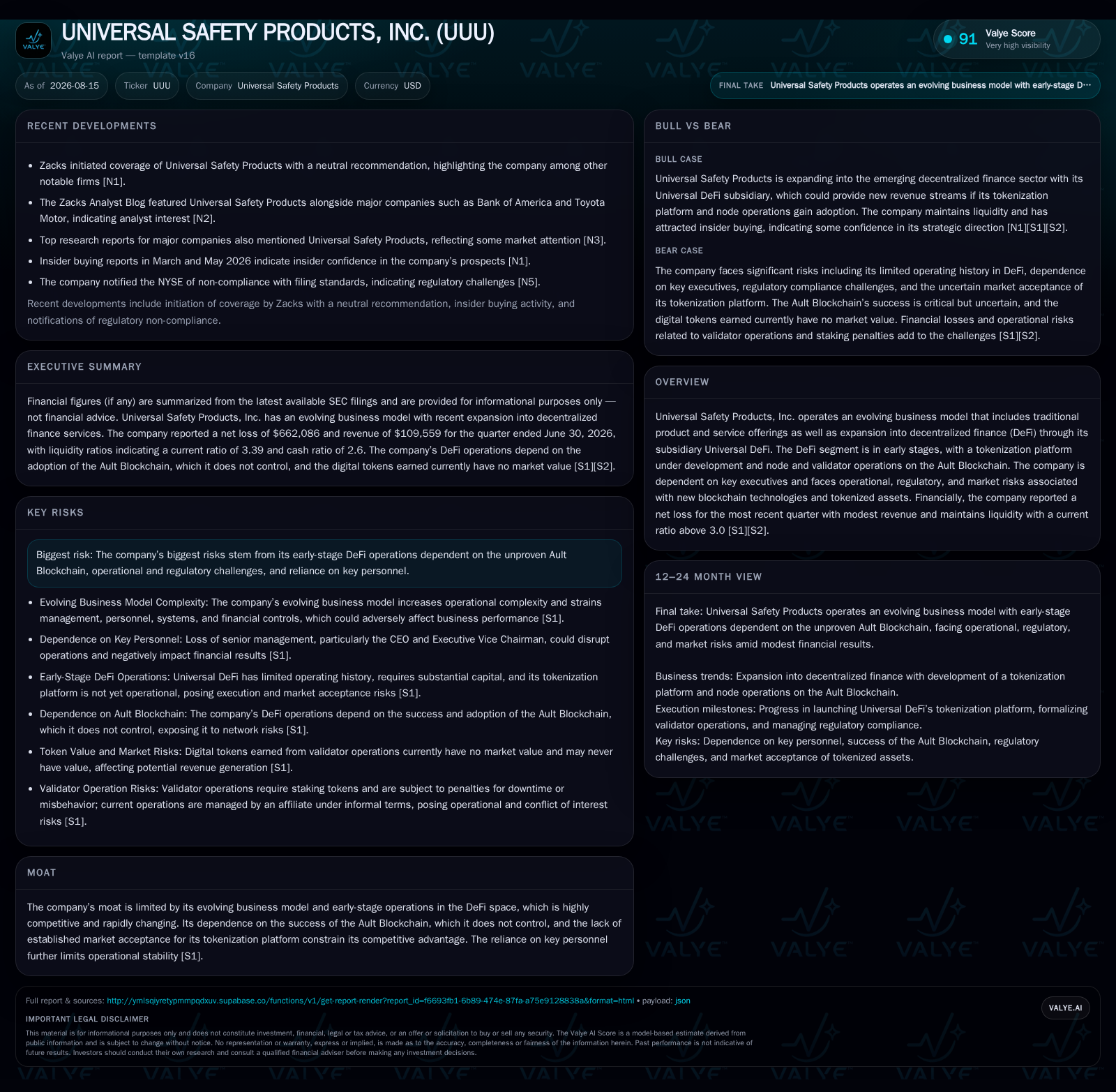
Universal Safety Products, Inc. continues to evolve from its legacy business of safety and security product distribution towards decentralized finance (DeFi) services via its subsidiary Universal DeFi. The most recent quarter showed no revenue generation from the DeFi segment and ongoing net losses, despite a stable liquidity position. The company remains dependent on key executives and faces operational and regulatory hurdles in adopting blockchain-based tokenization platforms and validator node operations. Its competitive moat is constrained by early-stage DeFi adoption challenges and technology dependencies. Future growth will hinge on successful platform development, regulatory clarity, and effective capital deployment.
Recent Operating Update
Universal Safety Products’ latest quarterly report dated August 14, 2026 reveals that its emerging decentralized finance (DeFi) subsidiary, Universal DeFi LLC, has yet to book any revenue since inception while incurring losses associated with platform development and validator operations. The company explicitly states it expects continued losses as it focuses on building its tokenization platform and deploying node licenses within the Ault Blockchain network [S2]. This underscores the nascent stage of its transition from a traditional safety equipment distributor to a blockchain service provider.
As of June 30, 2026, UUU reported $3.7 million in cash and cash equivalents alongside working capital of $3.4 million, delivering a robust current ratio of approximately 3.39 — indicating reasonable short-term liquidity despite the absence of operating cash inflows from DeFi activities at this juncture [F1][S2]. These liquidity levels support ongoing R&D and operational expenses but highlight the critical need for additional capital raises or strategic partnerships to sustain long-term development.
Additionally, the company completed a significant strategic shift by divesting its smoke and carbon monoxide alarm business earlier in the fiscal year—removing a historically stable revenue source in favor of concentrating resources on wiring devices, bath fans segments, and its newly launched blockchain initiatives [S1][S22]. This reorientation reflects both opportunity ambitions in digital assets but also increased volatility in near-term revenue streams.
Concurrently, UUU shareholders approved amendments to the Articles of Incorporation eliminating super-majority voting requirements—an adjustment effective upon regulatory acceptance expected shortly post-July 31 special meeting—which may facilitate easier governance for future equity issuances or strategic decisions critical during this transitional period [S3].
Business Model
Historically rooted in selling safety products requiring minimal installation primarily via retail distribution channels and wholesale electrical distributors (including manufactured housing companies), Universal Safety Products' legacy consumer product model generated revenues through direct sales confirmed at shipment or delivery [S16]. Margins in this segment would typically derive from product mix efficiency, supply chain management amidst import tariffs which have been noted as headwinds impacting cost structures recently [S21].
However, with the establishment of Universal DeFi LLC in July 2025 as a wholly owned subsidiary targeting decentralized financial services ecosystems, the company’s business model now incorporates blockchain infrastructure roles such as operating validator nodes within the Ault Blockchain network plus developing a tokenization platform designed to facilitate issuance and transacting of cryptographic tokens backed by various asset classes [S1][S2]
Monetization in this new model is expected from fees charged on token transactions executed through their platform, licensing or staking rewards linked to validator participation incentives, and potentially software services enabling decentralized applications (dApps) or smart contract deployments integrated with governance token economies.
This evolution adds operational complexity given different contract structures: whereas prior purchase orders applied mostly for physical goods with one-time recognition upon transfer of control, tokenization platforms require ongoing transactional fee capture subject to user adoption rates, network uptime reliability metrics, token staking volumes for security guarantees, plus compliance with dynamic regulatory frameworks impacting how tokens can be issued or marketed legally.
Industry Structure and Competitive Position
The broader blockchain and DeFi technology sector comprises various specialized subsets including blockchain infrastructure providers (operating nodes and validators), tokenization platforms focusing on asset digitization for financial markets, cryptocurrency exchanges equipped with integrated DeFi functions (like Coinbase or Binance), traditional financial institutions experimenting with distributed ledger technologies (DLT), alongside many startups targeting niche applications like staking as a service or liquidity pool facilitation.
In this environment, companies gain advantage through technology scale (number of active nodes/validators), platform adoption evidenced by transaction volumes and number of tokens issued/managing digital assets economy-wide. Network effects build defensibility; larger user bases command more liquidity pools enhancing fee income and reinforcing ecosystem value.
Universal Safety Products’ current positioning is unique insofar as it blends legacy hardware manufacturing with an ambitious pivot toward blockchain infrastructure—but faces structural constraints from an unproven blockchain (Ault Blockchain) over which it holds no governance stake nor protocol control. This dependency not only limits flexibility but magnifies regulatory risks when aligned with emerging securities laws surrounding token offerings. Moreover, their late-stage entry into an already competitive market requires accelerated execution combined with distinct differentiation either via customer vertical focus or proprietary tech enhancements which have not yet materialized publicly.
Growth Drivers
Key growth drivers within Universal Safety’s new strategy will depend heavily on milestones related to:
- Successful development and launch readiness of their proprietary tokenization platform enabling issuance/trading of cryptographic tokens representing real-world assets or digital securities;
- Expansion of active blockchain node/validator operations contributing staking rewards plus supporting overall network consensus mechanism stability;
- Platform user base acquisition metrics indicating traction among investors seeking decentralized alternatives;
- Strategic partnerships potentially bridging traditional financial firms into decentralized ecosystems;
- Regulatory clarity providing compliant pathway for token sales without incurring legal impediments;
- Capital adequacy permitting sustained R&D investment attracting key technical talent needed to improve scalability/security features amid sector innovation pressures.
Attainment of these KPIs will signal intangible progression beyond developmental burn phases toward potential monetization inflection points crucial for eventual profitability transition.
Risks / Watchpoints / Growth Constraints
Despite the forward-looking potential presented by blockchain technology adoption,
- Regulatory uncertainties pose threats given ever-evolving legal interpretations around digital asset custody, classification of tokens as securities versus commodities,
- The technological risk associated with reliance on the Ault Blockchain compromises operational autonomy creating single points of failure,
- Market acceptance constraints remain formidable; users generally favor established blockchains backed by greater developer communities such as Ethereum or Solana,
- Vulnerability to cybersecurity breaches or hacking incidents could harm reputation irreparably,
- Key personnel dependence heightens vulnerability especially given Milton C. Ault III’s considerable role leveraging his expertise within this specialized domain,
- Financial constraints due to sustained negative operating cash flows require continuous funding raises possibly dilutive to shareholders,
- Legacy product performance impacts create ongoing top-line pressure due to divestiture of stable business segments.
What To Watch Next
Investors should monitor Universal Safety Products’ progress against several critical upcoming milestones:
- Announcement regarding regulatory approval status or legal opinion clarity favorable toward its tokenization operations;
- Operational updates detailing number of nodes actively operated on the Ault Blockchain reflecting commitment intensity;
- Early transaction volume data once their platform enters commercial use which would confirm initial market validation;
- Liquidity trends including cash burn rate vis-à-vis any planned capital raises announced publicly;
- Executive management changes which could materially impact strategic continuity given current dependencies;
- Any indications from customer acquisition efforts focused at institutional investors or alternative finance sectors interested in digital asset innovations.
Financial Profile Discussion
Universal Safety Products reported net operating losses consistently over recent quarters tied predominantly to early-stage investments underpinning its pivot toward decentralized finance services [S2]. The latest snapshot indicates revenue was approximately $4.85 million recorded at March 31, 2026 end-point (largely from residual traditional product sales prior to divestitures), accompanied by an operating loss exceeding $4.6 million resulting in reported net loss close to $2.5 million over the corresponding period [F1].
As highlighted previously, Universal DeFi has yet to generate commercially meaningful revenue; combined losses stem mainly from personnel costs including key executive compensation aligned with industry-experienced talent retention efforts alongside technological development expenditures.
Liquidity remains adequate short term with $3.7 million cash balances complemented by strong working capital ratios (~3.39 current ratio) ensuring solvency regardless of operating deficits [F1][S2]
Overall financial sustainability will hinge upon successful expansion into viable revenue streams via scalable DeFi platforms combined with optimized cash management strategies geared toward minimizing dilution impact while extending runway for innovation cycles required within cutting-edge blockchain environments.
This analysis synthesizes publicly available filings focusing strictly on substantiated facts without speculative projections regarding future profitability or market impacts. It reflects the inherent challenges faced by companies transitioning into emerging high-tech sectors where technology uncertainty intersects regulatory complexity frequently impeding rapid commercialization pathways.
Disclaimer: This is research-only, informational analysis and not investment advice. It may include AI-generated interpretation and general industry context. Always verify important details using primary sources.

Comments