
ClearOne's Transition from Hardware Manufacturing to Strategic Merger and Warranty Management
ClearOne, Inc. has exited product manufacturing after selling key assets and is now focused on warranty servicing and a transformative merger with Cortigent.
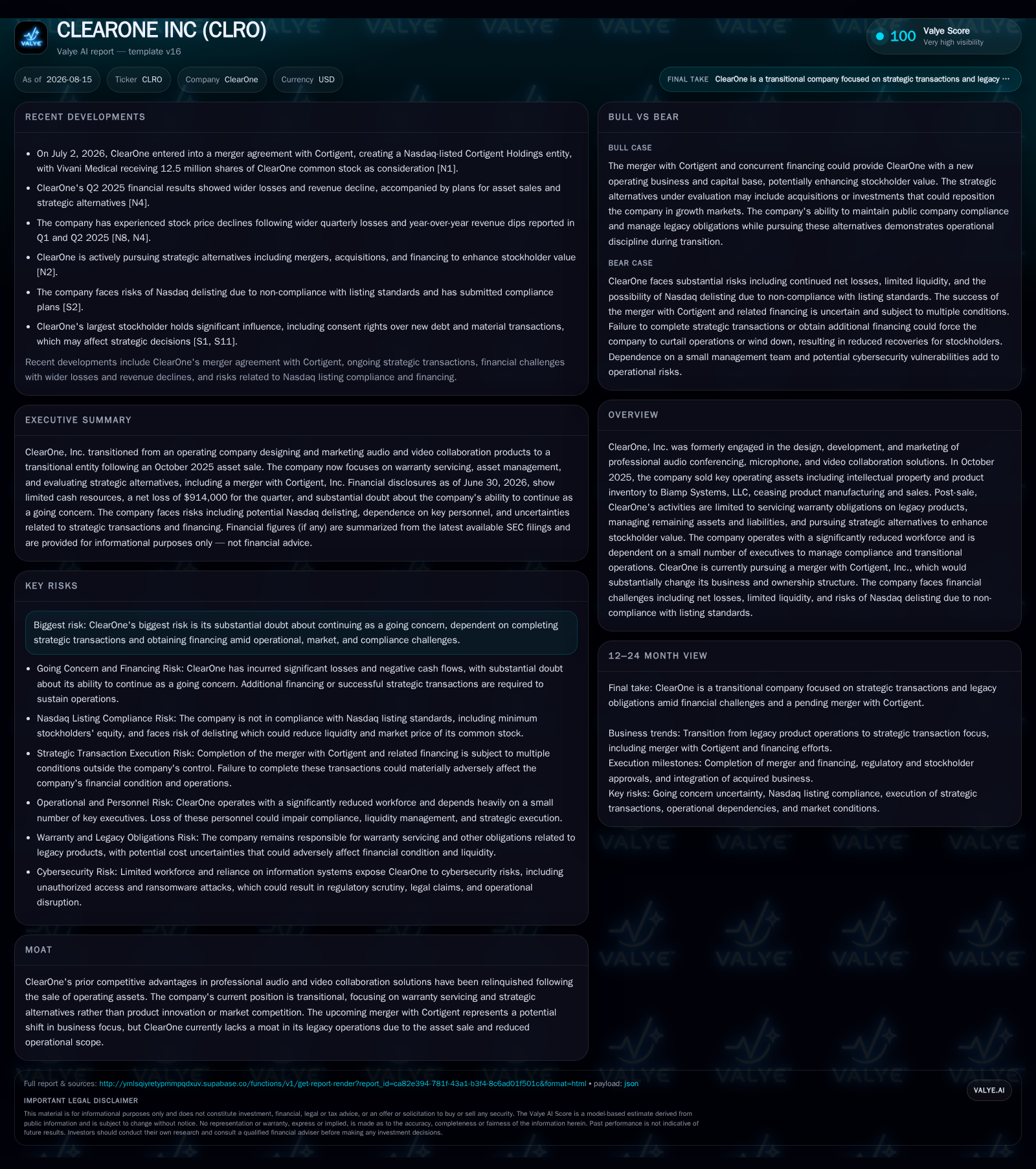
ClearOne completed a significant asset sale in October 2025, relinquishing its core professional audio and video equipment business, including intellectual property and product inventory, to Biamp Systems. Currently, ClearOne operates in a transitional mode, servicing warranties on legacy products and managing remaining corporate obligations while pursuing strategic alternatives. A merger with Cortigent, Inc. announced in mid-2026, represents a pivotal potential shift away from the legacy business. However, ClearOne faces critical financial challenges including minimal cash resources, Nasdaq listing compliance risks, and substantial doubt about its ability to continue as a going concern absent successful strategic transactions.
Recent Operating Update
ClearOne's latest quarterly filing dated August 14, 2026 [S2] confirms that the company has fully exited its historical business of designing, manufacturing, and selling professional audio conferencing and video collaboration equipment following an October 2025 asset sale to Biamp Systems [S1]. This divestiture included key intellectual property rights, product inventory, and non-exclusive customer data rights for gross proceeds of $3 million [S1]. In tandem with this transaction, ClearOne ceased all production and sales activities.
Since the asset sale, ClearOne has repositioned into a transitional phase focusing largely on warranty servicing for legacy products sold prior to October 2025 [S1]. The company retains a small amount of inventory solely for warranty claims fulfillment but no longer generates revenue through new product sales. Additional post-sale responsibilities include liquidating remaining assets related to historical operations, managing receivables and liabilities, maintaining regulatory compliance as a public entity, and actively pursuing strategic alternatives intended to enhance value [S1][S2].
Notably, a material development reported in July 2026 was the execution of a merger agreement with Cortigent Inc., an unrelated medical technology firm affiliated with Vivani Medical Inc. [S26]. This merger involves ClearOne's wholly owned subsidiary merging into Cortigent with Cortigent surviving as a subsidiary of ClearOne. As part of the transaction terms set forth publicly, Vivani will receive approximately 12.5 million shares of ClearOne common stock as consideration [S26]. Concurrent efforts include raising between $10 million and $15 million through a public offering registered via Form S-1 to finance the combined entity's operations post-merger [S26]. Completion of this transaction depends on multiple contingencies including stockholder approvals from both companies, Nasdaq's approval of an initial listing application (triggered by deemed change-of-control), the effective registration statement for financing proceeds' distribution, and satisfaction of other customary closing conditions [S28]. Failure of these conditions within prescribed time limits could lead to termination of the agreement along with related costs borne by ClearOne [S28].
Business Model Evolution
Traditionally operating as a hardware manufacturer within the professional audio/video equipment industry, ClearOne generated revenues by selling integrated conferencing systems combining microphone arrays, signal processing technologies, video collaboration hardware components, software licensing agreements for unified communications platforms, and related technical support services. Revenue performance depended on metrics such as product sales volume influenced by enterprise demand for remote collaboration tools, average selling price shaped by technological differentiation (e.g., superior audio fidelity or AI-driven voice capture), channel partner penetration enabling broad market reach through distributors or integrators, recurring maintenance contracts enhancing revenue stability, and customer retention rates sustaining aftermarket service income.
After the October 2025 divestiture to Biamp Systems—a known peer specializing in professional audio/video solutions—ClearOne effectively ceded its core operating model [S1]. The transition eliminates direct exposure to highly competitive product development cycles characterized by rapid technological obsolescence risks, demand volatility tied to enterprise digital transformation budgets, supply chain complexities including sourcing advanced components for microphones or video modules, and price pressure from established incumbents like Poly or Logitech.
Now constrained to limited warranty servicing obligations on legacy products with declining claim volumes over time—a natural lifecycle following product discontinuation—ClearOne's revenue mechanics have shifted dramatically. Instead of transactional sales driven by volume growth or pricing power across technology cycles, revenues now rely on controlling warranty claim costs relative to established reserves amidst uncertain claims frequency or parts availability [S13]. This fundamental shift compresses margin opportunities while imposing operational demands on service response times and customer support quality despite reduced scale.
Moreover, ongoing public company costs including compliance filings impose fixed overhead absent substantive operating income [S2][S13]. Owning minimal tangible assets tied directly to active business lines challenges liquidity generation under this model
Industry Structure and Competitive Position
The professional audio/video equipment sector is characterized by innovation-led competition where firms develop proprietary microphones arrays optimized for clear speech capture in diverse acoustic environments and video collaboration peripherals integrating with software communication platforms. Key competitors include Biamp Systems (the acquiring party of ClearOne's assets) known for integrated solutions; Poly offering combined hardware/software unified communications; Shure specializing in advanced microphones; Logitech providing video peripherals; and Cisco integrating hardware with enterprise collaboration platforms.
ClearOne historically occupied a mid-tier position offering differentiated product designs with moderate channel penetration through resellers and system integrators serving sectors like corporate boardrooms and education institutions. However, its departure from manufacturing removes it entirely from this competitive dynamics matrix post-asset sale.
Consequently, ClearOne currently lacks competitive advantage or moat elements such as intellectual property licensing income or ongoing platform ecosystem participation. Its role is reduced to an issuer maintaining residual operational functions during corporate transition.
Growth Drivers
In its historical context prior to asset sale, growth drivers included increasing adoption of remote/hybrid work collaboration tools demanding high-quality audio/video integration; enterprise digital transformation funding for upgrading conferencing infrastructure; expanding cloud-based unified communication platforms embedding AI-enabled audio enhancements; growing sectors like healthcare and education requiring secure collaboration technologies; and natural replacement cycles driving demand for next-generation hardware.
Post-divestiture growth prospects within legacy operations are negligible as warranty claims diminish over time with no new product introduction pipeline nor active sales force involvement. The company's sustainable growth opportunity is now contingent upon successfully completing strategic transactions like the pending Cortigent merger which could effectively redefine business scope.
Risks and Watchpoints
Key risks include substantial doubt about continuing as a going concern absent completion of strategic transactions or new financing due to minimal cash reserves ($75K) against current liabilities (~$929K) as of June 30, 2026 [F1][S2]. The company also holds net debt estimated at approximately $1.17 million factoring available cash versus outstanding debts last reported at $1.245 million (September 2023) highlighting ongoing leverage concerns [F1].
Compliance risk is acute given Nasdaq notified ClearOne in early April 2026 that it failed continued listing requirements primarily because stockholders’ equity fell below minimum thresholds ($2.5 million); failure to regain compliance risks delisting which would impair equity liquidity adversely affecting shareholder value receptivity for capital raise efforts [S2][S29][S13]
Warranty servicing poses unpredictable cost exposures due to potential increases in claim frequency or parts costs beyond reserved estimates potentially stressing liquidity further [S13]. Operational risks arise from significantly downsized workforce impairing internal controls required for public reporting obligations alongside cybersecurity vulnerabilities impacting administrative systems critical even during wind-down phases [S13][S18]. The merger process carries execution risks related to integration complexity between firms with different sector focuses plus regulatory approvals compounded by conditionally linked financing outcomes where failure cascades into worsening going-concern standing [S25][S28].
What To Watch Next
Investors should monitor milestones such as stockholder votes on the Cortigent merger proposal anticipated post-registration statement effectiveness; progress updates regarding Nasdaq’s determination on initial listing approval after change-of-control; completion status of the concurrent financing round which underpins transaction viability; any revisions in projected timing triggered by regulatory scrutiny or market reception; updates related to potential alternative strategic transactions if merger falters; evolving warranty cost trends either enhancing reserve adequacy confidence or signaling financial pressures; plus announcements regarding operational changes signaling progress toward business model transformation or orderly wind-down scenarios [N1][S25][S28]
Financial Profile Discussion
Overall financial posture underscores necessity for additional capital infusion via merger-related financings or alternative special transactions coupled with strict cost discipline around warranty obligations alongside prudent stewardship of residual asset portfolios intrinsic to maximizing eventual shareholder recoveries.
This analysis summarizes publicly available SEC disclosures up through August 14th, 2026 without speculation beyond evidenced facts. It provides framing within industry context appropriate for professional audio/video equipment players facing significant structural shifts after exiting core hardware production businesses.
Disclaimer: This is research-only, informational analysis and not investment advice. It may include AI-generated interpretation and general industry context. Always verify important details using primary sources.

Comments