
SMITH MIDLAND CORP's Growth Dynamics and Earnings Variability Amid Infrastructure Cycles
Smith-Midland's latest quarterly results underscore the influence of public infrastructure spending patterns on its dual revenue streams from precast product sales and barrier rentals.
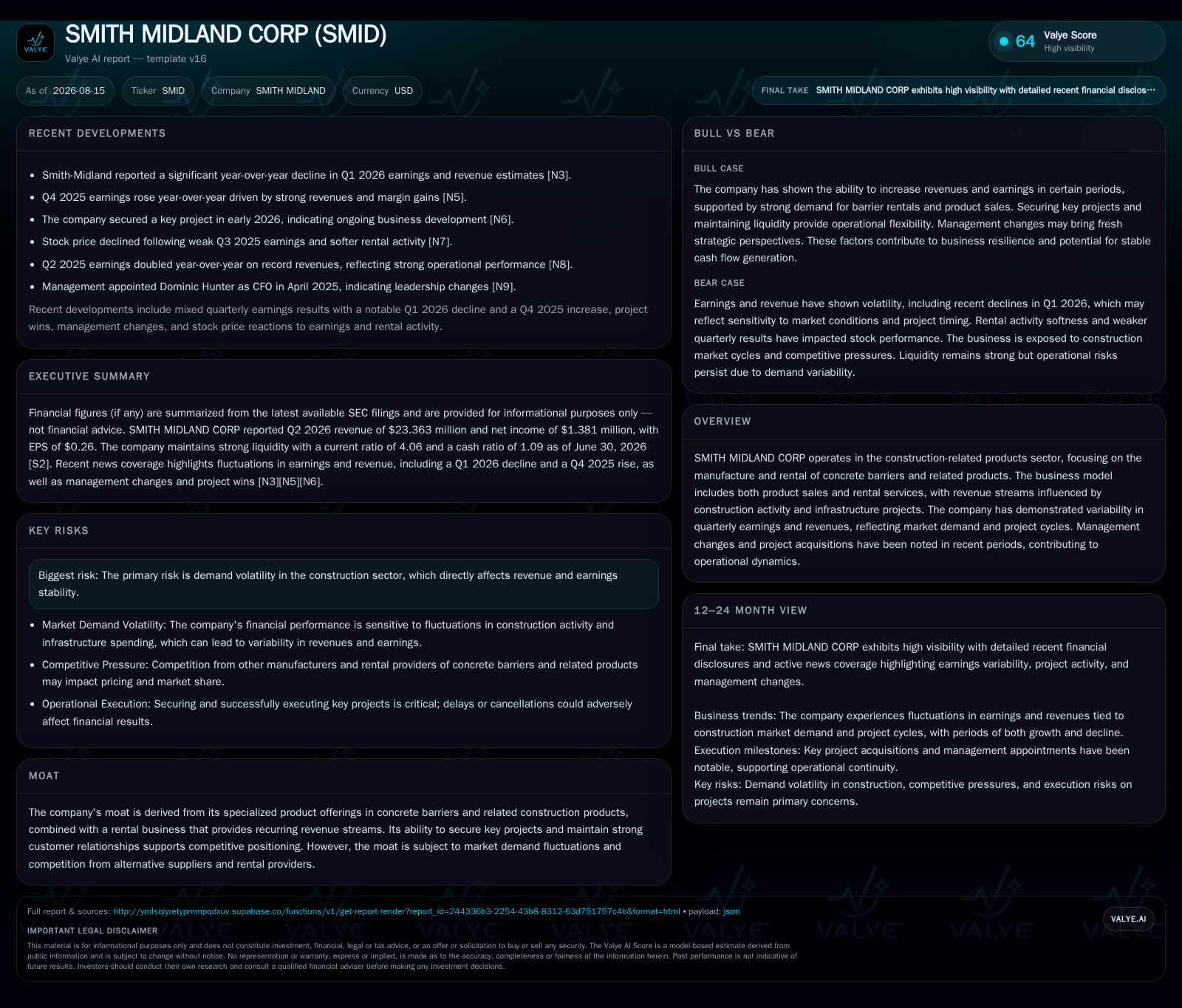
Smith-Midland Corporation reported a quarterly performance reflective of the cyclical nature of infrastructure project demand, a key driver for its revenue mix of proprietary precast concrete products and rental highway safety barriers. The company's specialized product portfolio, including patented systems like SlenderWall® and J-J Hooks®, supports competitive positioning but faces volatility tied to raw material costs and government contract timing. Rental fleet utilization offers some earnings stability amid market fluctuations. Looking forward, growth hinges on infrastructure investment trends, geographic expansion, and maintaining innovation pipelines balanced against execution risks such as labor constraints and pricing pressures.
Latest Quarter Highlights Reveal Demand Sensitivity to Infrastructure Spending Cycles
In the second quarter ending June 30, 2026, Smith-Midland Corporation’s financial results illustrated the direct impact of fluctuating infrastructure spending cycles on operational outcomes. The Management Discussion in the company's Form 10-Q notes that both revenues and earnings exhibited variability tied to shifts in public project funding patterns which dictate order flow timing for precast products and rental demand for highway safety barriers [S2]. This dynamic reflects the standard cyclicality embedded in the construction materials sector where activity is often lumpy given multi-phase infrastructure contracts. An accompanying press release reaffirmed this situational dependency with references to customer contract awards influenced by governmental budget allocations [S3]. This quarterly snapshot sharpens understanding of how Smith-Midland’s top-line and operating leverage behave in response to infrastructural investment rhythms.
Dual Revenue Streams: Manufacturing Proprietary Precast Products and Rental Income Synergies
Smith-Midland operates at the midstream segment of the construction value chain through two complementary revenue lines: sale of proprietary precast concrete products and rental of highway safety barrier systems. The manufacturing arm produces innovative solutions including SlenderWall®, an energy-efficient lightweight concrete-and-steel exterior panel; SoftSound™, a sound absorptive finish designed for noise abatement applications; Sierra Wall™, a roadside sound barrier; along with modular transportable buildings under the Easi-Set® brand [S1]. This product diversity caters chiefly to general contractors executing commercial construction projects as well as federal, state, and local transportation authorities engaged in infrastructure improvements across key US regions.
Concurrently, Smith-Midland’s rental division provides recurring income by deploying its J-J Hooks® Highway Safety Barrier system—a patented positive-connected barrier recognized for crash test certifications—targeted primarily at transportation agencies requiring temporary or semi-permanent solution deployments [S1]. The integration of sales and rental offerings not only diversifies revenue but also moderates earnings swings typical in construction-centric companies due to the steady demand nature of barrier rentals.
Innovation and Certification: Strategic Differentiators in a Competitive Materials Market
The company’s moat rests substantially on its product innovation pipeline supported by patents, trademarks, and regulatory certifications. These cover both functional superiority and compliance dimensions critical in public infrastructure projects. For instance, SlenderWall® incorporates third-party validated features mitigating moisture intrusion risks — addressing tenant liability concerns — while SoftSound™ leverages proprietary acoustical technology enhancing roadway environments [S1].
Moreover, Smith-Midland continually invests in testing protocols such as crash tests for its J-J Hooks® barriers meeting federal standards. These innovations bolster bidding competitiveness enabling premium product positioning over generic precast vendors who may lack equivalent certification or proprietary systems. Industry peers in precast concrete manufacturing similarly emphasize certifications (e.g., CRH plc), underscoring their importance in securing governmental contracts.
Rental Fleet Utilization as a Buffer Against Industry Cyclicality
Revenue durability is further enhanced through Smith-Midland’s rental model. High utilization rates of highway safety barriers provide steady cash flow irrespective of variable new construction starts [S1], [S2]. This characteristic is vital because while product sales are discrete transactions contingent on order backlogs and project schedule phases, rental contracts offer ongoing income subject to fleet deployment efficiency.
Industry benchmarks highlight fleet utilization as a key metric driving margin optimization for rental service providers.
Demand Volatility: Exposure to Construction Market Fluctuations Poses Growth Challenges
Despite its diversified offering mix, Smith-Midland remains exposed to traditional cyclicality risks dominating construction materials suppliers. The company acknowledges fluctuations in federal, state, and local government spending can delay approvals or shift tender calendars adversely impacting order backlogs quarter-over-quarter [S2], [S25]. Additionally, raw material cost inflation—chiefly cement and steel prices—exerts margin pressure given commodity price pass-through lags inherent in contract structures.
Operational challenges include supply chain logistics affected by labor availability constraints specifically skilled trades necessary for specialized installation services accompanying their modular building components or complex barrier systems. Peer companies face similar headwinds which complicate cost controls even amid stable demand environments.
Decoding Growth: Infrastructure Investment Trends, Geographic Strategy, Product Pipeline Insights
Smith-Midland’s growth outlook ties closely to anticipated increases in public infrastructure investment stimulated by federal programs targeting aging roadways plus urban development projects concentrated within the Mid-Atlantic and Midwest regions where its customer base is strongest [S1], [S2]. The company’s focused regional footprint potentially offers scale efficiencies yet also presents expansion opportunity should it diversify geographically into emerging growth corridors.
Product innovation supplements geographic initiatives with new launches like Beach Prisms™, a concrete architectural element that augments aesthetic appeal alongside functional durability intended for specialized projects. The sustained emphasis on R&D signals management’s commitment to broadening addressable markets beyond conventional sound walls or barriers toward modular building applications.
Risks in Execution: Raw Material Price Pressure, Contract Dependencies, Labor Constraints
Risks outlined include susceptibility to volatile building material costs that can erode gross margins if price escalations cannot be fully passed onto customers swiftly due to rigid contract terms or intense competition bidding down prices [S25],[S2]. Contract dependencies concentrate revenue risk since delays or cancellations materially alter production schedules causing fixed cost underabsorption.
Labor shortages compound these execution risks by limiting capacity to ramp production or execute timely installations—a critical factor for maintaining customer satisfaction in high-stakes public contracts. Regulatory compliance costs related to environmental standards add complexity though arguably contribute to competitive moat by raising barriers for less compliant rivals.
Next Steps: Order Backlog Evolution, Contract Awards Timelines, Key Operational Milestones to Monitor
Looking ahead, monitoring operational KPIs such as changes in order backlog sizes will prove crucial for validating recovery or growth momentum post recent quarters’ volatility [S2], [S3]. Similarly important are tracking project win rates reflecting competitive success especially amidst tightening public budget allocations.
Rental fleet usage rates will remain a relevant barometer of recurring income health during cyclical troughs. Renewals or expansions of barrier contracts with transportation authorities signal strength in customer retention strategies vital for sustaining margins.
Financial Profile Discussion: Balance Sheet Resilience Supports Strategic Flexibility
Smith-Midland maintains a strong liquidity position evidenced by a current ratio approximating 4.06x at June 30, 2026—reflecting substantial current assets versus liabilities—and holds minimal total debt relative to cash balances indicating a net cash stance estimated around $11.8 million [F1]. Such balance sheet conservatism provides flexibility to absorb project timing fluctuations or finance innovation capex without threatening solvency.
Operating profitability revealed by last full-year data supports ongoing reinvestment capacity while conservative leverage limits refinancing risk amid potential interest rate changes affecting its sector peers dependent on more aggressive capital structures.
Disclaimer: This is research-only, informational analysis and not investment advice. It may include AI-generated interpretation and general industry context. Always verify important details using primary sources.

Comments