
Silicon Valley Acquisition Corp. Advances Business Combination with Quantum Tech Firm Amid Liquidity Concerns
SVAQ pursues merger with EigenQ, a quantum security company, while managing financing and going-concern risks inherent to SPACs.
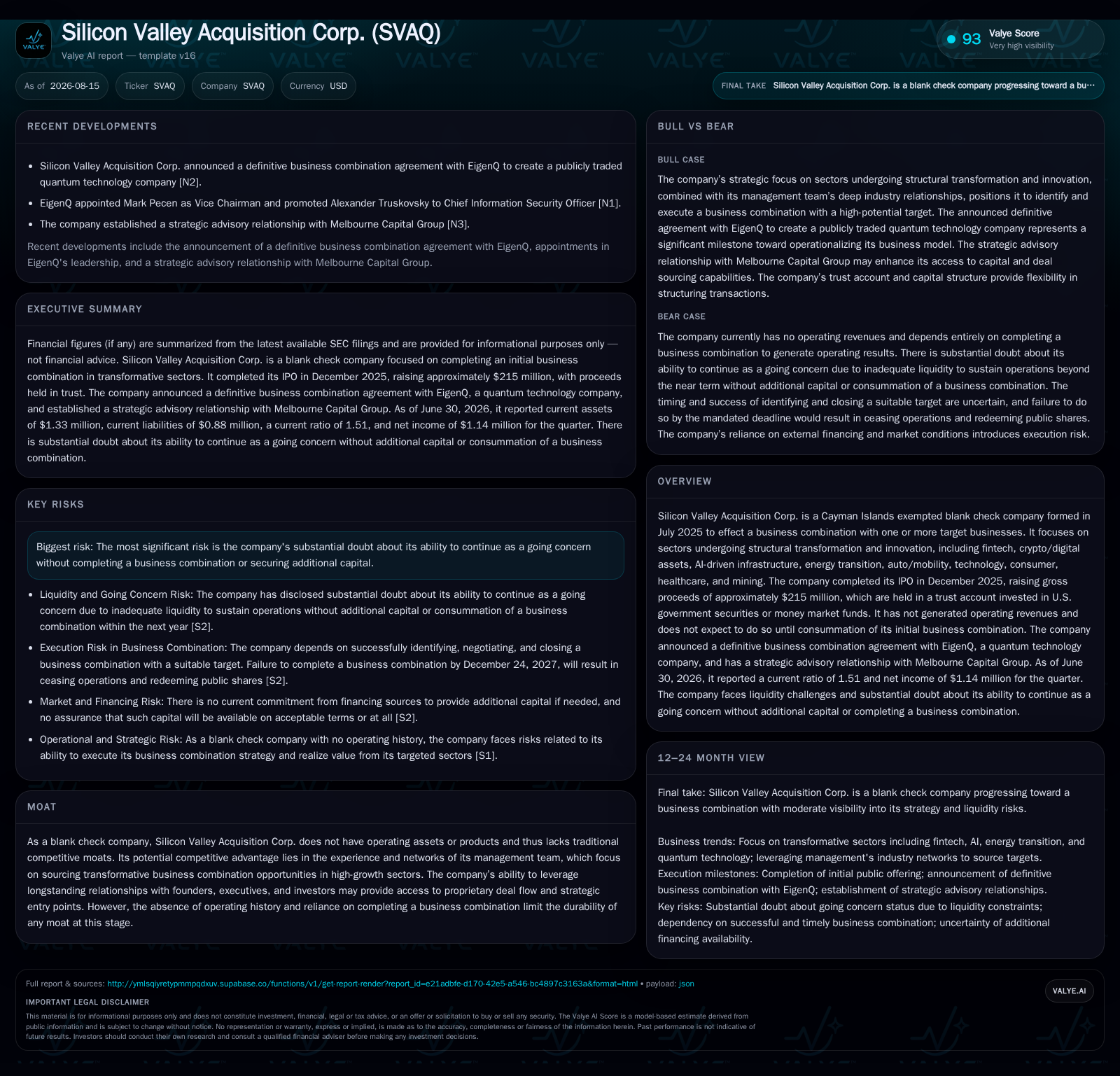
Silicon Valley Acquisition Corp. (SVAQ), a Cayman Islands-based special purpose acquisition company (SPAC), announced a binding business combination agreement with EigenQ Inc., a quantum technology firm, progressing its de-SPAC process. Despite raising $215 million from its December 2025 IPO into a trust account, SVAQ faces substantial doubt about its ability to continue as a going concern without completing the transaction by late 2027 or securing additional capital. The first amendment to the merger agreement adjusts governance and sponsor share arrangements to facilitate closing. Success hinges on execution capabilities, shareholder approvals, financing structure, and broader SPAC market conditions.
Recent Operating Update
Silicon Valley Acquisition Corp. (SVAQ) filed its latest quarterly report on August 14, 2026 ([S2]), updating investors on progress toward completing its initial business combination. The company remains on track toward merging with EigenQ Inc., a Delaware-based quantum technology company specializing in cybersecurity solutions through quantum encryption methods ([S4], [S7]). Notably, on August 6, 2026, SVAQ entered into a first amendment to its Business Combination Agreement with EigenQ and SVAQ’s merger subsidiary ([S3], [S26]). This amendment clarifies that the sponsor’s Transaction Support Shares can be transferred for any purpose related to the merger as agreed by the parties, ensures redemption mechanics for public shareholders occur immediately before domestication to Delaware, and expands the prospective post-merger board from seven to nine members. The equity incentive plan post-closing will also reserve approximately ten percent of issued and outstanding shares for employee incentives.
Despite these advancements toward consummation of the de-SPAC transaction (business combination), SVAQ raised a cautionary flag regarding liquidity: it expressed “substantial doubt” about continuing as a going concern past December 24, 2027 should it fail to close this transaction or secure alternative financing sources ([S2]). While confident it can seek additional capital if needed, there is no firm commitment yet from external financers. The risk underscores typical SPAC deadline pressures—failure to close mandates liquidation or share redemption events. Currently, SVAQ’s balance sheet shows approximately $1.33 billion in current assets against $0.88 billion in current liabilities as of June 30, 2026 ([F1]), reflecting trust account holdings primarily in government securities.
Business Model Overview
As a blank check company formed in July 2025 under Cayman Islands law ([S1]), SVAQ’s sole purpose is effecting an initial business combination with one or more target companies. It does not produce products or generate revenues until such a transaction closes. Instead, SVAQ monetizes through an initial public offering (IPO) that raises capital placed into a trust account segregated from operational expenses and governed by strict investment guidelines—primarily short-term U.S. Treasuries or money market funds ([S1]). The IPO completed in December 2025 raised gross proceeds of roughly $215 million via sale of units consisting of Class A ordinary shares plus redeemable warrants ([S1]).
Revenue realization only begins when the combined entity forms following successful completion of the de-SPAC transaction; until then operating losses arise solely from administrative costs such as legal fees, accounting compliance, underwriting fees paid upfront (cash plus deferred commissions), and general corporate expenses ([S1], [F1]). The primary financial driver is thus time-to-close the initial business combination given fixed operational burn.
In SVAQ’s case, management leverages extensive entrepreneurial networks across fintech, AI infrastructure, energy transition, healthcare innovation, mining sectors — pinpointing transformational enterprises undergoing structural change ([S1]). Its current merger partner EigenQ aligns strategically within quantum cybersecurity — an emerging frontier driven by increasing demand for secure encryption capable of resisting next-generation cyber threats ([N1], news). This specialization ideally positions SVAQ post-merger to capitalize on robust sector growth trends once public listing liquidity unlocks growth capital access for EigenQ.
Industry Structure and Competitive Position
Operating purely as an acquisition vehicle places SVAQ upstream within capital markets value chains serving technological innovation ecosystems. Unlike traditional operating companies or private equity funds engaging directly with product development or portfolio management over years, SPACs operate within compressed timeframes that emphasize deal sourcing acumen amid broad market cycles affecting valuations and investor appetite.
Competitors include other SPACs targeting high-growth sectors such as Churchill Capital Corp series focused on tech-driven deals or larger scale operations like Pershing Square Tontine Holdings which leverage brand recognition or proprietary pipelines. Venture-backed late-stage private firms pursue similar growth narratives but via private equity channels rather than public markets facilitated by SPAC mergers.
The viability of any particular SPAC hinges heavily on: quality of management teams who bring domain expertise; access to potential target businesses through long-term relationship networks; ability to negotiate favorable terms balancing PIPE (private investment in public equity) financing needs alongside shareholder approval dynamics; market environment supporting de-SPAC activity; regulatory clarity minimizing adverse restrictions or delays; and shareholder confidence limiting redemption rates that reduce available closing capital.
At present SVAQ’s management appears aligned with these expectations providing deep sector insights across targeted industries including crypto/digital assets and AI infrastructure harnessed by EigenQ’s quantum technologies ([S1]).
Successful realization depends on timely proxy filings followed by shareholder votes scheduled before expiration deadlines requiring swift legal & compliance deliverables ([S11],[S8],[S12]).
Risks and Watchpoints
Key operational risks include:
Continued monitoring of SEC proxy filing effectiveness along with shareholder vote outcomes remain critical near-term indicators. Also relevant will be announced PIPE financing details evidencing market confidence or dilution risk profiles ([S11],[S26]).
What to Watch Next
Investors should prioritize the following milestones:
- Filing and clearance of definitive proxy statement/prospectus describing full terms of the business combination upon receipt of audited financials ([S8],[S11]).
- Scheduling and conducting extraordinary general meeting for shareholder approval ahead of mandated outside date (December 24, 2027) ([S8],[S11]).
- Confirmation around PIPE or other transaction financing plans including amounts committed and terms influencing post-merger capitalization structure ([S26]).
- Execution progress regarding domestication relocation from Cayman Islands to Delaware enhancing governance standards pre-closing ([S18],[S22]).
- Market reception post-announcement reflected through warrant exercise activity levels and trading volumes on common stock units traded under ticker SVAQU/SVAQW ([N1], Nasdaq data).
Treasuries or money funds ensuring principal protection per regulatory standards ([F1],[S1]). Current liabilities stood at approximately $0.88 billion resulting in an acceptable current ratio near 1.51 reflecting manageable short-term obligations primarily related to deferred fees owed around underwriting payments alongside accrued operational expenses ([F1]). Total debt was minimal at around $161 thousand as of year-end December 31, 2025,[F1] consistent with typical low-leverage profiles expected for non-operating blank check companies.[F1]
Net losses continue since inception owing exclusively to administrative costs associated with corporate governance activities including expenses tied to legal counsel framing merger agreements advanced negotiations and audit procedures ([F1],[S1]). Interest income accruing in trust accounts partially offsets these costs but does not affect core operations since revenues are absent prior to completing the de-SPAC transaction.[F1]
Liquidity pressure arises mainly due to fixed timelines mandated under SPAC regulatory frameworks obligating positive closure or else liquidation occurs after about two years origination date which here aligns with late December 2027.[S2] Efforts made recently through amendments clarifying sponsor incentives around Transaction Support Shares aim at solidifying required funding commitments while mitigating dilution exposure.[S3]
Overall financial standing remains aligned with peer blank check vehicles pending transaction closure leveraging heavy cash-on-hand cushions earned during IPO proceeds less underwriting fees but reflecting limited path beyond de-SPAC success without external capital infusions should delays arise.
This analysis is based solely on publicly available information including SEC filings up through August 2026 and does not constitute investment advice.
Disclaimer: This is research-only, informational analysis and not investment advice. It may include AI-generated interpretation and general industry context. Always verify important details using primary sources.

Comments