
Wetouch Technology Advances Capacity Amid Product Mix Shift and China Regulatory Risks
Latest quarterly results highlight capacity expansion and revenue gains tempered by concentrated customer base and regulatory constraints.
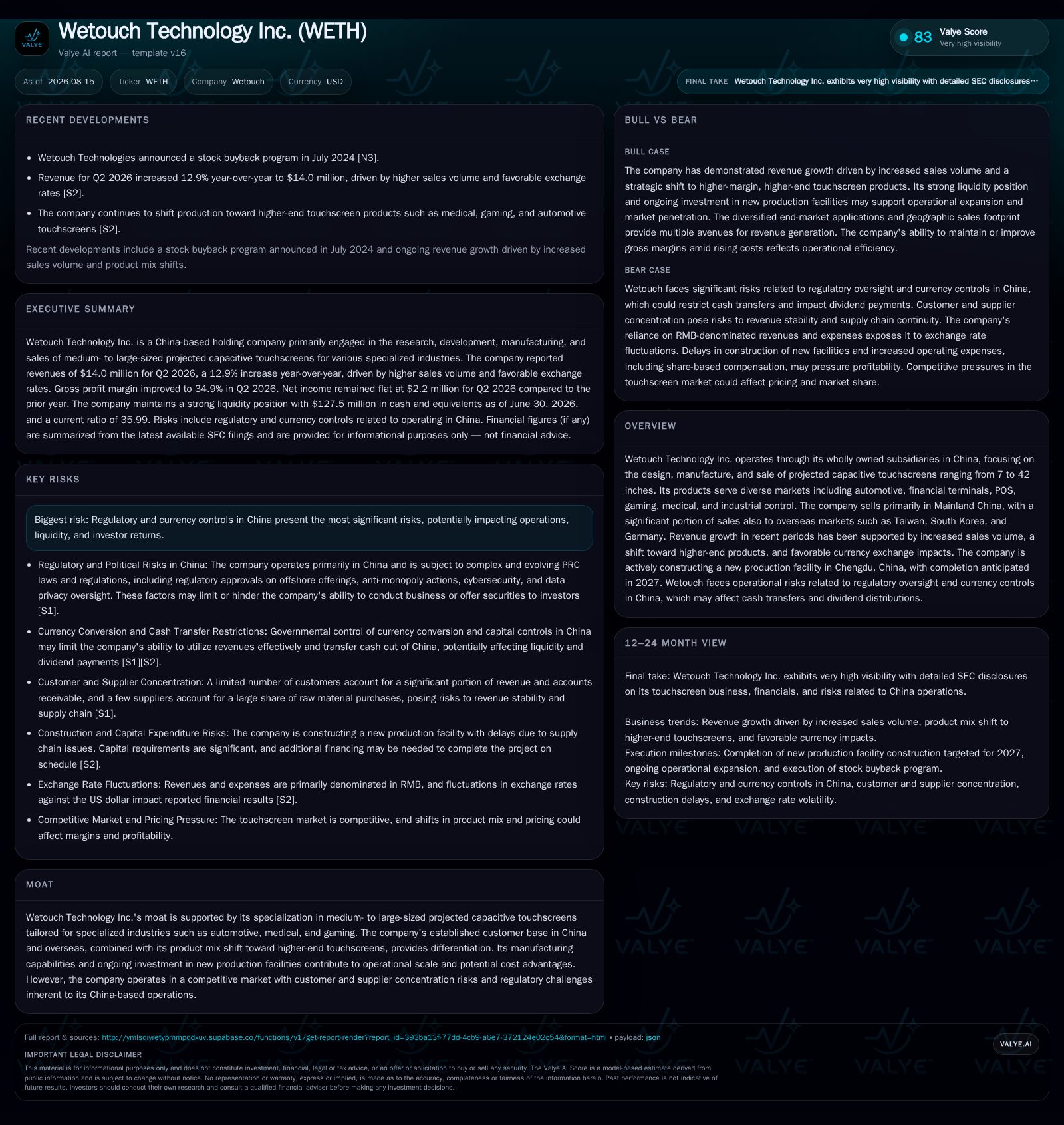
Wetouch Technology Inc. reported revenue growth driven by increased sales volume, product mix upgrading toward higher-end projected capacitive touchscreens, and a currency tailwind in its latest quarter. The company is progressing on a new facility construction targeting completion in 2027 to scale medium- to large-sized touchscreen manufacturing capabilities. However, regulatory oversight and currency controls in China present operational challenges that could impact liquidity and dividend repatriation. Wetouch's business model centers on specialized large-format touchscreens for automotive, medical, industrial, and gaming sectors with a customer base concentrated mainly in Mainland China but also extending to Taiwan, South Korea, and Germany. The interplay of capacity expansion, product mix evolution, and geopolitical risks will be key to Watch as the firm aims to improve margins while navigating competitive pricing pressures.
Recent Operating Update
Wetouch Technology Inc.'s Q2 2026 filing reveals a continuation of gradual revenue growth driven by multiple factors. For the three months ended June 30, 2026, the company achieved $16.3 million in revenue – a 6.5% increase over the same period last year [S12]. This rise was supported by a near-flat increase in sales volume (0.1%), a modest uptick in average selling price (+1.5%), alongside a favorable exchange rate effect from RMB appreciation against the US dollar (~4.8%). The domestic market remained dominant at around 68% of total revenues with international sales hovering near 32%, primarily sourced from Taiwan, South Korea, and Germany [S2]. Despite these positive trends, the company faces execution complexity related to a new production facility under construction in Chengdu which is delayed due to supply chain issues but anticipated to come online by late 2027 [S2].
Business Model Overview
Wetouch specializes in designing and manufacturing medium- to large-sized projected capacitive touchscreens ranging from 7" up to 42" diagonal size. These components are sold primarily to OEM customers across specialized verticals including automotive infotainment systems, medical equipment displays, gaming terminals, financial POS devices, and industrial control panels [S1][S2]. Revenue derives mainly from unit sales multiplied by negotiated selling prices; product mix changes significantly influence average selling prices as high-end touchscreens command premium pricing due to enhanced technical specifications and customization.
Key operating levers include production volume (units made), sales volume (units shipped), average selling price per unit influenced by product segmentation shifts, manufacturing yield rates critical for cost efficiency, and geographic revenue distribution affecting currency exposure [S2][S5]. Wetouch operates through wholly owned subsidiaries headquartered in China with operations concentrated chiefly in Mainland China but serving international customers in Asia-Pacific and Europe. Customer concentration is notable with a limited number of major clients accounting for a substantial portion of sales – exposing the firm to demand volatility risks tied to client purchasing cycles or contract renewals
Capital expenditure focus is the ongoing Chengdu facility investment valued at approximately $14.8 million aimed at expanding throughput capacity for larger format touchscreens [S2]. This capacity addition targets scaling production volumes while leveraging newer technologies that may improve manufacturing yields and reduce unit costs.
Industry Structure and Competitive Position
The touchscreen electronic components industry is characterized by rapid technological innovation cycles and intense pricing pressure due to commoditization risks. Firms compete primarily on product quality differentiation (sensitivity, durability), customization capabilities for end-markets like automotive or medical sectors requiring stringent certification standards, manufacturing scale efficiencies, and geographical reach.
Wetouch's specialization in medium- to large-sized projected capacitive touchscreens places it among niche producers servicing complex verticals where switching costs for OEMs are moderate but technical specification adherence is critical. Peers such as TPK Holding and GIS share similar end-market coverage though tend to have broader product portfolios including smaller-size modules or different touchscreen technologies.
The company's Chinese base offers cost advantages compared with some Western players but introduces regulatory challenges uncommon in other regions: tight governmental controls over foreign exchange conversions directly impact dividend remittances overseas along with obligations around statutory reserves limiting distributable earnings [S1][S17]. Wetouch's current strong cash position permits flexibility but does not eliminate external oversight risks that may curtail capital movements or impose operational constraints.
Growth Drivers
Several structural factors underpin Wetouch's growth trajectory:
- Increasing adoption of projected capacitive touchscreens in automotive infotainment units as cars become more connected drives demand for larger and more functional displays.
- Expansion into medical devices and industrial automation sectors where human-machine interface (HMI) technology penetration continues accelerating.
- Product mix shift favoring higher-resolution, larger-area screens (up to 42 inches) boosts average selling prices and gross margin potential.
- Geographic diversification with expanding export sales beyond mainland China into Asian neighbors and Europe mitigates single-market dependency.
- Technological advancements enabling greater touchscreen sensitivity and durability enhance product appeal especially for demanding applications like gaming or medical use.
- Investments in production facilities seek to raise manufacturing scale while capturing cost efficiencies that can support competitive pricing strategies.
Risks and Watchpoints
Key risks remain concentrated around:
- Regulatory interventions by PRC authorities controlling capital outflows could severely restrict Wetouch's ability to repatriate profits or service foreign investors despite strong underlying cash generation [S1][S17].
- Customer concentration implies that loss or reduction of orders from one or several major clients would materially impact near-term revenues.
- Supply chain vulnerabilities including raw material scarcity or delayed equipment deliveries may challenge timely completion of Chengdu capacity expansion.
- Competitive pressures within the touchscreen manufacturing landscape may compress margins if price cuts are necessary to maintain or grow share.
- Geopolitical tensions risking trade disruptions between China and key export markets such as South Korea or Germany could adversely affect international sale growth.
- Fluctuations in RMB/USD exchange rates add unpredictability to reported revenue figures given dual-currency operating environment.
Given these factors monitoring progress on facility construction milestones alongside order backlog trends will provide early signals of operational scalability realization post-2027.
What To Watch Next
Investors should track several upcoming developments:
- Management updates regarding phased completion status of the Chengdu production facility through remainder of 2026 into early 2027.
- Quarterly KPIs highlighting changes in product mix ratios (high-end vs standard-sized screens) that drive margin profiles.
- Shifts in geographic revenue splits signaling expansion success outside China versus domestic concentration trends.
- Movement in Days Sales Outstanding (DSO) metrics reflects working capital efficiency critical amid supplier payment terms tightening.
- Any additional disclosures concerning currency control impacts on cash repatriation or dividend declaration capabilities from PRC subsidiaries.
- Financing activity announcements if supplemental capital raising is required beyond existing cash resources for capacity build-out or strategic investments.
Financial Profile Discussion
As of June 30, 2026, Wetouch held $127.5 million in cash and equivalents against current liabilities of roughly $3.8 million resulting in an exceptionally healthy current ratio near 36x indicating robust short-term liquidity [F1][S18]. Total debt stood minimal relative to cash reserves at approximately $1.35 million as last reported at end-2023 with no recent increases noted [F1].
This liquidity cushion funds ongoing capital expenditure commitments estimated around $9.1 million incurred on new facilities through mid-2026 [S2][S21]. The company historically finances growth internally via operating cash flows supplemented by occasional equity raises as evidenced by a $10.8 million public offering completed early 2024 [S9], though future needs may prompt additional funding depending on construction pace or market conditions.
Operating income margins have strengthened aligned with rising revenues: net income nearly doubled from $2.6 million Q1 2025 to $3.9 million Q1 2026 supported by gross profit improvements despite modest upticks in selling expenses [S24]. Days Sales Outstanding trends advanced positively reducing from circa 56 days end-2025 to mid-40s range mid-2026 indicating improving collections discipline critical for capital cycle management [S12][S18].
Overall financial positioning appears sound with conservative leverage levels offering flexibility; however sustained profitability gains hinge upon successful execution of capacity expansion alongside maintaining favorable product pricing amidst competitive pressures.
-- This analysis is based on publicly available filings as of August 14, 2026 ([S1], [S2], [S3], [S12], others cited) combined with sector knowledge of electronic components manufacturing focusing on touchscreen technology.
Disclaimer: This is research-only, informational analysis and not investment advice. It may include AI-generated interpretation and general industry context. Always verify important details using primary sources.

Comments