
QS Energy’s Challenge in Commercializing Applied Oil Technology Amid Persistent Capital Constraints
QS Energy’s latest quarterly report highlights ongoing liquidity pressures and delayed commercial adoption of its proprietary pipeline efficiency technology.
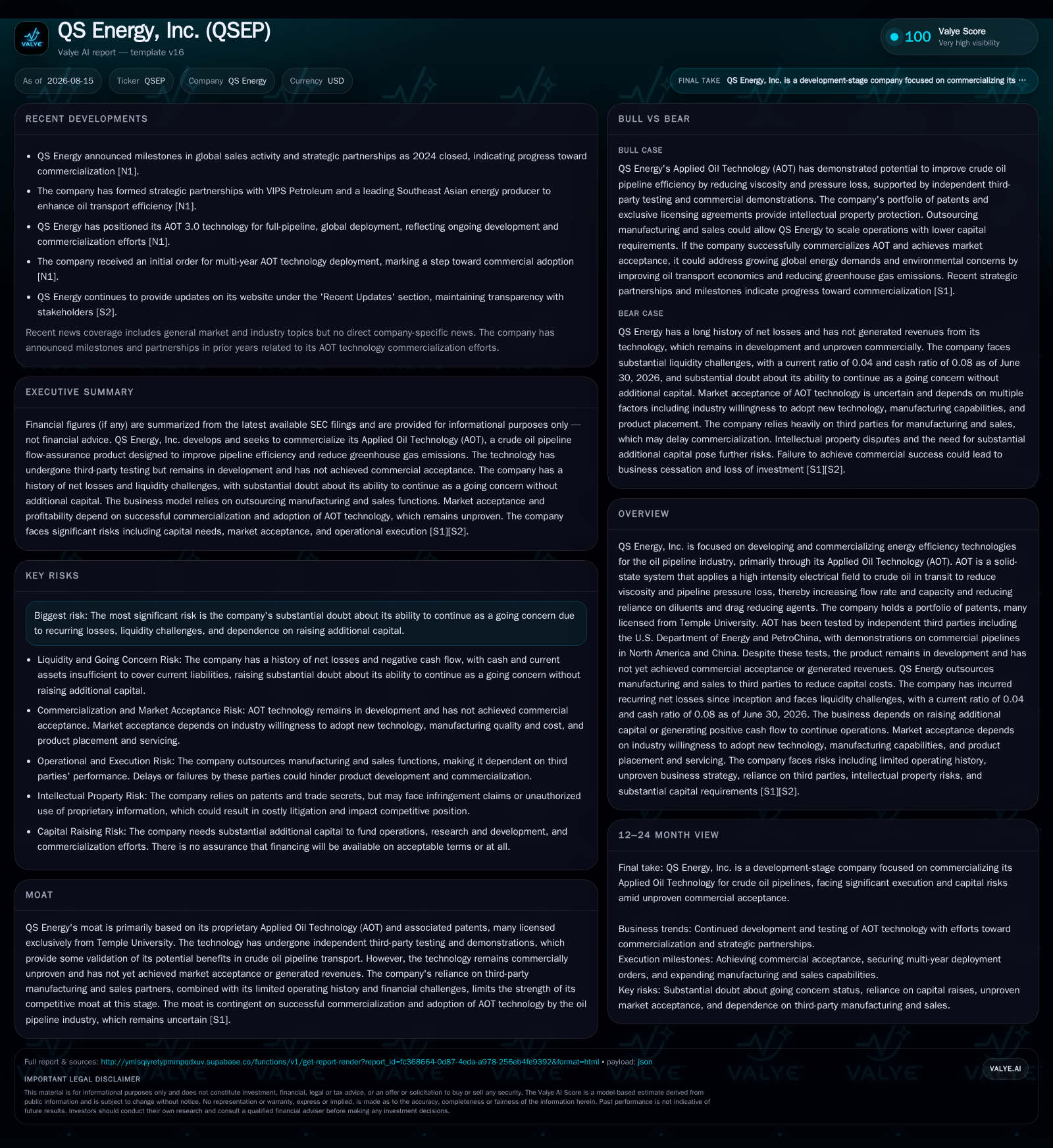
QS Energy, Inc. remains reliant on raising additional capital while continuing to develop and demonstrate its Applied Oil Technology (AOT), a patent-backed system designed to improve crude oil pipeline flow efficiency by reducing viscosity and pressure loss. Despite validation testing from respected third parties, the technology has not achieved commercial acceptance or generated revenues as of mid-2026. The company’s outsourced manufacturing and licensing model fits the midstream energy technology niche but underscores its vulnerability until steady adoption occurs. Persistent net losses, cash burn, and a frail balance sheet accentuate questions on near-term viability absent successful financing or breakthrough contracts.
Slower Commercial Traction during Continued Cash Drain in Latest Quarter
Management estimates available funds will only sustain operations through early 2026 Q2-Q3 absent new capital infusion [S1]. This fiscal reality casts doubt on near-term commercialization progress or business scaling given capital allocation primarily toward sustaining R&D and corporate expenses rather than generating customer revenue streams or deploying scalable units.
Applied Oil Technology: Intellectual Property Backing Meets Execution Realities
At the core of QS Energy’s offering is Applied Oil Technology (AOT), a proprietary solid-state system licensed from Temple University that applies high-intensity electrical fields to flowing crude oil aiming to reduce viscosity and pipeline pressure loss [S1]. This theoretically increases pipeline throughput capacity and lowers operators’ reliance on diluents and traditional drag reducing agents—chemical additives commonly used but carrying operational costs and environmental concerns.
Independent testing by credible entities including the U.S. Department of Energy and PetroChina Pipeline R&D Center affirms AOT’s capacity to reduce crude oil viscosity under lab-scale and some commercial conditions [S1]. Data collected via supervisory control and data acquisition (SCADA) systems during pipeline demonstrations suggest tangible operational benefits such as flow rate improvement and reduced pressure losses. However, these validations have thus far failed to translate into broad industry acceptance or contract wins.
QS Energy has transitioned AOT from pure laboratory experiments to initial field demonstrations but lacks evidence of full commercial deployment or recurring revenue streams. The company's intellectual property portfolio forms a moat contingent entirely upon eventual market penetration—a milestone yet unmet given the conservative buying patterns typical in midstream energy infrastructure services.
Midstream Pipeline Efficiency Niche and Competitive Dynamics
QS Energy operates upstream of midstream pipeline operators in the value chain as a technology licensor rather than direct service provider or equipment manufacturer [S1]. Its business model hinges on licensing AOT patents and outsourcing both manufacturing and sales functions to third-party partners, minimizing capital expenditure but increasing reliance on partner execution quality.
This stance contrasts with peers supplying chemical drag reducing agents or diluents who benefit from entrenched usage patterns backed by decades of operational trust and established delivery infrastructure. Companies like ATS RheoSystems exemplify alternatives in flow assurance technology focusing on rheological modification through additives rather than solid-state applications.
Consequently, QS Energy faces a steep adoption curve against incumbents offering lower-risk solutions with demonstrated ROI. The company must demonstrate not only technical efficacy but also the economic case compelling enough for conservative pipeline operators — typically wary of unproven innovations — to replace or supplement existing chemical regimes.
Drivers Behind Market Adoption: Pipeline Operational Economics and Regulatory Trends
The economic rationale for improving crude transportation efficiency amid rising global energy demands forms a principal growth driver for technologies like AOT [S1]. Pipelines operating at high volume face capacity constraints driven by fluid properties such as viscosity impacting pumping power requirements and throughput rates. Declining pipeline pressure loss through innovative mechanisms reduces fuel consumption associated with pumping stations and enhances overall transport economics.
Environmental regulations increasingly pressure operators to minimize greenhouse gas emissions—a factor enhancing interest in energy efficiency technologies that reduce indirect carbon footprints via operational optimization.
Additionally, expansions in pipeline networks globally alongside ongoing efforts to modernize aging infrastructure provide potential installation opportunities for cost-saving solutions that operate transparently alongside existing supervisory control systems.
These trends collectively form favorable tailwinds for long-term demand but require overcoming adoption inertia intrinsic to a risk-averse industrial segment.
Risks Pelting QS Energy: Liquidity, Adoption Hurdles, and Competitive Pressures
Recurrent operating losses totaling over $15 million in fiscal 2025 alone underpin substantial doubts about QS Energy's viability without fresh financing [S1][F1]. Cash burns exceeding $4 million per annum compound existential risks given scant liquidity buffers evident from the current asset-to-liability mismatch [F1].
The extended absence of revenues despite nearly three decades since inception typifies extreme commercialization risk exacerbated by long sales cycles inherent in midstream infrastructure deals reliant on extensive pilot testing before commitments.
Competitive threats remain robust from mature chemical additive suppliers whose products are widely accepted across global pipelines. QS Energy must demonstrate compelling advantage not only technically but economically versus these incumbents to crack entrenched vendor relationships.
Furthermore, dependency on third-party manufacturing complicates scalability; any partner execution failure potentially delays deliveries undermining trust needed for pilot conversions into long-term contracts.
Milestone Watchpoints: Capital Raises, Pilot Deployments and Licensing Deals
Critical near-term milestones include successfully closing one or more financing rounds substantial enough to extend runway beyond several quarters—without which operational continuity is doubtful [S1][S2]. Monitoring announcements around binding licensing agreements beyond currently non-binding letters of intent (such as the tentative Indian deployment program referenced) will indicate commercial traction progress or stall risk [S1].
Scaling demonstration pilots into multi-unit installations validated by rigorous data collection would meaningfully advance investor confidence in eventual revenue generation potential. Conversely, failure to announce definitive customer contracts or sizeable purchase orders within the fiscal year should underscore persistent execution challenges.
QS Energy's path depends heavily on transforming proof-of-concept demonstrations into paid deployments that yield measurable KPIs: persistent pipeline flow rate improvement percentages, verified reductions in viscosity/pressure loss under real-world conditions, and ultimately customer adoption rates higher than token pilots.
Financial Profile Discussion: Funding Needs Overshadow Progress
QS Energy's financial standing paints a precarious picture as it enters late 2026 quarters. Although total debt is reportedly zero at end-June 2026 per companyfacts data [F1], this masks severe working capital deficits illustrated by current liabilities vastly outstripping current assets ($5.87 million vs $207k) [F1]. Liquidity is constrained seriously by negligible cash reserves without credit facility access or secured financing commitments [S1][S2].
Annual net losses rose dramatically from approximately $1.9 million in 2024 to over $15.3 million in 2025 driven by amplified R&D spending focused on AOT prototype development plus increased non-cash stock-based compensation expenses linked to incentivizing management personnel [S3]. Operating cash outflows followed suit at roughly $4 million annually representing a cash burn rate above $300k monthly exclusive of discretionary financing inflows.
Management acknowledges these deficits necessitate substantial external capital infusions through equity or convertible debt issuances to maintain ongoing product development efforts plus corporate expenditures related to public company reporting compliance and patent license fees payable to Temple University—the core IP licensor [S1]
The firm’s historical reliance on 'best-efforts' share issuance for funding despite pronounced dilution risks signals heightened uncertainty surrounding future financing availability under favorable terms—an ominous sign for sustaining operations absent transformative events such as licensing deals generating meaningful revenues or breakthrough adoption spikes [S1][S2].
In summary, QS Energy remains an early-stage technology developer with an innovative yet unproven approach addressing critical midstream energy challenges—the path ahead hinges heavily on securing patient capital willing to shoulder substantial adoption risk while waiting for solid evidence of economic benefits sufficient to disrupt established chemical additive paradigms.
Disclaimer: This is research-only, informational analysis and not investment advice. It may include AI-generated interpretation and general industry context. Always verify important details using primary sources.

Comments