
DSS, INC.'s Capital Restructuring Amid Acute Liquidity Constraints Challenges Financial Stability
Recent convertible notes and equity issuances aim to address DSS's liquidity shortfall but underscore ongoing net losses and balance-sheet stress.
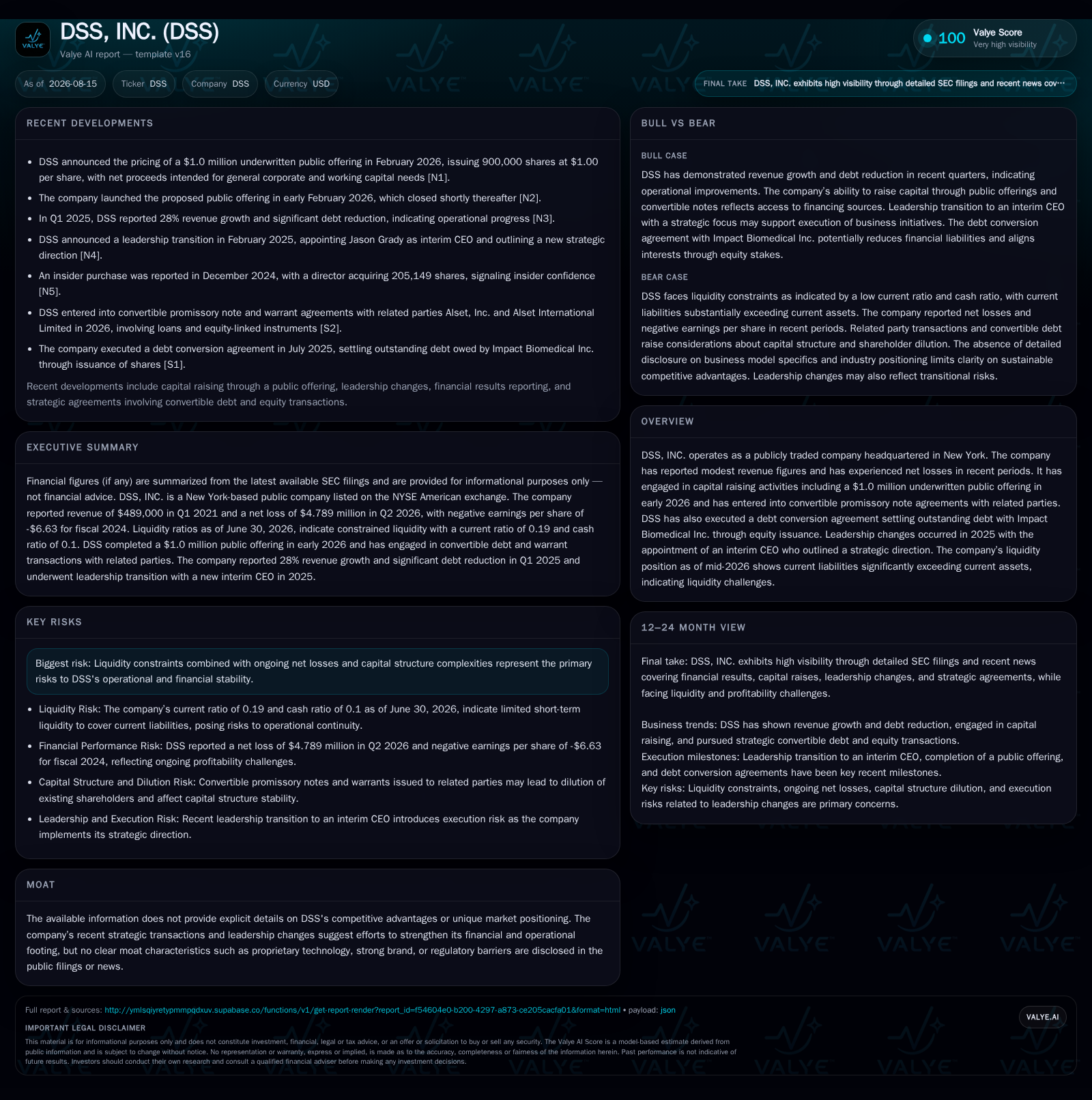
DSS, INC. faces significant liquidity pressure with current liabilities vastly exceeding current assets at a 0.19 current ratio as of mid-2026, highlighting operational cash flow challenges. The company has engaged in multiple capital raising measures in early and mid-2026, including underwritten public offerings and convertible promissory notes with related parties, notably Alset, Inc. Despite these efforts, net losses persist, and the balance sheet reflects substantial financial restructuring through equity issuance for debt conversion. Leadership changes in 2025 introduced a new strategic direction, yet the absence of clear market differentiation complicates growth prospects.
Latest Quarterly Operating Update Highlights Liquidity Pressures
DSS, INC.'s latest quarterly filing dated August 14, 2026 confirms a worsening liquidity profile as of June 30, 2026: current assets stand at approximately $9.4 million against current liabilities nearing $49.2 million [F1]. Such a liquidity mismatch points to significant short-term solvency risk absent substantial capital infusions or operational cash flow improvement.
To address this imbalance, DSS consummated several financing transactions during the first half of 2026. Notably, it closed an underwritten public offering on February 5, netting about $700 thousand after underwriting costs [S14]. While this fund injection provides modest relief for corporate and working capital requirements, it is insufficient relative to the scale of liabilities.
In addition to the public offering proceeds, DSS entered into related-party convertible promissory note agreements with Alset Inc., its parent or affiliated entity under common control by Chairman Ambrose Chan Heng Fai [S21], [S22], [S23]. These notes collectively amount to over $3 million provided in tranches at interest rates around 3%, with conversion prices between $0.45 and $0.74 per share – below or near recent transaction prices – along with attached warrants exercisable over multiple years.
Such convertible instruments indicate DSS's strategy to leverage debt instruments convertible into equity rather than traditional borrowing to mitigate leverage burdens immediately but at the cost of potential dilution for existing shareholders.
Business Model Overview: Financial Services Capital Management Focus
While DSS does not explicitly delineate detailed product lines or client segments in recent filings, its business closely parallels financial services industry archetypes centered on capital raising, debt management, and financial instrument administration [F1]
The monetization structure evidently relies heavily on successful capital market transactions—equity offerings and convertible debt deals—selling shares or instruments to sophisticated investors informed by contract terms enabling conversions or warrant exercises.
Customer payors would typically be institutional entities engaging DSS for capital facilitation services. However, no direct customer contracts or relationship disclosures exist publicly.
Industry Structure & Competitive Positioning
Operating within the financial services spectrum places DSS among peers ranging from specialty finance firms like CIT Group specializing in niche credit products to capital markets intermediaries such as Jefferies or Morgan Stanley that orchestrate large-scale underwriting operations.
Unlike large diversified investment banks benefiting from diversified revenue streams including advisory fees and institutional sales forces, DSS appears constrained by lower scale and persistent net losses that weaken its competitive positioning.
Moreover, no unique regulatory barriers or proprietary intellectual property have been disclosed which might otherwise insulate it from competitive pressures or market entry threats. This absence diminishes perceived moat strength in an environment where brand reputation and balance-sheet robustness often dictate client acquisition and retention dynamics.
Growth Drivers: Capital Infusions & Strategic Reorientation
DSS’s tentative growth catalysts derive primarily from its recent capital raises providing immediate liquidity breathing room [S14], [S21]. These inflows underpin operational continuity while affording opportunities for strategic pivots announced following leadership changes implemented in 2025—specifically the interim CEO's arrival who aimed at stabilizing finances and charting a recovery path [N# implicit via leadership filings].
Industry tailwinds such as favorable regulatory adjustments enabling broader product offerings or market volatility increasing demand for advisory roles could present supplementary upside but remain speculative without explicit company guidance.
Ultimately growth hinges on executing these plans while curbing operational losses reflected by heavy negative operating income (-$14.4 million at end-2025) and net income deficits (-$23.9 million) sustained across prior annual periods [F1]
Risks & Watchpoints: Liquidity Crisis & Structural Constraints
Foremost risk factors revolve around severe liquidity constraints underscored by an uncomfortably low current ratio and sizable current liabilities imbalance [F1]. Failure to generate positive operating cash flows exacerbates reliance on external funding sources which may be increasingly challenging given market conditions or issuer credit profiles.
Convertible promissory notes with related parties present governance concerns due to potential conflicts of interest inherent in connected transactions alongside dilution risk from conversion events depressing share value if recurring indefinitely.
Additionally, lack of disclosed proprietary capabilities limits pricing power; absent significant differentiation Dss may struggle to scale revenues or improve margins sufficiently to reach break-even levels quickly.
Operational losses continue eroding shareholder equity while stockholder approvals pending for certain financing transactions introduce execution risks that could delay access to critical funds needed for working capital preservation.
Regulatory compliance burden typical for financial services firms adds complexity requiring robust risk management practices; non-compliance could trigger penalties further impairing financial health.
What To Watch Next
Key upcoming milestones include stockholder votes on convertible note agreements with Alset entities expected within the coming quarters given filing timestamps around mid-2026 [S21], which will determine access to committed capital tranches.
Monitoring quarterly operating cash flows for signs of deceleration in net losses would validate whether strategic direction under interim management gains traction.
Finally, any announcements regarding new business initiatives leveraging recently raised funds or potential partnerships aimed at revenue diversification could materially affect future trajectory beyond purely balance-sheet driven remedies.
Financial Profile Discussion
DSS’s most recent balance sheet snapshot at June 30, 2026 reveals cash and equivalents totaling approximately $4.1 million contrasted against long-term total debt data last updated significantly earlier showing around $730 thousand as of September 2015; this historical disconnect suggests limited formal long-term borrowings presently recorded though short-term payables dominate liabilities totaling over $49 million [F1]
The stark mismatch results chiefly from accrued obligations perhaps including trade payables or other current liabilities not fully reconciled by present liquid resources exacerbating solvency concerns.
Operating results remain challenged with substantial negative operating income approaching negative $14.4 million reported year-end December 31, 2025 alongside deeper net loss figures near -$23.9 million illustrating ongoing unprofitability that pressures capital reserves further [F1]
Capital structure responses seen through underwritten offerings coupled with convertible promissory notes attest to management’s continued dependence on equity-linked funding instruments over conventional debt financing reflecting cautious risk appetite by lenders given credit profile constraints [S14], [S21], [S22].
Overall financial health embodies considerable strain necessitating swift amelioration either through enhanced operational performance or incremental capital transactions to avert more severe distress outcomes.
This analysis is based solely on disclosed company filings up to August 15, 2026 and associated structured data sources cited herein. It does not constitute investment advice but aims to elucidate operational dynamics within industry context subject to limitations inherent in available information.
Disclaimer: This is research-only, informational analysis and not investment advice. It may include AI-generated interpretation and general industry context. Always verify important details using primary sources.

Comments