
Talon Capital’s SPAC Structure and Trust Account Positioning Ahead of Business Combination Deadline
Talon Capital Corp. remains a blank check company with substantial IPO proceeds secured in trust and no operating revenues pending its initial business combination.
Talon Capital Corp., a Cayman Islands–incorporated SPAC formed in mid-2025, completed its IPO in September 2025, raising $249 million placed into a trust account dedicated to future acquisition. Its latest quarterly filing through June 30, 2026, confirms continued organizational activity with no commercial revenues and net income derived solely from trust account interest. The company maintains a healthy liquidity position but faces typical SPAC risks including deal execution uncertainty and potential redemption dilution before the September 2027 completion deadline.
Latest Operating Update: Trust Account Stability and Progress Toward Business Combination
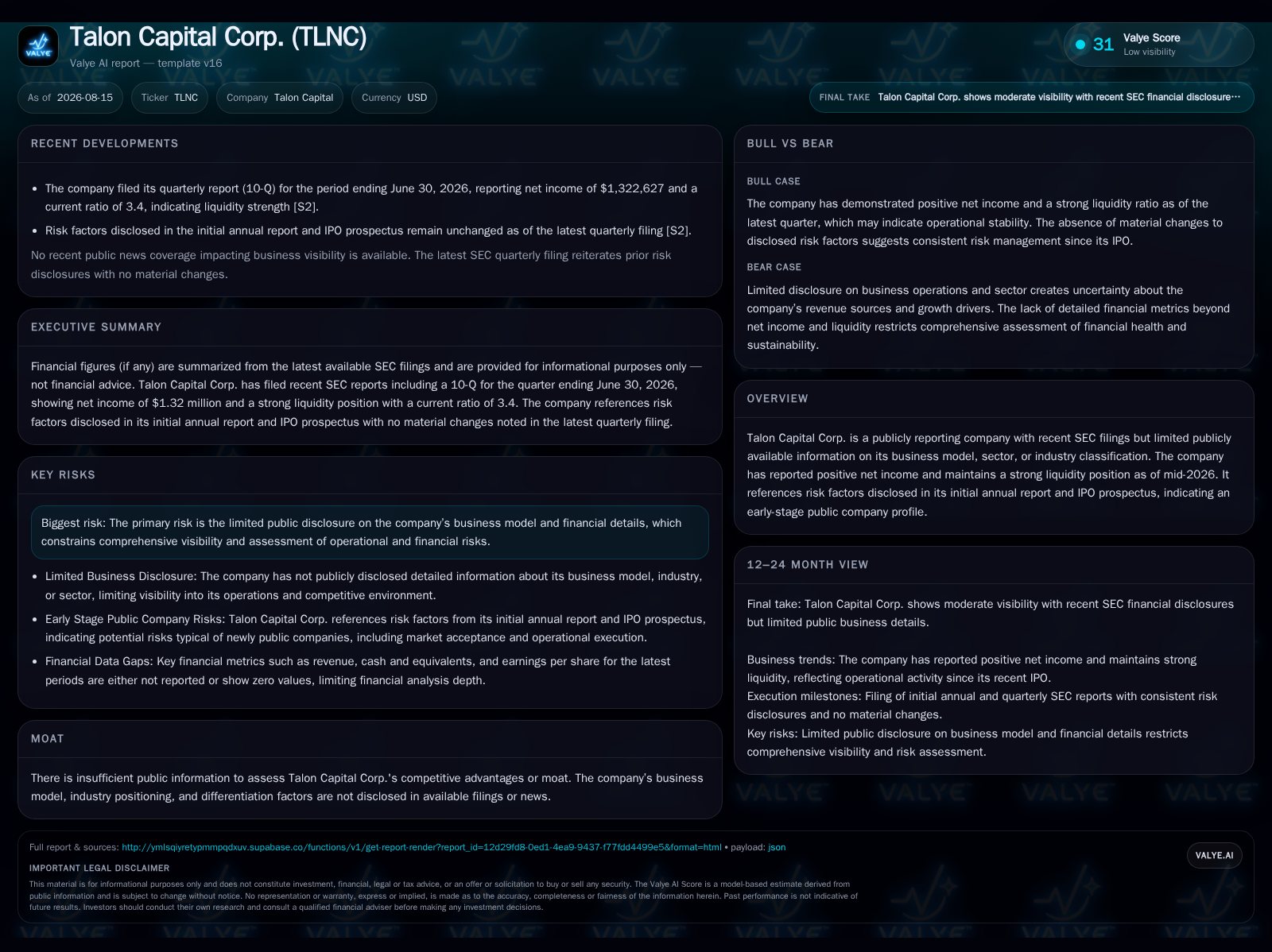
Talon Capital Corp.’s most recent quarterly report dated August 14, 2026, reveals a continued status as an early-stage blank check company with no commercial operations or revenue generation beyond interest income on cash held in its trust account [S2]. The company’s balance sheet as of June 30, 2026, shows total current assets of approximately $2.53 million against current liabilities totaling about $0.74 million, yielding a strong current ratio of roughly 3.4 — an indicator of solid short-term liquidity to meet obligations stemming from organizational expenses [F1].
No material changes have been reported relating to operational risks since the prior annual filing [S2]. Notably, net income recognized is anchored exclusively to non-operating interest income less administrative and underwriting expenses related to maintaining compliance and pursuing an initial business combination [S1].
Business Model Overview: SPAC Capital Vehicle Without Operating Revenues
Talon Capital operates as a Special Purpose Acquisition Company (SPAC), a publicly reporting shell entity incorporated in May 2025 for the express purpose of raising capital via an initial public offering (IPO) to acquire or merge with a target private company [S1]. The IPO completed on September 10, 2025, raised $249 million by offering 24.9 million units at $10 per unit; units comprise one Class A ordinary share plus one-third of a redeemable warrant exercisable at $11.50 per share [S1].
Concurrently, Talon raised an additional $7.79 million via private placement units sold to key insiders — 530,000 units to the Sponsor and 249,000 units to underwriters’ representatives — also priced at $10 per unit [S1]. The net IPO proceeds (excluding offering costs) were deposited in a trust account administered by Odyssey Transfer and Trust Company for the benefit of public shareholders [S1]. This trust account functions as collateral securing public investor funds until either the closing of an initial business combination or dissolution upon failure to consummate such within the prescribed timeframe.
Revenue generation is currently limited exclusively to interest accrued on the trust fund balances invested in ultra-safe short-duration U.S. government securities or qualifying money market funds that comply with Investment Company Act Rule 2a-7 standards [S1]. The arrangement restricts use of principal funds ensuring preservation of investor capital until shareholder-approved acquisition completion or liquidation scenarios.
Permitted withdrawals from the trust account are tightly controlled: only interest earnings can be accessed up to either $500,000 annually or five percent of total accrued interest — whichever is less — funding working capital costs such as legal fees, due diligence expenses, administrative services provided by the Sponsor under an Amended Administrative Services Agreement executed post-IPO [S4], or tax obligations excluding excise taxes [S1][S4].
This model inherently creates negative operating leverage since ongoing compliance costs incrementally reduce net interest income but are fixed regardless of acquisition progress. As such, monitoring operating expense management pre-acquisition is critical to preserve value for shareholders.
Industry Structure and Competitive Position: Placing Talon Within the SPAC Ecosystem
Talon Capital aligns with approximately hundreds of contemporaneously formed SPACs serving as upstream financial intermediaries in capital markets — vehicles designed principally for investors seeking access to private equity–style investments via public listings while providing targets faster go-public alternatives relative to traditional IPOs.
Its sponsor structure includes founder shares initially issued at formation totaling roughly eight million Class B ordinary shares post partial forfeiture tied to over-allotment adjustments — fairly standard dilution mechanics found among SPACs targeting alignment incentives for sponsors while preserving upside participation upon successful deals [S5][S8].
Underwriting fees imposed during the IPO procedure amounted substantially ($4 million cash paid plus deferred commissions close to $10 million) typical for transactions exceeding $250 million gross raising anchored by established investment banks like Cohen & Company Capital Markets acting as representatives [S1][S15]. Such fee structures align Talon competitively within peer groups being neither markedly higher nor lower than average market terms.
Notably absent at this stage are disclosures regarding specific target sectors or vertical expertise focus areas for acquisitions; this absence reflects either early-stage deal sourcing or sponsor discretion. However, no restrictions prevent acquisitions involving affiliates so long as independent director approval and fairness opinions are secured per governance safeguards disclosed [S1]
Growth Drivers: Capital Market Appetite and Timing Pressure Favor Deal Execution Urgency
SPAC growth drivers hinge heavily on robust capital market environments where investor appetite favors alternative vehicles offering liquidity combined with potential upside generated via warrants and sponsor alignments. Talon's successful substantial capital raise evidences sufficient initial demand despite broader market volatility impacting SPAC issuance since their peak popularity.
Private companies continue seeking expedited public listing routes that may entail lighter regulatory burdens than traditional IPO pathways — particularly attractive amid fluctuating equity markets or sector-specific growth cycles that favor strategic roll-ups or consolidation plays absent legacy operational encumbrances.
Talon currently operates within a Completion Window obliging consummation of its initial business combination by September 10, 2027 — effectively creating strategic timing pressure to identify viable targets quickly before expiration triggers capital return scenarios deleterious to sponsor economics and shareholder upside [S1][S9]. This looming deadline typically motivates accelerated diligencing processes and deal structuring innovation while potentially heightening redemption risk.
Risks and Watchpoints: Redemption Risk, Execution Uncertainty, Regulatory Compliance
Talon embodies typical SPAC-specific risks: failure to complete an approved business combination within two years mandates return of capital from trust accounts minus allowable interest payments withdrawn — risking full investment return but zero returns above principal for investors who do not redeem shares prior [S1][S9].
Redemption rights held by public shareholders can lead to dramatic fluctuations in available deal financing if sizeable redemptions occur ahead of agreement voting events. Elevated redemption rates can compel sponsors either to inject additional capital or alter transaction terms creating dilution concerns.
Risks related to regulatory scrutiny remain salient as evolving SEC guidance tightens compliance demands on disclosures around conflicts of interest between sponsors and public investors as well as valuation fairness protocols during proposed mergers [S9]. Talon's disclosure transparency so far complies scrupulously with these requirements but further regulatory developments could impose incremental procedural burdens.
Tracking ongoing operating expense trends reported each quarter will reveal administrative cost control effectiveness essential for preserving enterprise value until transaction.
Trust account balances should remain stable absent approved withdrawals beyond defined allowances; any unplanned depletion would warrant close scrutiny regarding operational decisions impacting principal security.
Finally, updates on administrative service agreements providing internal cost offsets via sponsor resources could influence pre-deal burn rate dynamics positively if expanded efficiently beyond initial scope ratified post-IPO [S4].
Financial Profile Discussion
As of June 30, 2026, Talon maintains current assets valued at approximately $2.53 million versus current liabilities near $0.74 million delivering a current ratio around 3.4 indicative of good liquidity reserves adequate for satisfying near-term liabilities principally linked to general administrative functions including due diligence efforts [F1]
The absence of any reported operating revenues corroborates with expectations given no completed business combination has occurred; net income recorded prior (year ended December 31, 2025) reflects positive non-operating interest income offset by modest administrative expenses characteristic of blank check companies maintaining compliance readiness between IPO and transaction closure phases [F1][S1]
Deferred underwriting fees aggregated nearly $10.2 million at IPO closing affecting initial cash flows but amortized over time reducing immediate earnings impact; this aligns with common industry practices designed to match fee recognition patterns extending beyond immediate receipt date ensuring accurate expense allocation across reporting periods [S1]
In sum, financial indicators affirm Talon's sound capital structure continuity paired with measured cost avoidance consistent with prudent pre-business combination stewardship customary among peer SPACs navigating similar lifecycle stages.
This analysis relies exclusively on publicly filed SEC disclosures through August 14, 2026 ([S1], [S2]) and company facts data ([F1]). It refrains from speculating on undisclosed acquisition targets or deal specifics absent explicit filings. Talon Capital currently manifests standard SPAC characteristics including healthy liquidity safeguards via trust account investments alongside inherent uncertainties prevailing until consummation or termination deadlines approach.
Disclaimer: This is research-only, informational analysis and not investment advice. It may include AI-generated interpretation and general industry context. Always verify important details using primary sources.

Comments