
Graf Global Corp. Approaches Business Combination Deadline with $230 Million Trust and Liquidity Constraints
Graf Global Corp., a Cayman Islands-based SPAC, holds substantial trust cash from its IPO but faces a narrow window to close its initial Business Combination amid liquidity pressures.
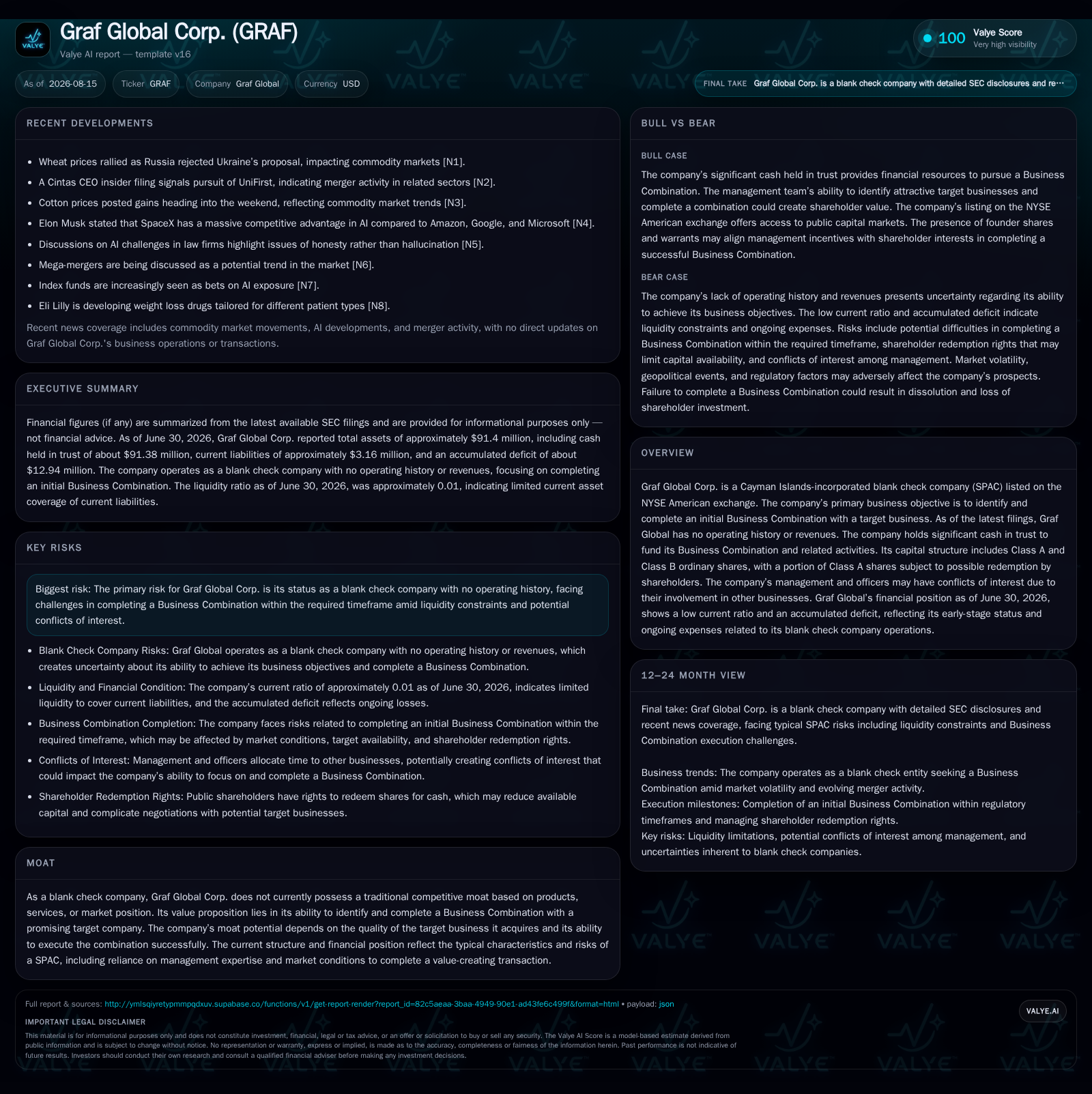
Graf Global Corp. remains a blank check company focused on completing its initial Business Combination before its September 27, 2026 deadline. The company raised $230 million in gross proceeds during its June 2024 IPO, funds that remain held in a segregated trust account invested conservatively. Its financial filings as of mid-2026 reveal minimal operating liquidity and significant working capital deficit, highlighting typical SPAC pre-combination constraints. Success hinges on deal execution within a truncating timeframe, while redemption risks and sponsor-related conflicts remain critical watchpoints.
Recent Operating Update
Graf Global Corp.'s latest quarterly filing dated August 14, 2026 ([S2]) provides a critical lens on its progress as it approaches the September 27, 2026 deadline to complete an initial Business Combination. Since closing its IPO on June 27, 2024, the company raised gross proceeds of $230 million by selling units priced at $10 each; these proceeds sit largely untouched in a trust account invested conservatively in U.S. government securities with maturities not exceeding 185 days. This preserves principal for the forthcoming acquisition while generating nominal interest income.
However, the company's standalone operating liquidity shows pronounced stress: only $21,149 in unrestricted cash sits outside the trust at quarter-end, leading to a working capital deficit of roughly $3.14 million [F1][S2]. Such imbalance typifies SPACs prior to consummating deals because ongoing expenses—legal fees, advisory costs, administrative overhead—consume operating cash without operational revenue inflows.
Importantly, the Board retains discretion to extend the September deadline up to three times by one-month increments if a definitive Business Combination agreement has been executed by then—a somewhat standard safeguard enabling additional time in complex deal negotiations [S2]. Still, this extension window compresses rapidly with summer turning into early fall.
Business Model Overview
Graf Global operates as a Special Purpose Acquisition Company (SPAC) incorporated in the Cayman Islands and listed on NYSE American under ticker GRAF. By design, it lacks commercial operations or revenues until it effectuates its first acquisition (termed the "Business Combination" or De-SPAC transaction). Its value proposition lies mainly in sourcing and executing an acquisition of a private business that can benefit from public markets access combined with Graf's capital resources and management expertise [S1].
The capital raise strategy deployed involved issuance of Units each comprising one Class A Ordinary Share plus half a redeemable warrant exercisable at $11.50/share after combination ([S2][S3]). Additionally, the Sponsor acquired Private Placement Warrants at $1 per warrant concurrently with the IPO for an aggregate of six million warrants. The proper classification and fair value allocation of these instruments affect future dilution estimates post-transaction [S2].
Revenue mechanics are inherently latent here since no direct sales occur; revenue realization depends entirely on acquiring a profitable or growth-oriented private target capable of producing sustainable free cash flows post-merger ([S1]). Operating metrics hinge heavily on deal pipeline health (number of evaluated targets), expected leverage ratios after combination (management prefers modest debt levels), and potential visibility into forward earnings — criteria shaping target selection scope.
Industry Structure and Competitive Position
SPACs such as Graf Global occupy an intermediary niche bridging institutional/public investors seeking alternative high-growth exposure and private companies desiring expedited paths to market liquidity without traditional IPO hurdles. This domain is increasingly crowded with variants including multi-sector vehicles like Social Capital Hedosophia or prominent investor-backed platforms such as Pershing Square Tontine Holdings.
Although SPACs share structural similarities—holding IPO proceeds in blind pools pending acquisition decisions—competitive differentiation often arises from sponsor reputation and deal sourcing capability. Graf emphasizes leveraging an "extensive business network" to identify proprietary deal opportunities preferably over bidding wars ([S1]), partially mitigating market competition effects on valuation multiples.
Despite this aspiration, prior experience warns that many SPACs face substantial redemption risk—where public shareholders opt out post-announcement—and unfavorable market conditions can delay or derail mergers entirely. As such Graf's near-term trajectory aligns closely with typical industry risks rather than unique competitive edges until consummation.
Growth Drivers
Graf's strategic growth horizon fundamentally aligns with general tailwinds favoring SPACs: robust investor appetite for alternative public offerings persists alongside growing private company demand for rapid market access. Sponsor-driven network effects may enable selective proprietary acquisitions potentially offering synergistic expansions or roll-up strategies.
Management's articulated preference for targets demonstrating predictable cash flows and conservative leverage immediately post-combination underscores an intent to stabilize post-merger performance quickly—a response perhaps shaped by lessons learned industry-wide about SPAC structural dilution and operational risk plumbing ([S1]). Furthermore, potential backstop or forward purchase agreements remain tools Graf could employ post-acquisition for capital optimization.
Incremental growth prospects will depend heavily on client acceptance during Business Combination voting rounds and shareholder retention rates amid redemption rights exercises—a critical metric for ensuring the deployed trust funds translate into accessible acquisition capital.
Risks and Watchpoints
The fundamental existential risk for Graf Global is failure to consummate any approved Business Combination within prescribed regulatory deadlines. This scenario triggers automatic liquidation distributing trust assets pro rata but forfeiting founder/sponsor equity components—a catastrophic outcome nullifying equity upside ([S2]).
Conflicts of interest pose persistent governance concerns since Graf’s management team and officers maintain external business involvements potentially competing for attention or influencing transaction terms unfavorable to minority shareholders ([S1]). Transparency around related-party transactions remains crucial going forward.
Market volatility coupled with evolving SEC regulatory scrutiny around SPAC disclosures inject additional uncertainty into timing and structural design of forthcoming transactions across this sector broadly beyond just Graf.
What to Watch Next
Key milestones for tracking Graf's near-term outlook include:
- Announcement of entering into definitive agreements for targeted acquisitions before the primary deadline or its possible extensions.
- Redemption vote outcomes gauging shareholder sentiment towards proposed deals once announced.
- Potential updates about entering forward purchase or backstop arrangements enhancing transaction financing options.
- Any board resolutions extending the Business Combination deadline signaling delays or negotiation complexities.
- Monitoring sponsor-related disclosures related to warrant exercises or additional equity issuances indicative of alignment shifts.
Each event will provide measurable guidance on whether Graf remains positioned to transition successfully from a blank check entity into an operational public company — pivoting from financial vehicle to business operator.
Disclaimer: This is research-only, informational analysis and not investment advice. It may include AI-generated interpretation and general industry context. Always verify important details using primary sources.

Comments