
SOBR Safe's Shift to Integrated Compliance Software: Opportunity Amid Financial Constraints
SOBR Safe discontinues hardware operations and refocuses on SaaS-based substance compliance solutions amid tight liquidity and restructuring.
In its latest quarterly filing, SOBR Safe, Inc. announced the discontinuation of its legacy alcohol monitoring hardware business, marking a strategic pivot towards enterprise software focused on substance compliance. This transition emphasizes recurring subscription revenue from an integrated SaaS platform but comes with significant financial headwinds, including a current ratio well below one and ongoing net losses. Strategic partnerships remain critical for market penetration in this niche compliance sector, while challenges around customer retention and lengthy sales cycles add pressure. Investors should monitor ARR growth milestones and additional financing steps as key indicators of sustainable turnaround.
Latest Quarterly Update Drives Software-Centric Pivot
In its August 14, 2026 10-Q filing, SOBR Safe disclosed a decisive move to exit its legacy hardware business segments, specifically ceasing production of its SOBRcheck and SOBRsure alcohol monitoring devices along with related software services effective July 31, 2026. This step involved terminating manufacturing operations and support agreements, alongside closing corporate office leases that were tied to these discontinued operations [S2][S6]. The company anticipates cost savings of approximately $1.2 million annually as a result. Additionally, workforce reductions totaling about 14 employees—roughly 70% of the staff—were implemented by mid-2026, incurring severance-related restructuring charges estimated around $155,000 between Q2 and Q3 [S6][S21].
This operational reset signals SOBR Safe's clear de-risking strategy aimed at preserving cash flow during precarious liquidity conditions while narrowing its product focus exclusively toward an integrated enterprise software solution for substance compliance management. Confirming sustained lower operating expense run rates will be critical to assessing the durability of these measures.
How SOBR Safe's SaaS Platform Underpins Future Revenue Models
Historically tied to hybrid sales of hardware devices coupled with software components, the company's redefined business model now centers on delivering substance compliance as an integrated software-as-a-service (SaaS) platform [S1]. This pivot aims to capture recurring subscription revenue streams typical in enterprise regulatory compliance software — a domain where automation of compliance monitoring, reporting analytics, and regulatory adherence are highly valued by end users such as HR departments and risk managers.
The shift enhances potential for consistent Annual Recurring Revenue (ARR), provided customer adoption scales appropriately during the long sales cycles characteristic of regulated industries [S1]. However, success hinges on managing customer churn during migration away from legacy offerings while expanding contract sizes through upselling features embedded within the integrated platform
By focusing on subscription revenue rather than capital-intensive hardware sales, SMBs like SOBR Safe gain improved margin leverage; yet realization depends heavily on reaching positive net retention rates within relatively niche target verticals.
Competitive Dynamics in Niche Compliance Software Markets
The specialized space that SOBR occupies straddles RegTech providers delivering substance/workplace compliance software versus larger diversified enterprise application vendors. Smaller players often depend on depth in regulatory knowledge and agile product updates aligned with shifting compliance rules.
Barriers arise from complex regulatory environments fostering switching cost stickiness; clients typically prefer minimal disruption due to liability risks around inaccurate reporting or poor compliance enforcement. Strategic partnerships can thus serve as vital channels for market access and integration capabilities — especially when internal scale is limited.
Compared to peers entrenched in similar specialty niches or broader SaaS portfolios with compliance modules, SOBR’s differentiated offering lies in its fully integrated platform pivot away from hardware dependency.
Strategic Partnerships as Growth Amplifiers and Market Access Points
As detailed in the annual disclosures, SOBR Safe leverages strategic alliances to compensate for comparatively limited internal go-to-market scale. These partnerships facilitate enhanced distribution reach into regulated industries where direct sales efforts involve protracted negotiation cycles exacerbated by legal/risk concerns [S1]
Partnerships not only broaden geographic or vertical coverage but also enable deeper product integration, providing incremental customer value through combined analytics or more streamlined compliance workflows that competitors may find hard to replicate.
Such alliances form a partial moat given regulatory complexity barriers preventing easy substitution; however, maintaining robust partner relationships will remain essential to sustaining operational momentum.
Constraints on Growth: Liquidity, Customer Retention, and Sales Dynamics
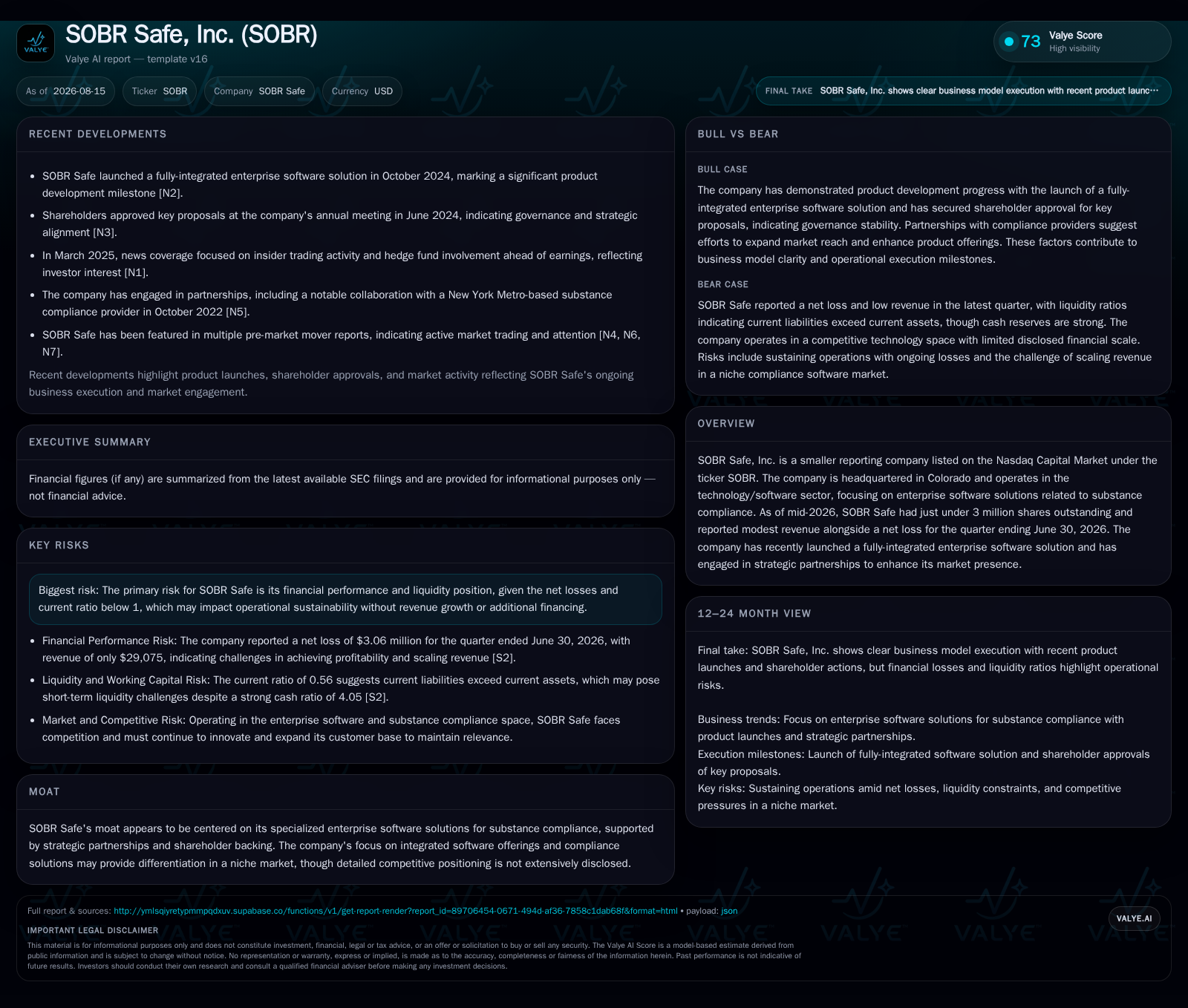
Despite restructuring efforts intended to preserve capital, the company's liquidity profile remains strained: at June 30, 2026 current assets were reported at approximately $515K against current liabilities near $926K yielding a current ratio around 0.56 — well below typical safety thresholds in enterprise SaaS sectors [F1][S2]
Ongoing negative net income reflects persistent cash burn consistent with earlier annual results (operating losses exceeding $9 million reported for FY 2025) [F1]. This financial position raises concerns about operational sustainability absent accelerated revenue growth or fresh capital infusion.
Customer acquisition costs (CAC) are likely elevated given long enterprise-class sales cycles intensified by regulatory diligence needs; slower payback periods could impair free cash flow conversion metrics common among mature SaaS vendors. Moreover, transitioning customers off legacy hardware/software hybrids introduces churn risk that could dampen net retention figures temporarily.
These factors collectively imply pressing needs for controlled expense management alongside marketing/sales effectiveness improvements.
"Looking Ahead": Catalysts and Milestones to Monitor
Future progress indicators worth attention include tracking ARR growth acceleration evidencing successful software migration traction beyond modest initial commercial adoption levels. Public disclosures should highlight shifting revenue mix favoring subscription streams rather than one-time device sales.
Additional milestone signals derive from expansions or renewals announced within strategic partnerships lending credibility to product market fit expansions or channel deepening efforts.
Capital structure developments also warrant scrutiny: recent warrant inducements executed mid-2026 introduce new potential equity dilution avenues that carry limited liquidity due to deliberate non-listing on any exchange—impacting shareholder rights until exercised [S3]
Regulatory environment shifts imposing stricter workplace substance control standards may enhance demand dynamics over medium term if platforms adapt swiftly.
Financial Profile Discussion: Liquidity Challenges and Capital Structure Context
As of quarter-end June 30, 2026, SOBR Safe reported current assets totaling about $515K versus current liabilities nearing $926K producing an uncomfortable current ratio of roughly 0.56 highlighting short-term liquidity pressures [F1][S2]. Cash equivalents balance is modest relative to operational outflows given prior years' losses.
The firm carries minimal recorded debt (~$440K at best-effort from older data), indicating limited leverage usage although any refinancing or additional credit facility would be critical amidst ongoing cash burn [F1]. Equity-related instruments such as newly issued warrants augment financing optionality but possess extremely constrained secondary market liquidity due to deliberate non-quotation policies [S3].
These financial realities underscore urgency surrounding execution against revenue growth targets coupled with stringent budget discipline following multi-phase workforce reductions totaling about three-quarters of personnel a few months ago [S6][S21]. Without clearly identifiable near-term drivers improving cash flow conversion metrics like net retention rates or ARR scaling acceleration, raising more capital or completing business combination transactions may become imperative.
This analysis incorporates all available SEC filings through August 2026 emphasizing recent operational pivots combined with sector-relevant financial framing. The transition toward integrated SaaS substance compliance software positions SOBR Safe strategically within a growing regulatory technology niche yet necessitates stringent execution discipline given pronounced liquidity headwinds currently evident.
Disclaimer: This is research-only, informational analysis and not investment advice. It may include AI-generated interpretation and general industry context. Always verify important details using primary sources.

Comments