
Rain Enhancement Technologies Battles Early-Stage Commercialization and Liquidity Headwinds
The company advances its proprietary atmospheric enhancement technology while managing operational and financial constraints.
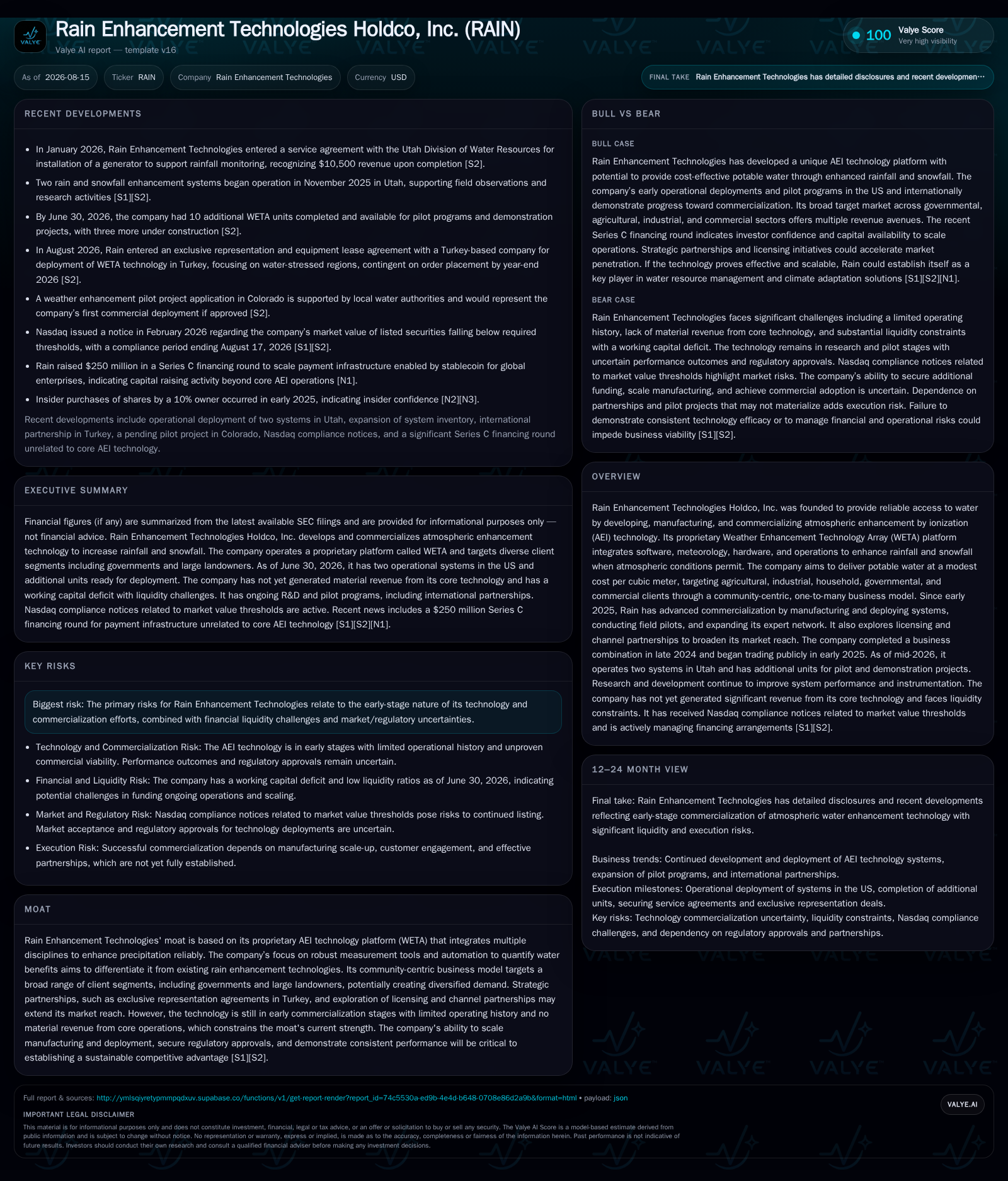
Rain Enhancement Technologies Holdco, Inc. (RAIN) is progressing with its atmospheric enhancement by ionization (AEI) technology, deploying systems in pilot settings and expanding its expert network since early 2025. The company targets a broad client base through a community-centric, one-to-many business model, aiming to deliver cost-effective potable water via rainfall and snowfall augmentation. However, the early commercialization phase is constrained by limited revenue generation, ongoing operating losses, and significant liquidity challenges underscored by a current ratio near 0.03 as of mid-2026. Strategic growth depends on successful system deployments, scaling manufacturing, securing additional financing, and establishing regulatory acceptance.
Recent Operating Update
Rain Enhancement Technologies Holdco (RAIN) remains in the nascent stages of commercializing its atmospheric enhancement by ionization (AEI) technology. As of the latest quarterly report filed August 14, 2026, the company reports two fully operational rain and snowfall enhancement systems deployed in the United States since November 2025 supported by ongoing data collection for performance validation [S2], [S10]. Additionally, it has ten more completed units ready for installation to support pilot programs pending site availability and permitting. This gradual scaling reflects a deliberate approach to advance reliable precipitation augmentation under real-world conditions while accumulating measurable evidence of water yield benefits through integrated meteorology and software analytics embedded within their proprietary WETA platform.
Financially speaking, progress is tempered by a lack of material revenue—total recognized receipts comprise a nominal $10,500 from a service agreement with Utah Division of Water Resources in early 2026—highlighting that commercial monetization is still embryonic at best [F1]. Net losses continue unabated; Q2 2026 net loss was approximately $3.2 million driven chiefly by general administrative expenses linked to personnel outlays including stock-based compensation and marketing efforts aimed at stakeholder engagement alongside modest research and development spending [S2]. The absence of recurring revenue accentuates risk around cash flow sustainability.
Business Model Analysis
The core value proposition lies in Rain's integrated WETA system that combines ionization hardware deployment with meteorological analytics software designed to artificially enhance rainfall and snowfall when atmospheric conditions permit. The company envisions providing potable water generation at an estimated cost of $0.10 per cubic meter excluding land costs—a claimed advantage over alternative atmospheric water technologies based on preliminary internal assessments [S1], [S2].
Revenue mechanisms are expected to evolve from outright system sales coupled with installation services toward ongoing service contracts allied with performance monitoring and possibly licensing agreements that leverage the WETA platform or its components. The company's approach employs a community-centric one-to-many business model targeting a diverse customer spectrum: large agricultural landowners needing water resilience; energy firms aiming at sustainable water sourcing; resorts requiring weather risk mitigation; insurance companies analyzing climate hazard impacts; decarbonization projects leveraging environmental tech; plus governments spanning local municipalities to supranational entities focused on water security initiatives [S1], [S2].
This broad segment targeting facilitates diversified demand but mandates complex sales strategies often dependent on regulatory acceptance and demonstrable efficacy—both areas where Rain's technology currently faces hurdle given limited track record. Licensing ambitions combined with channel partnerships also feature as strategic levers to expand market penetration without necessitating heavy capital expenditure on manufacturing scale-up immediately.
Industry Structure and Competitive Position
Rain operates within an early-stage environmental technology niche focused on atmospheric water enhancement via weather modification techniques incorporating ionization technology—a subsegment characterized by scientific uncertainty over efficacy benchmarks and evolving measurement standards globally. Its peer universe loosely includes weather modification providers such as Weather Modification International offering cloud seeding services; environmental hardware makers developing atmospheric water generators; renewable resource solution providers; meteorological analytics firms supporting precision weather interventions; plus government water utilities exploring augmentation technologies.
RAIN differentiates itself through its proprietary WETA platform's integration of hardware-ionization methods aligned tightly with software-enabled automation for precise measurement of precipitation volume augmented—addressing common criticisms faced historically by weather modification technologies regarding proof of actual incremental water gains. However, competitive barriers remain low given conventional competitors’ long-established presence servicing cloud seeding contracts under regulatory frameworks versus Rain's still unproven AEI system whose scalability beyond pilot tests has not yet been validated broadly.
Growth Drivers
Several structural factors underpin demand potential for Rain’s technology:
- Global escalations in water scarcity fueled by population growth, agricultural expansion needs, industrial urbanization drive investments into augmented water sourcing solutions.
- Climate change inducing greater variability in natural precipitation patterns heightens reliance on supplemental weather modification technologies.
- Governmental policy frameworks increasingly encouraging water resilience projects often backed by funding or incentives that could benefit first movers like Rain.
- Technological advancements enabling more precise meteorological analytics coupled with hardware-software synergies improve confidence in performance measurement reinforcing potential adoption.
- Expansion into adjacent atmospheric water applications like fog dissipation (piloted in Australia) and snowfall generation represents new use cases increasing total addressable market.
- Strategic licensing deals and partnerships might accelerate geographic scale without proportional capital burden.
These drivers combined create an innovation-fueled commercial landscape receptive to differentiated solutions like Rain’s WETA array once efficacy thresholds are proven convincingly.
Risks and Constraints
Key challenges confront the company at multiple fronts:
Addressing these risks requires disciplined execution along the R&D pipeline alongside strategic capital management tied closely to demonstrable field successes constrained by external factors like permitting lead times.
What to Watch Next
Investors and industry observers should monitor several key developments:
- System deployment cadence: Progression beyond current pilot footprint towards commercial-scale installations including timing/location update reflecting permitting status.
- Precipitation augmentation metrics: Credible independent data validating incremental rainfall/snowfall volumes generated per unit system deployed based on enhanced measurement automation tools.
- Regulatory milestones: Clearances or certifications obtained facilitating broader market entry including jurisdiction-specific environment impact approvals.
- Capital raises: New equity or debt financings extending liquidity horizon critical given ongoing cash burn and working capital deficits noted at mid-year.[S2], [S6]
- Partnerships/licensing announcements expanding geographic or client access potentially yielding revenue streams without upfront manufacturing outlays.
- R&D progress on adjacent applications such as fog mitigation merits attention especially subsequent instrumented field pilots scheduled in key U.S. states affecting market perception of versatility.
Careful tracking of these indicators will illuminate trajectory towards viable commercial scale infrastructure necessary for sustainable financial footing.
Financial Profile Discussion
The balance sheet reveals ongoing working capital imbalance driven by current liabilities surpassing $13 million against less than half a million in current assets creating pronounced liquidity stress ([F1]). Though total debt outstanding reported at end of 2024 was relatively modest around $839K mainly reflecting related-party borrowing ([F1]), management acknowledges substantial doubt regarding going concern viability absent new capital infusion given continued operating deficits nearing $5 million over the first half of 2026 alone ([S2]).
Efforts mitigate this risk have included incrementally increasing authorized borrowings under related-party loan agreements up to $10 million capacity with some drawdowns after year-end 2025 ([S14]) alongside utilization of Nasdaq at-the-market equity program though no confirmed material funding success is reported yet ([S2]). Ultimately sustaining operations hinges on securing external investor confidence potentially hinging on demonstrated technological proof points driving customer contracts converting field pilots into revenue-generating deployments over upcoming quarters.
This analysis draws exclusively upon publicly filed SEC documents and company disclosures without projecting future performance or giving investment guidance.
Disclaimer: This is research-only, informational analysis and not investment advice. It may include AI-generated interpretation and general industry context. Always verify important details using primary sources.

Comments