
Investcorp Credit Management BDC Navigates RIC Qualification Risk and Portfolio Valuation Challenges
The latest quarterly filing highlights Investcorp Credit Management BDC’s ongoing efforts to address regulatory tax qualification issues while managing portfolio complexity and capital structure adjustments amid a challenging credit environment.
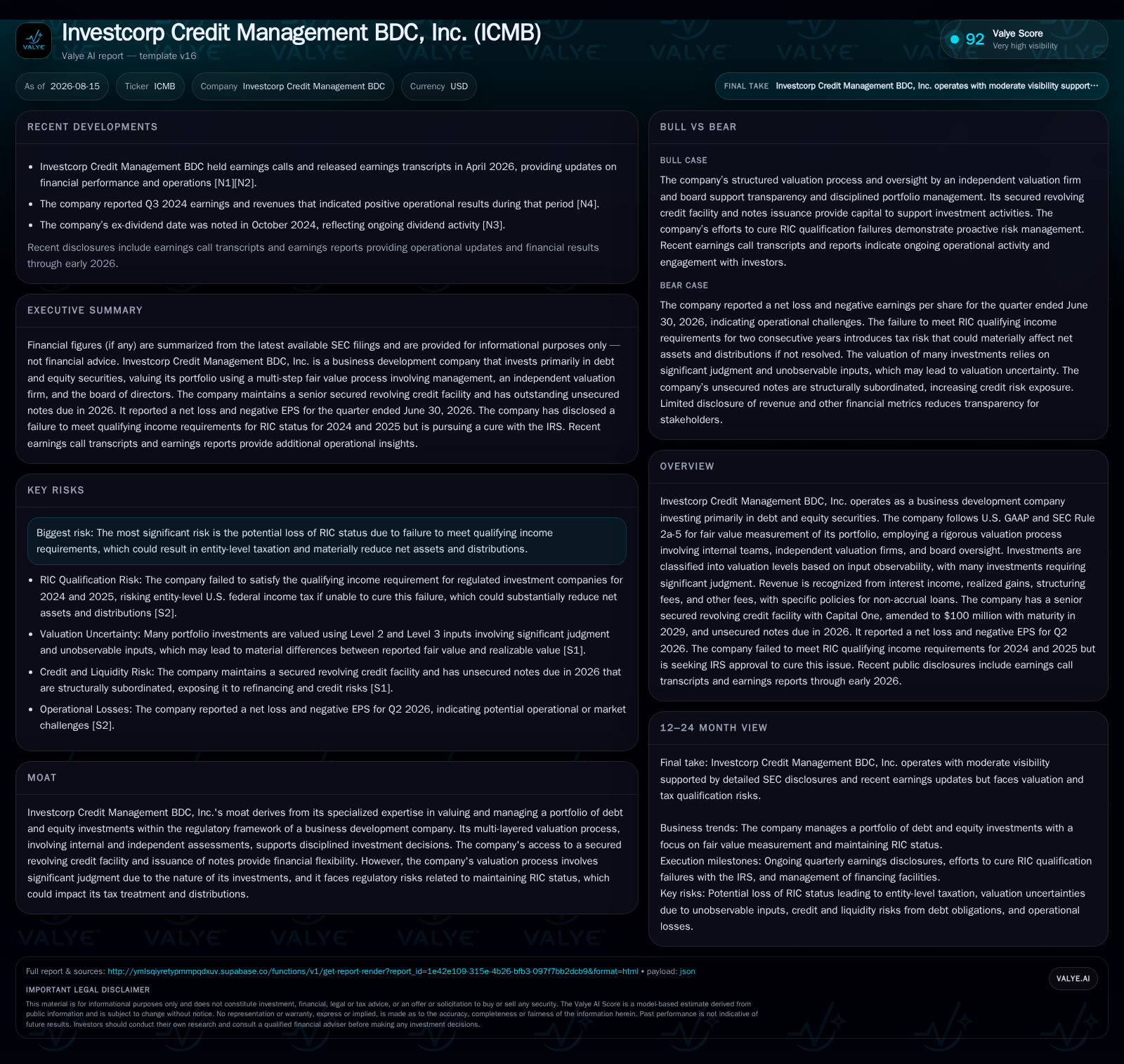
Investcorp Credit Management BDC, Inc. (ICMB) disclosed a net loss in its Q2 2026 report and revealed it failed to meet the qualifying income requirements for Regulated Investment Company (RIC) status in 2024 and 2025, risking entity-level U.S. federal income taxation. The company is pursuing a cure process with the IRS by disclosing the failure and proposing additional tax payments. ICMB’s portfolio valuation involves significant judgment due to illiquid debt and equity investments, supported by a board-approved multi-layered valuation framework. Operationally, ICMB executed a $10.3 million portfolio exit in May 2026 and amended its senior secured revolving credit facility to reduce capacity from $100 million to $50 million, reflecting prudent leverage management in line with evolving liquidity needs.
Recent Operating Update
To mitigate potential adverse consequences, ICMB is invoking Section 851(i) of the Code which allows a RIC to cure such failures by disclosing them to the IRS and paying an excise tax calculated on nonqualifying income. The company has submitted a request for a closing agreement with the IRS seeking confirmation that it maintained RIC qualification despite these failures. Estimated additional taxes payable approximate $1.1 million for the short year ended December 31, 2024, and $0.9 million for the full year ended December 31, 2025 [S2][S18][S19]. While this strategy provides a pathway to preserve tax advantages, there remains uncertainty pending IRS approval. Failure to secure relief would result in entity-level taxation that could substantially erode ICMB’s net assets and reduce distributions available to shareholders.
Operationally, ICMB completed the disposal of its entire exposure in Work Genius Holdings, Inc. and Work Genius, LLC in late May 2026 for approximately $10.3 million [S3][S9], demonstrating active portfolio management amidst illiquid market conditions prevalent in middle-market credit.
Additionally, ICMB amended its senior secured revolving credit facility in May 2026 through a sixth amendment that reduced capacity from $100 million to $50 million [S15]. This adjustment signals prudent capital structure management aimed at balancing liquidity needs against lender risk appetite amid evolving market dynamics.
As of June 30, 2026, ICMB held roughly $10.9 million in cash and equivalents against total debt near $109.9 million resulting in net debt close to $98.96 million [F1]
Business Model Overview
ICMB functions as a publicly traded BDC specializing in providing debt and equity financing solutions primarily targeting middle-market private companies [S1]. Operating under the Investment Company Act of 1940 and subject to SEC Rule 2a-5 fair value measurement guidelines, ICMB serves as an intermediary channeling capital from public markets into private credit opportunities.
The firm generates revenue principally through interest income on debt investments complemented by structuring fees from deal origination activities and realized gains upon asset dispositions [S1]. Interest income reflects portfolio yield calibrated against risk profiles inherent in private credit markets; fee income enhances margins offsetting portfolio seasoning or impairment effects.
Given many investments lack readily available market quotations due to bespoke structuring or illiquidity, ICMB employs a comprehensive valuation approach incorporating:
- Level 1 inputs: observable quoted prices when available;
- Level 2 inputs: observable but adjusted market data;
- Level 3 inputs: unobservable inputs requiring significant management judgment.
A substantial portion of ICMB’s portfolio falls under Level 3 valuations necessitating board-approved policies supplemented by independent third-party pricing firms to ensure objectivity and governance rigor [S1]. This multi-tiered valuation framework helps mitigate subjectivity risks but inevitably introduces volatility into reported net asset values (NAV).
Preserving RIC status is fundamental given it confers pass-through taxation enabling distributions without entity-level corporate tax burdens—a key feature supporting shareholder returns characteristic of BDCs [S1][S2]. To maintain this status under Subchapter M of the Code, ICMB must annually satisfy source-of-income tests (minimum 90% qualifying income), asset diversification limits on issuer concentrations, and distribution thresholds.
Failure on any front jeopardizes RIC qualification potentially triggering double taxation that would materially impact NAVs and dividend capacity—a critical risk highlighted by recent lapses related to nonqualifying income items.
Industry Structure and Competitive Positioning
The BDC credit management sector addresses financing gaps for middle-market companies often underserved by traditional banks constrained post-regulatory reforms. Firms like ICMB compete among publicly traded BDCs focused on private credit alongside specialized asset managers deploying private debt funds.
Key sector challenges include managing opaque borrower financials leading to heightened credit risk; navigating interest rate fluctuations affecting loan yields versus funding costs; maintaining liquidity buffers; and implementing robust valuation methodologies compliant with SEC mandates.
Peers such as Ares Capital Corporation (ARCC) benefit from scale advantages lowering cost of capital while Golub Capital BDC (GBDC) leverages direct origination platforms enhancing underwriting control—strategic differentiators within this competitive set.
ICMB’s competitive strength lies chiefly in its disciplined valuation process addressing illiquidity risks combined with access to flexible capital structures including unsecured notes alongside recently downsized revolving facilities [S1][S15], enabling cautious deployment strategies preserving NAV integrity.
Growth Drivers
Structural trends underpinning demand for ICMB’s offerings include:
- Regulatory constraints limiting traditional bank lending enhance reliance on private credit providers;
- Secondary market development facilitates monetization of legacy equity stakes generating realized gains;
- Innovations expanding fee-based revenue streams beyond interest income;
- Enhanced regulatory clarity around fair value methodologies improving transparency;
- Macroeconomic environments supporting borrower repayment capacity bolstering yield stability.
While specific KPIs such as portfolio yield or non-accrual ratios were not detailed explicitly here [F1], these remain critical metrics shaping growth quality within private credit portfolios across the BDC industry.
Risks and Watchpoints
The paramount risk centers on regulatory compliance regarding RIC status as failure entails entity-level taxation significantly diluting distributable net assets [S2][S18][S19]. The resolution depends on IRS acceptance of the company’s cure request; denial would adversely affect valuation multiples reflective of higher tax burdens anticipated by investors.
Credit risk inherent in middle-market loans poses default potential impacting interest income recognition relative to provision expenses. The reliance on board assessments for fair valuing illiquid investments injects volatility into NAV calculations complicating investor visibility.
Leverage usage demands monitoring especially following facility reduction from $100 million to $50 million reflecting potentially tighter operational parameters influenced by lender conservatism or strategic recalibration [S15]. Undisclosed concentration risks may also exacerbate losses during economic downturns.
Macroeconomic headwinds including rising interest rates or slowing growth threaten borrower fundamentals potentially pressuring yield sustainability emphasizing prudent underwriting discipline going forward.
What To Watch Next
Key upcoming developments include IRS decisions on closing agreement requests clarifying whether ICMB can preserve RIC status—fundamental for avoiding double taxation impacting future dividends.
Operationally, disclosures on portfolio turnover or changes in non-accrual loan ratios will illuminate asset quality trends amid economic shifts. Debt facility amendments or renewals will indicate liquidity positioning influencing investment pacing.
Additional portfolio sales akin to May’s Work Genius exit may signal strategic repositioning responsive to market conditions. Tracking NAV per share trends will provide insight into realized gains versus mark-to-model valuation adjustments driven by subjective assumptions affecting reported net assets.
Financial Profile Discussion
At June 30, 2026, ICMB held approximately $10.9 million cash and equivalents against total debt near $109.9 million resulting in net debt close to $98.96 million [F1]
The reported net loss reflects ongoing pressures including impairment charges or expenses likely associated with addressing RIC qualification issues noted above [F1][S2]. Negative earnings amplify concerns raised by regulatory setbacks but underscore dependence on stable interest income complemented by volatile realized gains from illiquid portfolios.
Disclaimer: This analysis is based solely on publicly available information as of August 15, 2026. It does not constitute investment advice nor an endorsement of any security mentioned herein. Readers should conduct their own due diligence before making investment decisions.
Disclaimer: This is research-only, informational analysis and not investment advice. It may include AI-generated interpretation and general industry context. Always verify important details using primary sources.

Comments