
Air T Inc's Post-Acquisition Integration and Operational Dynamics in Regional Aviation
The recent Q2 filing highlights Air T’s integration challenges with Rex acquisition amidst capital-intensive operational pressures, setting the stage for evaluating margin recovery and competitive positioning in regional airline markets.
Air T Inc’s August 14, 2026 quarterly report reveals early signs of complexity from its integration of the Rex regional airline acquisition, impacting key operational metrics such as load factor and available seat miles. The company’s business model remains rooted in scheduled regional passenger services augmented by ancillary revenues and codeshare partnerships, but capital-intensive cost structures and regulatory compliance demand vigilant management. Peer comparisons underscore the challenges of scale expansion combined with fleet utilization efficiency to support operating margins. Going forward, Air T’s growth depends on successfully leveraging Rex’s network, managing fuel and labor costs, while navigating regulatory risks inherent to the sector.
Q2 Update Frames Integration Complexity After Rex Acquisition
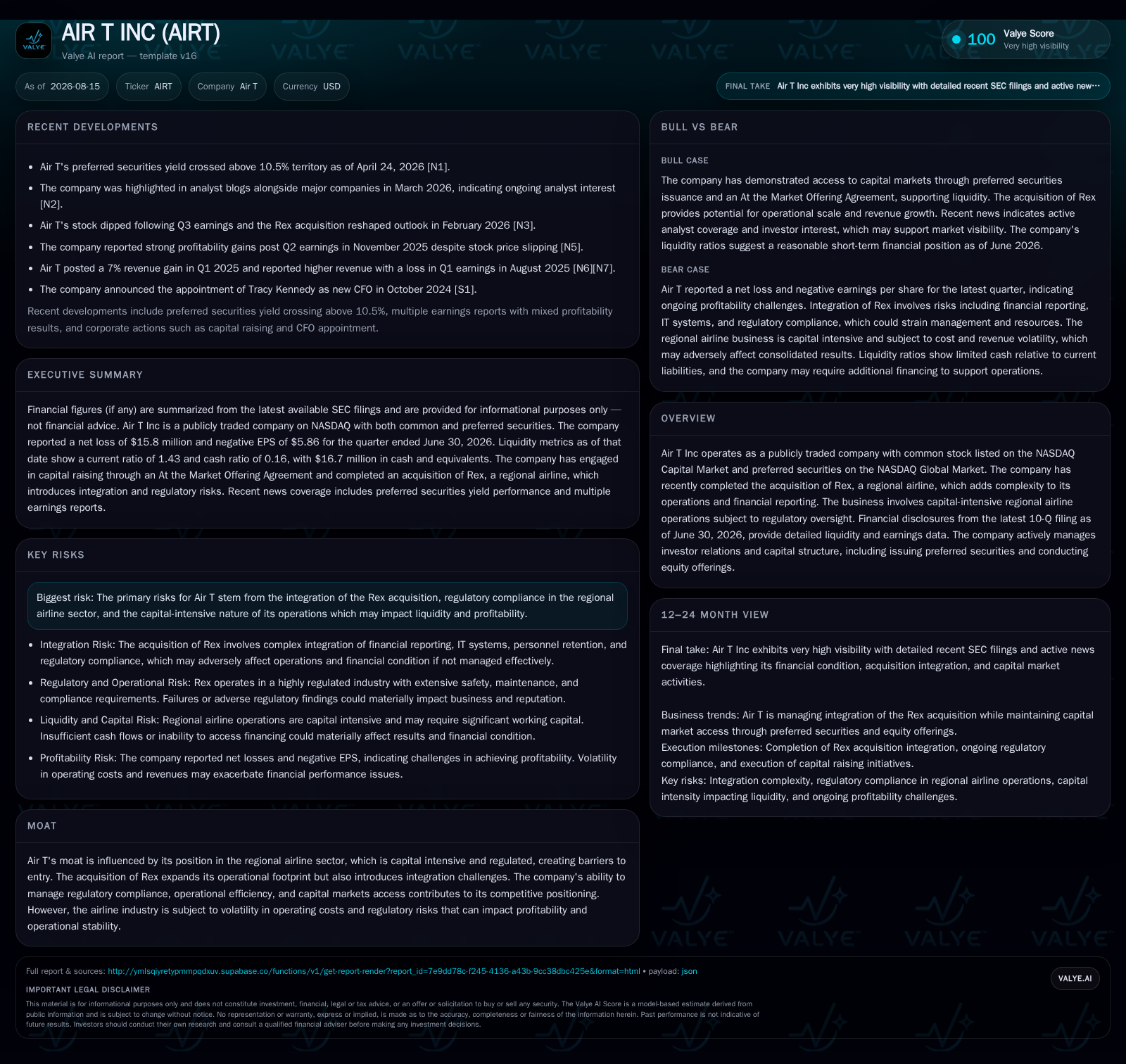
Air T Inc's most recent quarterly filing dated August 14, 2026 sheds light on operational challenges emerging from its acquisition of Rex, a regional airline that broadens Air T's footprint but complicates day-to-day operations [S2][S3]. This strategic move has introduced noticeable effects on key capacity metrics such as available seat miles (ASM) and passenger load factors. While the acquisition expands route coverage and potential revenue streams, it simultaneously burdens the airline with increased integration demands—ranging from aligning schedules to streamlining fleet operations—which can temporarily depress operating margins.
The company reported fluctuations in operational capacity deployment reflecting these integration hurdles [S2][S3]. Management commentary emphasized efforts to manage increased complexity without committing to specific synergy timelines—a prudent stance given the capital-intensive nature of regional airline operations where fleet utilization rates heavily influence profitability. Such integration phenomena are typical of peers undertaking similar expansion efforts; they require balancing short-term cost absorptions against long-term network strength
Business Model Nuances: Revenue Composition and Capital-Intensive Cost Drivers
Air T generates the bulk of its revenue from scheduled passenger flights on regional routes feeding into larger national carriers through established codeshare agreements. Ticket sales form the primary income source complemented by ancillary revenues including baggage fees, priority boarding, and other service charges [S1][S2]. These codeshare partnerships not only extend market reach but also diversify revenue beyond direct ticket sales, providing some buffer against demand shocks.
On the cost side, Air T faces the hallmark pressures of a capital-intensive model: high fixed costs tied to aircraft ownership or leasing; maintenance reserves needed to ensure regulatory compliance; airport fees; labor wages negotiated typically under union contracts; and fuel expenses subject to volatile commodity markets. The latest quarterly disclosure highlights a slight uptick in per-ASM costs related to integration inefficiencies and fuel price increases—pressures that directly compress operating margins until higher utilization or pricing power is achieved.
Furthermore, regulatory compliance costs remain substantial due to stringent safety oversight expected in commercial flight operations. Maintenance expenditures must be carefully balanced to avoid both service disruptions and unplanned capital outlays.
Competitive Set Contextualizes Operating Efficiency and Scale Challenges
Within the context of regional airlines such as SkyWest Airlines or Republic Airways, Air T's recent scale jump via Rex introduces both opportunities for scale economies and integration friction typical among mid-tier operators expanding rapidly. Peers have demonstrated that achieving an optimal cost per available seat mile (CASM) hinges critically on elevating load factors while maintaining disciplined fleet scheduling.
Air T’s load factor performance currently trails somewhat behind top-tier regional peers who benefit from more mature network optimization strategies. Fleet utilization rates also reflect early-stage amalgamation inefficiencies as combined fleets are rationalized for maximum profitability [S1][S2]. Such dynamics place near-term limits on operating margin expansion despite larger route coverage
Growth Potential Fueled by Regional Connectivity Expansion and Codeshare Leverage
The Rex acquisition opens new avenues for Air T’s growth through expanded service offerings in underserved regional hubs, improving network connectivity that aligns with broader airline partnering strategies. Economic growth trends supporting passenger travel in these regions amplify this runway.
Moreover, further development of codeshare agreements can enhance yield per revenue passenger mile (RPM) by linking passengers across multiple carriers seamlessly [S1]. Ancillary fees remain an additional lever for growing non-ticket revenue streams which tend to boast higher incremental margins compared to base fares
Continued investment in fleet modernization could improve fuel efficiency—a critical factor given fuel’s outsized share of operating expenses—and support better operating margins over time.
Risks From Regulatory Oversight, Fuel Volatility, and Acquisition Execution Missteps
Operating in a highly regulated environment exposes Air T to risk on multiple fronts: safety compliance mandates impose ongoing maintenance spend requirements, while any lapses can trigger costly penalties or grounded aircraft scenarios. Post-acquisition complexity amplifies these risks due to integration of distinct regulatory practices or systems.
Fuel price volatility constitutes a perennial risk destabilizing cost forecasts; without effective fuel hedging programs or cost-offsetting measures, margins can erode swiftly under sudden commodity price spikes. Labor relations remain another significant risk vector given union presence in many regional carriers; protracted negotiations or disputes could disrupt operations or impose wage inflation.
Lastly, failure to timely realize operational synergies from Rex could exacerbate liquidity stress during capital cycles characterized by heavy expenditures for aircraft upkeep or capacity adjustments.
What’s Next: Key Milestones And Operational Metrics To Benchmark Progress
Analysts should closely track Air T's forthcoming quarterly figures focusing on incremental changes in load factor percentages as an indicator of improved fleet usage efficiency post-acquisition. Monitoring ASM growth alongside RPM provides insight into whether capacity deployment is translating into actual passenger demand realizations.
Importantly, incremental uplift in operating margin will serve as an early sign of successful cost control over increased scale complexities [S2][S3]. Refinancing activity or shifts in liquidity profiles disclosed could hint at financial strategy adaptations addressing leverage impact from Rex-related capital needs
Financial Profile Discussion: Liquidity Health And Debt Dynamics Support Near-Term Stability
As of June 30, 2026, Air T reported cash and equivalents amounting to approximately $16.7 million against total debt near $249 million resulting in net debt around $232 million while maintaining a current ratio of about 1.43 [F1]. This liquidity positioning provides a moderate cushion to meet short-term obligations yet requires attentive management given ongoing capital expenditures inherent in fleet operations.
The leverage level aligns with industry norms reflective of capital-heavy transportation operators but necessitates balance sheet discipline especially under volatile revenue conditions influenced by cyclical travel demand patterns.
This analysis contextualizes Air T Inc within its evolving post-acquisition phase where operational complexities intersect with sector-specific capital demands and regulatory frameworks characteristic of the regional airline industry. Readers should consider how future quarters' KPI trajectories regarding ASM growth, load factors improvement, and margin restoration will define Air T's path toward fully realizing benefits from the Rex acquisition while maintaining competitive stance amidst peer carriers managing similar scaling challenges.
Disclaimer: This article is intended solely for informational purposes based on publicly available filings and does not constitute investment advice or a research view regarding the purchase or sale of securities.
Disclaimer: This is research-only, informational analysis and not investment advice. It may include AI-generated interpretation and general industry context. Always verify important details using primary sources.

Comments