
China Pharma Holdings Faces Profitability and Liquidity Challenges in Competitive Chinese Generics Market
The company’s latest results highlight operating losses amid pricing pressures, regulatory demands, and distribution concentration in the Chinese off-patent generics and medical devices sector.
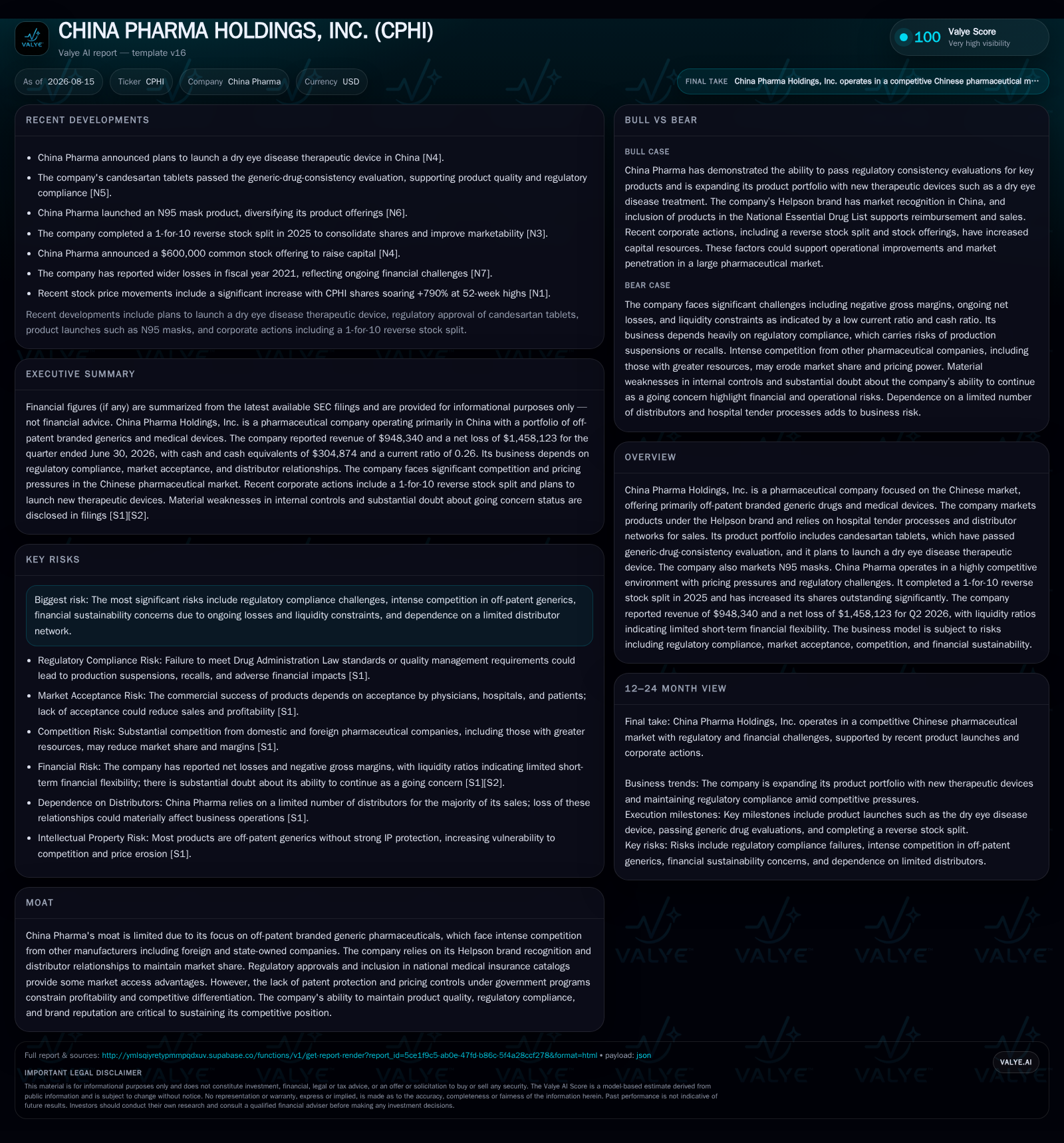
China Pharma Holdings, Inc. reported a net loss of $1.46 million in Q2 2026 on modest revenue of under $1 million amid intense competition in China’s pharmaceutical generics landscape. The company's product portfolio includes off-patent branded generics like candesartan tablets, which have passed regulatory consistency evaluation, but profitability is constrained by government price controls and reliance on a narrow distributor base. Liquidity remains tight with a current ratio of 0.26 and the firm depends heavily on director-related borrowings and credit lines. Growth plans include launching a dry eye disease medical device and leveraging national insurance catalog inclusion. However, risks around regulatory compliance, distributor relationships, and financial sustainability persist.
Recent Operating Update: Sluggish Revenue and Persistent Losses
China Pharma Holdings reported revenue of roughly $948,340 alongside a net loss of $1,458,123 in Q2 2026 [S2], underscoring ongoing profitability challenges in the off-patent pharmaceutical space within China. Cost of revenue remains high relative to sales but benefited recently from depreciation relief as machinery became fully amortized [S7]. This quarter's figures confirm the continuation of low-scale operations that struggle against government price controls on generics and limited pricing power.
Parallel to its pharmaceutical operations, China Pharma markets N95 masks and plans to enter the medical device segment with a dry eye disease therapeutic device product line—both efforts aimed at diversifying revenue sources beyond heavily commoditized generic drugs [S1,S6]. Supporting market access for its core pharmaceuticals, including candesartan tablets—an important cardiovascular generic—these products have successfully passed China’s rigorous generic drug consistency evaluation required for National Medical Products Administration (NMPA) acceptance [S1]. Achieving consistency evaluation is a fundamental KPI in its sector as it confirms bioequivalence to originators and enables hospital tender eligibility.
Business Model: Focused on Off-Patent Branded Generics Through Hospital Tenders and Distributors
China Pharma operates primarily through Hainan Helpson Medical & Biotechnology Co., Ltd, producing an assortment of pharmaceuticals—dry powder injectables, capsules, tablets—and cephalosporin oral solutions targeted at high-incidence diseases prevalent in China [S1,S15]. It monetizes by selling exclusively to certified pharmaceutical distributors who then supply predominantly state-owned hospitals selected via centralized tender processes.
The company's revenue mechanics hinge critically on its ability to secure hospital tender wins under national procurement programs which impose strict volume allocation rules with capped reimbursement pricing. Distributor relationships are governed more by individual purchase orders than binding long-term contracts; distributors reconcile payments based on state hospital remittances with typical credit terms extending up to 90 days or more due to local industry practices and policy-caused payment delays [S23]. This structure constrains predictable cash flow visibility and puts pressure on receivables quality.
Brand leverage from the Helpson name plays a modest role given the commoditized nature of generics; however, maintaining product quality standards per Drug Administration Law provisions is essential for distributor confidence and customer retention [S11]. The company invests periodically in R&D largely focused on meeting evolving consistency evaluation standards as well as advancing select patented technologies acquired recently that add amortization burden to general expenses but aim to enhance future gross margins [S7].
Industry Structure and Competitive Position
The Chinese generics pharmaceutical sector is intensely competitive with numerous domestic manufacturers including state-owned enterprises and well-financed foreign entrants vying for market share through price reductions following government-driven procurement reforms. China Pharma’s moat is weak due to lack of exclusive patent protection; success is largely dependent on regulatory approvals like passing consistency evaluations which enable participation in reimbursed hospital tenders critical for sales volume generation.
Peers generally differentiate via scale advantages enabling lower cost manufacturing as well as more diversified distributor networks that reduce buyer concentration risk. In contrast, China Pharma’s concentrated distributor base amplifies exposure to counterparty risk. Foreign manufacturers often compete aggressively through cross-subsidization or marketing support schemes unavailable to smaller players like China Pharma.
Pricing controls under centralized procurement limit gross margin expansion for all participants in this segment [S1]. While inclusion in the national medical insurance catalog confers reimbursement status critical for affordability among patients and hospital uptake, it also anchors pricing pressure with little room for premium pricing even for branded generics
Emerging growth opportunities include broadening medical device offerings where efficacy demonstration might command better margins versus generic drugs but also necessitates substantial upfront investment and approval cycles.
Growth Drivers: Regulatory Compliance Passes and Diversification into Medical Devices
A significant enabler for China Pharma is its ability to comply with the NMPA’s generic drug consistency evaluation requirements—a gatekeeper for sustainable hospital tender participation [S1,S6]. Successful passage of these evaluations for key products like candesartan tablets supports maintaining existing market access amidst intensifying competition.
Expanding product offerings into therapeutic medical devices aligns well with rising healthcare infrastructure investments in China targeting unmet clinical needs such as dry eye disease—a condition growing alongside aging populations and increased screen use—with less pricing compression than traditional generics [S6]. Success here depends on regulatory approvals and effective marketing within hospital channels.
Additionally, participation in national insurance reimbursement schemes continues to provide volume stability albeit at controlled prices.
Risks and Constraints: Financial Sustainability Amid Distributor Dependence and Regulatory Complexity
China Pharma faces pronounced risks from its narrow dependency on limited distributors without long-term binding contracts; any withdrawal or disruption could materially impair revenues given there are no guaranteed distributor purchase commitments under standard agreements [S11,S23].
Regulatory compliance presents ongoing challenges: failure to maintain production quality standards or pass evolving drug administration requirements can lead to costly recalls or suspensions impacting brand reputation adversely [S11,S13]. The company also has modest insurance coverage against product liability which elevates risk exposure relative to peers domiciled in geographies with more comprehensive protections.
Market-wide pricing pressures driven by central procurement policies enforce stringent margin compression limiting operational leverage despite modest improvements from depreciation savings reported recently. Scaling production or achieving better cost efficiencies remains challenging without meaningful capital infusion or expanding higher-margin product lines.
What To Watch Next
Key monitoring points include quarterly trends in revenue growth tied directly to new tender wins or expanded distributor penetration—any broadening beyond current seller-concentrated channels would improve outlook materially. Operational KPIs such as the number of products retaining consistency evaluation certification provide signals regarding regulatory compliance trajectory.
Progress in launching planned dry eye disease medical device products will be crucial for diversification ambitions; milestones around regulatory submission timelines or early commercial uptake within hospital networks will validate this strategic pivot.
On financials, management’s ability to execute recent capital raises effectively toward easing liquidity constraints will affect viability going forward; watch for changes in cash burn rates, receivables turnover improvements reflecting collection tightening initiatives, or new credit facility arrangements potentially backed by operating assets.
The company’s CEO/Chairwoman Ms. Zhilin Li has provided personal guarantees securing short-term credit lines approximating RMB 5 million (~$700k USD), highlighting limited third-party financing alternatives given weak earnings profiles [S2]
In addition, the Company has related-party borrowings from Chairperson Li totaling approximately $1.64 million as of June 30, 2026, including recent interest-bearing loans of about $147,000 USD due within one year, reflecting ongoing reliance on insider financing arrangements [S2]
Recent equity financings executed via registered direct offerings garnered approximately $4.4 million net proceeds after commissions evidencing attempts at bolstering capital structure amid operational cash deficits [S3,S14]
Despite some easing cost structures via depreciation benefits improving gross profit margin from negative territory toward around 29% recently [S7], sizeable administrative expense burdens linked partly to intangible asset amortization from patent acquisitions suppress profitability resulting in reported net losses persisting through fiscal periods ending mid-2026 consistent with prior years’ negative operating income trajectory exceeding $3 million annually per last full-year disclosures [F1]. This dynamic underscores structural earnings challenges inherent in aggressively contested generic drug markets characterized by government-controlled price ceilings coupled with consumer purchasing dominated by public hospitals reliant on tenders rather than differentiated products.
Overall liquidity risk combined with tight pricing environment demands prudent capital deployment focusing on portfolio rationalization emphasizing higher margin cardiovascular products while managing declining respiratory/infectious categories affected by reduced demand and policy shifts as management has indicated during recent disclosures aiming for gradual operational resilience uplift rather than immediate profit turnaround [S7,S9]
This analysis is based solely on publicly available filings dated through August 2026 without investment research views or forward-looking investment advice.
Disclaimer: This is research-only, informational analysis and not investment advice. It may include AI-generated interpretation and general industry context. Always verify important details using primary sources.

Comments