
Solana Co Validator Performance and Stake Dynamics Shape Q2 Outcomes
Q2 2026 results underscore the interplay of operational execution, delegated stake shifts, and protocol evolution in driving Solana Co’s staking revenue dynamics.
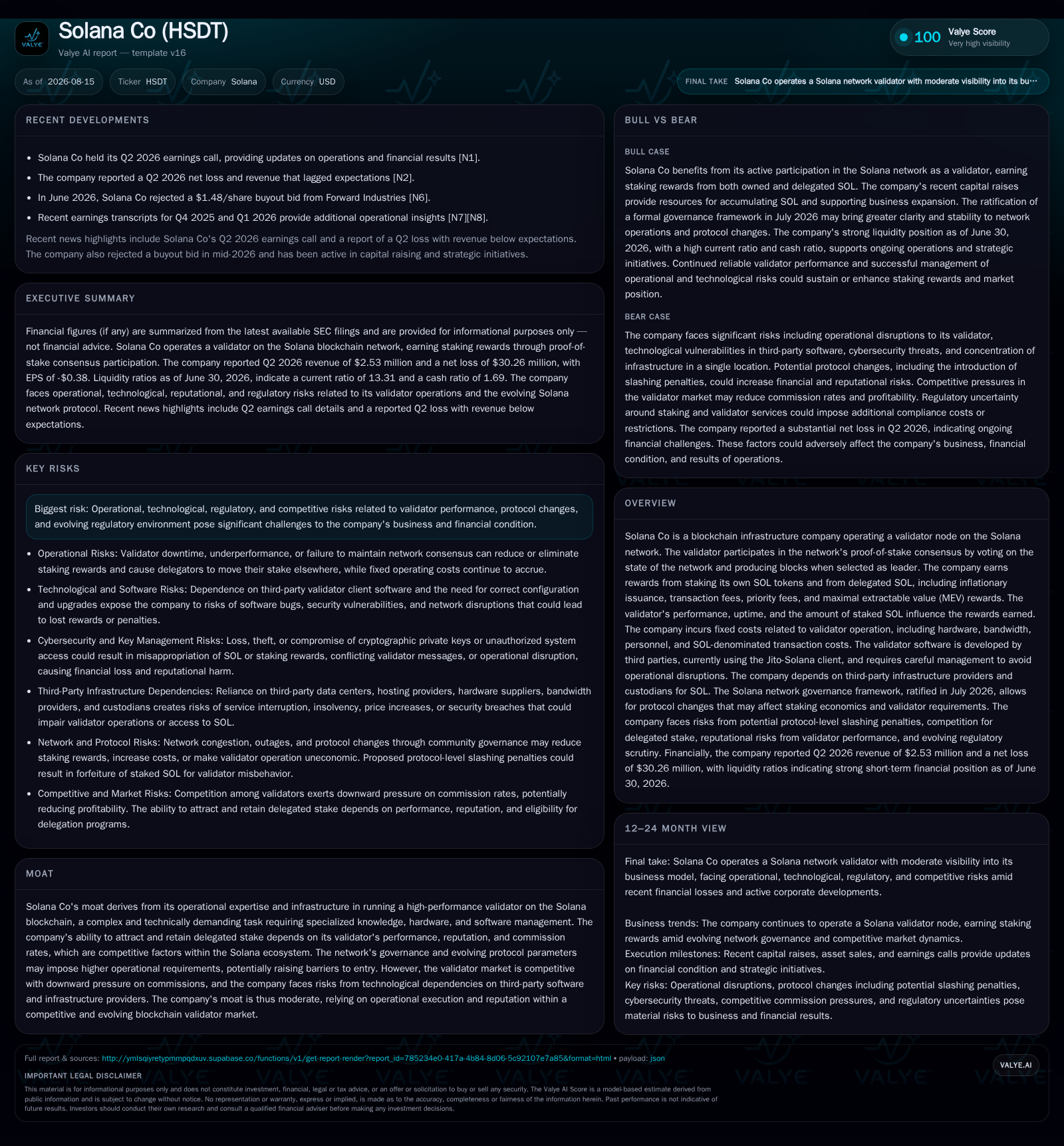
Solana Co’s latest quarterly filing reveals core dependencies in its validator staking revenue model centered on validator uptime, delegated SOL inflows, and commission pressures. Operational performance—dominated by validator uptime and block production—remains a critical lever for maximizing inflationary issuance, transaction fees, and MEV rewards. Competitive compression of staking commissions challenges top-line growth despite growing delegated stake. Concurrently, protocol upgrades necessitate ongoing software client adaptation, posing short-term operational risks. The company’s solid liquidity position supports continued investment in validator infrastructure amidst these pressures.
Q2 Validator Operations Drive Revenues Amid Commission Pressures
Solana Co’s Q2 2026 Form 10-Q filing [S2] provides a comprehensive update on how its core validator node activities translate into staking revenue streams. The company operates a node on the Solana blockchain that participates directly in proof-of-stake consensus by voting on ledger state and producing blocks when selected. Its primary revenue source derives from staking rewards denominated in SOL tokens earned via (a) inflationary issuance of new tokens, (b) transaction fees paid by network users, (c) priority fees for expedited processing, and (d) maximal extractable value (MEV) captured through specific software operations.
The total rewards earned depend crucially on the combined amount of SOL staked – including both the company’s own holdings and any tokens delegated by third parties – and critically on the validator's operational performance metrics such as uptime percentage and block production rate. A key recent development highlighted involves ongoing downward pressure on staking commission rates charged to delegators within the Solana ecosystem, consistent with competitive trends among peer validators [S2]. This commission compression imposes direct constraints on top-line revenue growth despite efforts to expand delegated stake inflows.
Revenue recognition rules further complicate reported financials since Solana Co recognizes the total staking rewards earned on a gross basis rather than netting against payouts to delegators. While this inflates reported revenues, it also heightens earnings volatility tied intimately to network activity fluctuations.
Validator Performance Metrics: Uptime and Block Production Implications
The effectiveness of Solana Co’s validator node depends significantly on uptime stability and efficient block production. Uptime represents the ratio of time the validator remains online and responsive to network consensus duties; downtimes lower potential reward capture due to missed leader slots or voting opportunities [S1], [S2]. High-performance block production ensures the company gains transaction fee shares as blocks are finalized under its leadership.
Maintaining near-continuous uptime demands resilient hardware infrastructure, high bandwidth network connectivity, skilled personnel oversight, and timely software upgrades. Solana Co utilizes the third-party Jito-Solana client for managing these tasks—a complex piece of software requiring careful configuration. Operational lapses or adverse protocol changes pose risk of downtime penalties or reduced MEV capture efficiency [S2]. Thus, these KPIs are leading indicators for staking yield realization.
Delegated Stake Dynamics: Sustaining Revenue through Network Participation
Delegated staking forms the backbone of revenue scalability by multiplying the base SOL amount generating rewards at the node. Solana Co reports that both owned SOL stakes and third-party delegations contribute materially to its total staked token base [S2], [S1]. Attracting delegators depends on multiple factors including competitive commission pricing, validator reputation linked to uptime reliability, transparency in operations, and reputation within the Solana community.
The broader industry observes continual growth in delegated tokens as more holders seek passive income without operating nodes themselves; however, fierce competition among validators compresses commissions globally. Peers like Figment Networks differentiate via value-added services while Blockdaemon emphasizes managed node portfolios across multiple chains. In this light, Solana Co’s moat rests primarily on operational expertise rather than pricing power alone.
Given these dynamics, sustained revenue growth hinges substantially on increasing delegated stake volume despite margin pressure from shrinking commissions.
Protocol Upgrades Impact Validator Economics and Operational Risks
Upstream protocol governance frequently introduces upgrades affecting consensus parameters, transaction processing logic, or reward distribution mechanics. Such modifications necessitate ongoing updates to validator software clients for compatibility—to maintain uptime without risk of slashing penalties or missing leader slots [S1],[S2].
Solana Co relies heavily on Jito-Solana as its client software; this reliance presents operational risk exposure wherein bugs or delayed updates could cause validator underperformance or outages. The company acknowledges that evolving protocol demands may raise hardware requirements or bandwidth consumption further increasing operational costs.
Successfully navigating these transitions is critical for reward continuity; delays or failures would degrade reputational standing among delegators risking capital withdrawals.
Competitive Benchmarking: Commission Trends and Peer Operational Execution
Validator competition centers primarily on commission rate setting versus peers given all operate similar underlying technology stacks adhering to Solana consensus rules. Industry-wide trends indicate a gradual march toward lower commissions driven by market entry of new validators aiming to attract stake volume with price incentives.
Solana Co competes with established providers such as Figment Networks which couple competitive commissions with broad DeFi integration services, while Blockdaemon operates validated institutional-grade infrastructure supporting multi-chain deployments. Unlike liquid staking protocols like Lido Finance which scale via derivative token offerings enhancing liquidity but with different economic models, pure validators rely fundamentally on protocol-level reward shares.
Solana Co’s moderate moat arises from demonstrated operational reliability rather than distinct pricing power or proprietary software capabilities.
Growth Opportunity Drivers: Token Staking Expansion and Technology Advances
Underlying demand trends favor increasing adoption of proof-of-stake networks with rising total tokens staked across ecosystems fueling reward pools [S1]. Within Solana specifically, growing developer activity expands transaction volumes accentuating fee-based earnings potential beyond pure inflationary supply issuance.
Concurrently, improvements in validator automation technology—including more sophisticated MEV extraction methods embedded within software clients—promise higher net yields per unit staked [S1].
These factors collectively suggest an expanding addressable market for Solana Co’s services provided it maintains high uptime standards while managing commission competitiveness.
Key Risks: Regulatory Compliance, Software Dependencies, and Market Volatility
Operational risks permeate this business model including technical disruptions causing downtime that directly curtail rewards [S2]. Dependency on third-party developed validator clients like Jito-Solana exposes the company to external code quality issues beyond direct control.
Regulatory landscapes remain uncertain globally concerning cryptocurrency staking activities particularly regarding securities classification or tax treatment potentially escalating compliance burdens [S2].
Additionally, volatile SOL token prices impact treasury valuations underpinning corporate financial health alongside fluctuating staking economics influencing delegator behavior.
Hence risk management balancing technical execution with regulatory vigilance is paramount for sustainable operations.
Near-Term Catalysts to Watch: Network Activity & Delegated Stake Inflows
Critical monitoring points over coming quarters include tracking delegated stake growth post any recent protocol upgrades which could either bolster confidence or induce withdrawals depending on perceived stability [N1], [S2]. Simultaneously observing network transaction volumes informs fee income potential complementing inflationary rewards.
Successful continuous uptime during upgrade cycles would reinforce operational credibility serving as a positive signal to stakeholders evaluating validate performance. Conversely any outages or reputational damage could accelerate deleveraging risks adversely impacting revenues.
These must be tracked alongside industry-wide commission trends signposting competitive pricing dynamics.
Financial Profile Discussion: Liquidity Resilience and Operating Expense Structure
As of June 30, 2026, Solana Co held $3.65 million in cash equivalents supported by current assets totaling $28.75 million against current liabilities of just $2.16 million yielding an exceptionally strong current ratio above 13x [F1]. Total debt stands nominally at $200 thousand underlying minimal leverage exposure relative to asset base.
This liquidity cushion enables sustained investment in critical hardware upgrades, bandwidth provisioning, personnel expertise acquisition necessary for reliable validator operation notwithstanding quarterly operating losses reported previously [F1]. Operating expenses largely reflect fixed infrastructural costs plus variable token-denominated outlays linked directly to blockchain transaction processing overheads inherent in running high-throughput nodes.
Thus financial strength provides runway amid inherent revenue intermittency typical in emerging blockchain infrastructure sectors.
This analysis synthesizes available public disclosures without offering investment advice.
Disclaimer: This is research-only, informational analysis and not investment advice. It may include AI-generated interpretation and general industry context. Always verify important details using primary sources.

Comments